

Article begins
My “news” is at least two-hundred-years old. However, as current news can only mean something in relation to context and history, we can use my old news to place the recent attack on Anthropology in the “Vanderbilt Report” within a longer historical arc. Looking squarely at the early formation of anthropology one must admit that there is no golden age to return to in which scholars produced knowledge without consideration of their own or their interlocutor’s differential positions and conditions on voice in the surrounding national and global world system.
My story concerns two 1816 Middlebury College classmates, and their subsequent parallel and contrasting careers. Each joined expeditions to the western territories as geologists where each would also become experts in Algonquian languages and peoples. Most significant for Anthropology are the different terms in which each would cast Native American languages and voices. What was at stake was the standing of indigenous leadership to have their words understood and responded to in civic debates shaping the new nation and its incursions into indigenous lands. The younger of the two students was Edwin James, whose family still owns Monument Dairy Farm in Weybridge, Vermont. The elder student was Henry Rowe Schoolcraft, whose family was going broke trying to sustain the Vermont Glass Factory in Salisbury against unfavorable market conditions. American Anthropology was still nascent. Its precedents in natural philosophy and classical philology were freshly established in the new nation’s institutions of higher education. Attending to the differences between James and Schoolcraft lets us sketch out competing economic and civic horizons within which American Anthropology emerged, and which have remained in play as the field has continued to develop. One horizon holds a place for indigenous people to shape shared futures. Another recasts them as an ancient resource to be appreciated and used by citizens of a supplanting regime.
Although both studied at Middlebury College, James and Schoolcraft’s respective Algonquian expertise did not come from their college curriculum. It came from the fact that both held positions on expeditions to the interior of the continent where their parties were outnumbered by the Indigenous North Americans already living there. This is also where the differences between them get interesting. James presented his Native American interlocutors as contemporaries and as comparable historical actors to himself and his countrymen. Schoolcraft celebrated Algonquian imaginative tales as ancient resources, which, like the minerals in their threatened territories, waited be unearthed and used by the new settler nation.
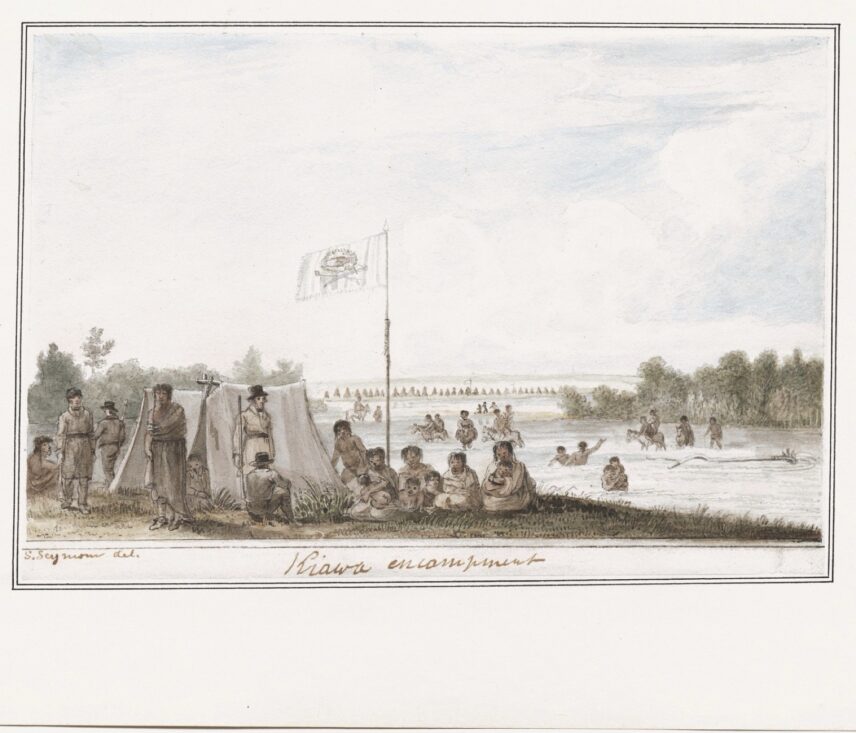
In 1819, James joined the Long Expedition across Missouri to the Rockies. Theirs was the first in the United States with a dedicated scientific unit. Theirs was also the first to include visual artists: Samuel Seymour and Titian Peale. As they travelled, they encountered speakers of Algonquian (and other) languages, who they engaged with trade, practical cooperation and ceremonial diplomacy, speeches and exchange of stories. James wrote the expedition’s report from the collected diaries of all members of his unit. It was published as a two-volume set and circulated with great acclaim internationally. Through it, he describes landscape, geology, flora, and fauna; but his account is especially full of encounters with indigenous leadership, translators, military parties and family groups. One of the expedition artists, Samuel Seymour, chose to depict their unit in the company of large congregations of Oto, Pawnee, Kiowa, Omawha and others. Especially noteworthy, in “Kiowa Encampment” (Figure 1) he places the scientific party alongside Kiowa families under a “peace flag.” The flag featured red and white hands clasped, a peace pipe crossed over a sword. The flag was the unit’s own invention, and James states that they carried it to express their “peaceable intentions.” The scene is relatively relaxed, with expedition members and Kiowa mothers with infants sitting next to one another. Two indigenous men and one United States soldier stand guard with rifles leaning on their shoulders. There are figures wading on horseback and playing in the water that divides the two camps.
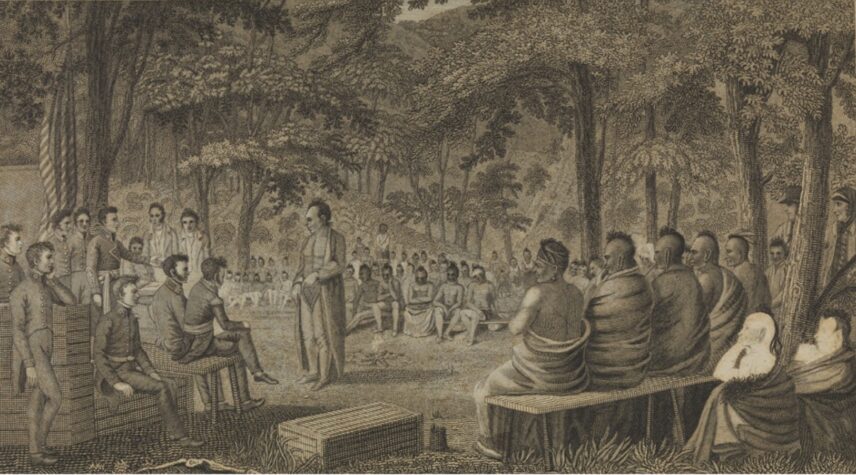
The Long Expedition report in both its text and images describes not a wilderness, but an inhabited, responsive territory filled with indigenous leaders in council with the members of the expedition (Figure 2). One speech James includes in the report (from unit member Thomas Says) recounts the words of Omawhaw leader Ong-pa-ten-ga, The Big Elk:
“Some think, my father, that you have brought all these warriors here to take our land from us, but I do not believe it. For although I am but a poor, simple Indian, yet I know that this land will not suit your farmers; if I even thought your hearts bad enough to take the land, I would not fear it as I know there is not wood enough on it for the use of the whites.”
Ong-pa-ten-ga’s political and ethical arguments are mirrored in the Long Expedition’s characterization of the western interior as the “Great American Desert” (Figure 3).
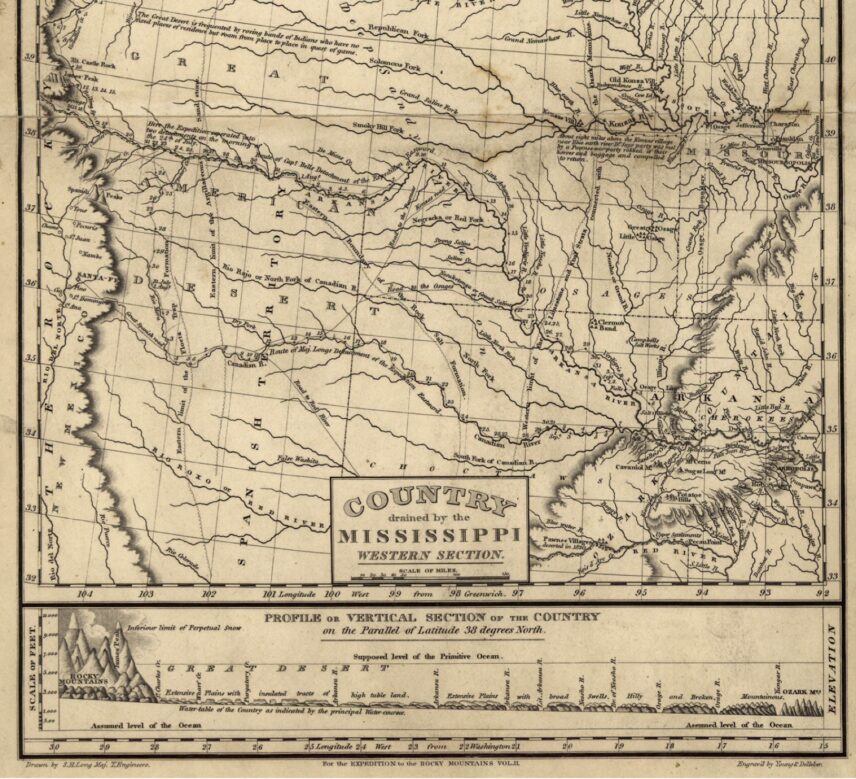
Stephen Long advised congress and the public that the Great American Desert was not fit for settlement. It is widely acknowledged that their report delayed mass westward migration for at least a decade. Their assessment was empirically supported by what they observed of the landscape; but it is noteworthy that the rhetorical and policy direction of “The Great American Desert” is consistent with the argument they received from Ong-pa-ten-ga.
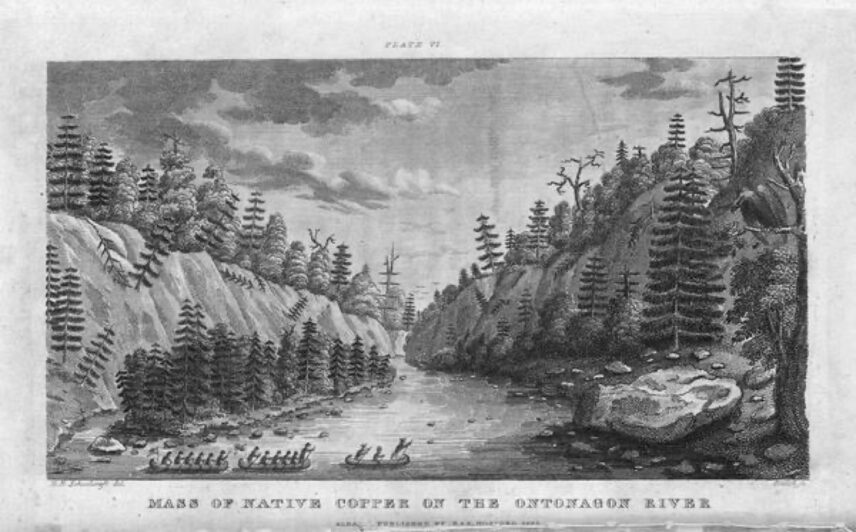
Schoolcraft, by contrast, aspired to be superintendent of lead mines. His 1819 report: A View of the Lead Mines of Missouri, was the first scientific treatment of mineral resources in the United States. Indeed, resource extraction and colonial settlement fueled his career. Following the publication success of the Long Expedition narrative, Schoolcraft published a narrative of his own expedition, entitled Narrative Journal of Travels through the Northwestern Regions of the United States extending from Detroit through the Great Chain of American Lakes, to the Sources of the Mississippi River. In it, he depicts his party’s interactions with indigenous leaders in which he emphasizes their knowledge of copper-rich areas and their willingness to lead him to these (Figure 4).
While Schoolcraft was not successful in obtaining an appointment as superintendent of mines; he was appointed Superintendent of Indian Affairs. This was a reward for his help securing a treaty with Ojibwe (Anishinaabe) leadership ceding their rights to more than thirteen million acres. He married intelligently into a prominent French-Anishinaabe trading family. With their help, he became a noted expert in Algonquian ethnology, languages and stories.
Schoolcraft claimed “imaginative tales and oral poetry among North American Indians” as his own singular discovery. He published collections of myths and tales and urged their use as an ancient world resource, akin to Greek and Latin mythology, but in service to an independent United States literary cannon. Henry Wadsworth Longfellow would take up the tales in a successful national epic entitled Song of Hiawatha. As Richard Bauman has previously explored, the stories that his wife, Jane Schoolcraft (and her extended family), collected for him were from his next-door neighbors whom he saw regularly. But he presented the people and their stories to the American and international public as ancient and already replaced by the modern world. While celebrating Algonquian stories as ancient mythology, Schoolcraft encouraged his own national countrymen to rapid settlement of the western territories and voiced his support for the “hard choice” that Friends of the Indian (such as James) had failed to steel their stomachs for: Indian Removal.
In contrast, James expressed admiration for young Algonquian leaders who he described as risking their lives to advance reform in their own communities. He conducted a comparative philology of Algonquian languages, presented at Lyceums and philosophical societies, in which he established a history for Algonquian peoples comparable to what was being established in European linguistic circles for the Indo-European language family. And when answering the question of how “Indians” can give credence to some of the fantastical aspects of their stories, James answers: “With as Much Faith as Many Equally Absurd Doctrines Are Observed in Christendom.” This is to say that James cast Indigenous peoples as contemporary political actors engaged in their own struggles and reforms, with a history as deep as that of Europe and with comparable diversity in popular understandings of the world.
Unsurprisingly, in their own time, James and Schoolcraft became political enemies. The point of this bit of old news is that each established a different legacy of intertwined civic and academic work. Among anthropologists, Schoolcraft, and not James, has name recognition. The print record is flooded with Schoolcraft’s writings, many of them funded by acts of Congress. In 1842 Schoolcraft used his proximity to mining and other capital to secure funding to found the American Ethnological Society. By contrast, much of James’ Algonquian language scholarship is held in philosophical society archives of the northeast.
In hindsight, James seems to represent a road less travelled among his contemporaries. But perhaps our hindsight is shaped by the control of information in the print record exerted by capital and by brokers like Schoolcraft. When we look back to the history of the discipline before it was professionalized, when capital extraction and nation building were an explicit part of how knowledge of indigenous North Americans was accumulated, we can see that more than one experiment in freedom and domination was in play. That is, we can see that there were scholars advocating for a different, what we could term a “dialogic” course, from the earliest years. That Schoolcraft was better positioned in the world of letters due to his proximity to extractive capital allows us to precisely identify how political inequality was enacted by control of information and how this shaped the early institutionalization of the discipline. What is often less precisely attended to is the equally true history of struggle, between indigenous peoples and the colonial national frontier which included alliances between indigenous and non-indigenous citizens and scholars as they made their bids to diagnose the errors, expand the citizenry and shape the future of both international letters and the new nation.
More than two centuries hence, with anthropology singled out for scrutiny, we can reflect upon James and Schoolcraft as two roads that diverged. James was more modestly institutionalized and memorialized; but also more prescient. We can attend to the push of indigenous voices in his and other less circulated, but more deliberative, accounts that have been sitting in our archival record (see Stephen Powers’ reply to John W. Powell’s request, forwarded from Congress, that he reduce his field assessment of the indigenous population of California). We can see what difference listening to less circulated indigenous engagements in our archives makes—to the accuracy and precision of our knowledge, to our understanding of the history and future of the discipline and the role of the discipline in relation to Indigenous civic voices in shaping our shared future. That current anthropology includes deliberative experiments in access, methodology, epistemology and ethics is not a crisis. We are as diverse as any discipline and hash out our disagreements through peer review, including challenge and correction when warranted. The range and dynamism of our arguments is a sign of an ethically responsible discipline with memory intact, cognizant of the terms of its own origin and development.
For more reading on similar questions of how anthropologists have framed forms of Indigenous knowledge, check out these recent pieces in the Journal of Linguistic Anthropology:
Anthony K. Webster’s 2026 article “The Passion of Butterflies: Notes on “translating” a Navajo Poem by Rex Lee Jim.”
Hannah McElgunn’s 2024 article “What Do Repatriation and Reclamation Sound Like? Two Examples From the Hopi Cultural Preservation Office.”
Barrett, Rusty Barrett’s 2019 article “The Poetic Line, the Popol Wuj, and the History of Anthropology.”