

Article begins
In May 2024, I returned to Prato to continue my fieldwork on its Chinese-led fast fashion production. Located ten miles northwest of Florence, this small Tuscan city is widely recognized as one of Europe’s major textile and garment manufacturing centers, boasting over 6,000 textile and apparel firms. It is also home to Europe’s largest concentration of Chinese migrants. More than 30,000 documented Chinese residents, about 16 percent of the population, live in Prato, alongside a large but indeterminate number of undocumented Chinese migrants. Most Chinese migrants work as small entrepreneurs or hired workers in the fast fashion industry, which not only forms the backbone of the local economy, but also helps make Made-in-Italy fashion globally competitive.
Upon my arrival, I learned that my hosts, Mei and her husband, had closed their small garment workshop after being heavily fined for tax-related violations. Because the firm was registered under her husband’s name, they could have simply registered a new firm under Mei’s name, an informal yet common workaround in Prato. However, the couple, both in their early forties, refused. “I must keep my name qingbai [clean],” Mei told me. “My two teenage sons will need at least one guarantor to buy a house in the future.”
Mei and her husband’s choice to expend one “clean” name while protecting the other is a common strategy among Chinese migrants navigating Italy’s complex legal landscapes. In Prato’s fast fashion production ecosystem, tax evasion, fabricated contracts, unreported labor, and other violations are routine. Far from aberrations, these practices align with Italy’s broader rule-bending patterns, fueled by widespread perceptions of an inefficient and corrupt state bureaucracy. Yet, Chinese-run enterprises face disproportionate scrutiny in the form of raids, fines, and inspections. How, then, do Chinese migrants, who are socially and legally precarious, navigate the fluid boundaries between legality and illegality in an economy that paradoxically depends on and penalizes semi-informal labor and entrepreneurship? And under these conditions, what does it mean to keep one’s name “clean”?
Family surfaced repeatedly when Mei and other interlocutors made decisions while caught between entrepreneurial aspirations and bureaucratic scrutiny. As feminist anthropologists have argued, kinship is central to capitalist production and reproduction. For Mei, protecting her “clean” name was neither simply about preserving an untainted legal status, nor about pursuing legal purity for its own sake. It functioned above all as a form of capital and a parental strategy, necessary for supporting her sons’ futures and upholding a moral standing rooted in kinship obligations. Mei’s refusal to risk her “clean” name highlights what I focus on in this essay: the intimate and fluid entanglements of capitalism, kinship, and the state in shaping Chinese migrants’ economic lives in Prato. Navigating the blurred and liquid legal boundaries thus becomes not only a means of economic survival, but also an act of hope for aspirational Chinese migrants and their families.
Local public discourses often cast Chinese migrants as either illicit entrepreneurs with ties to underground criminal organizations or as workers trapped in human trafficking and ruthless exploitation. Such racialized narratives flatten migrant subjectivities and obscure the complexity of lived experiences. The stories of Mei and others offer an ethnographic counter-narrative, foregrounding more nuanced forms of subjectivity and personhood. They show how aspirational migrants navigate state power within a precarious economy in their enduring pursuit of a good life and intergenerational mobility.
Subcontracting Production and Illegality
Every few days during my fieldwork, I watched Mei or her husband load stacks of finished garments into their small Ford van and drive them to a Chinese-owned fashion firm that supplied their subcontracting orders. After dropping off completed pieces, they would load bundles of new, ready-to-sew components and return to their cramped workshop. This circular rhythm—between their workshop hidden in a manufacturing street just outside Prato’s medieval city walls and the firm in a compact suburban district ten minutes away—structured their working life.
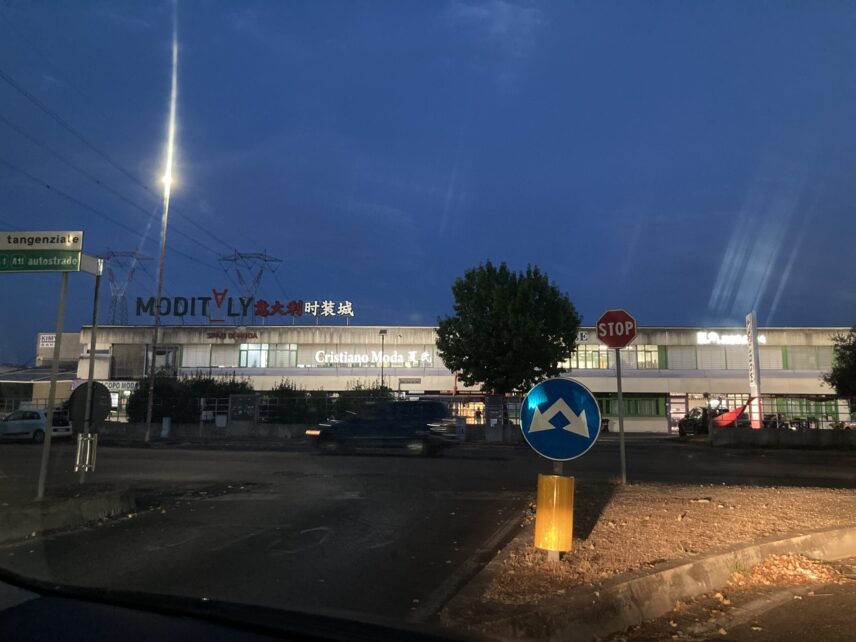
The suburban district where Mei delivered her work is a dense hub of small, Chinese-run family enterprises that anchor Prato’s fast-fashion supply chain. These businesses typically manage design, pattern making, and fabric cutting in-house, while subcontracting sewing, ironing, and finishing to local workshops. This business model, centered on rapid-turnover, small-batch manufacturing outsourced to local workshops, was first adopted by small Italian firms in the 1990s. Subcontracting both reduced production costs and allowed their firms to sidestep stringent labor regulations, while keeping production tempos that outpace global fast-fashion giants. Since then, large numbers of Chinese newcomers, many undocumented, have entered this emerging fast fashion sector in response to its demand for flexible, low-paid, and disposable labor.
By the late 1990s, some Chinese subcontractors had learned from Italian firms and begun opening their own fashion companies. Today, over a thousand such firms, together with numerous workshops, mostly Chinese-run, dominate the sector. They have inherited Prato’s existing textile infrastructure and leveraged transnational Chinese networks for textiles, labor, and wholesale distribution. Their low-cost, unbranded garments mainly circulate through open-air markets, beach stalls, and other budget retail circuits across Europe, while still carrying the symbolic value of the Made-in-Italy label, associated with good taste, high quality and artisanal excellence.
Behind this label, however, lies a demanding labor regime that is built on blurred lines between legality and illegality. Even the most compliant fashion firms rely on subcontracting workshops whose everyday operations follow legally ambiguous rhythms structured around piecework pay. Although piecework pay is not necessarily illegal per se, it often masks excessive hours, placing workshops in routine violation of Italy’s working-time law, which caps the workweek at 48 hours, including overtime. With profit margins extremely thin, subcontractors survive by cutting costs wherever possible. As one workshop owner put it, “Everything is calculated by output, piece by piece. All the rest is cost. If you don’t cut corners, no business can survive, Chinese or Italian.”
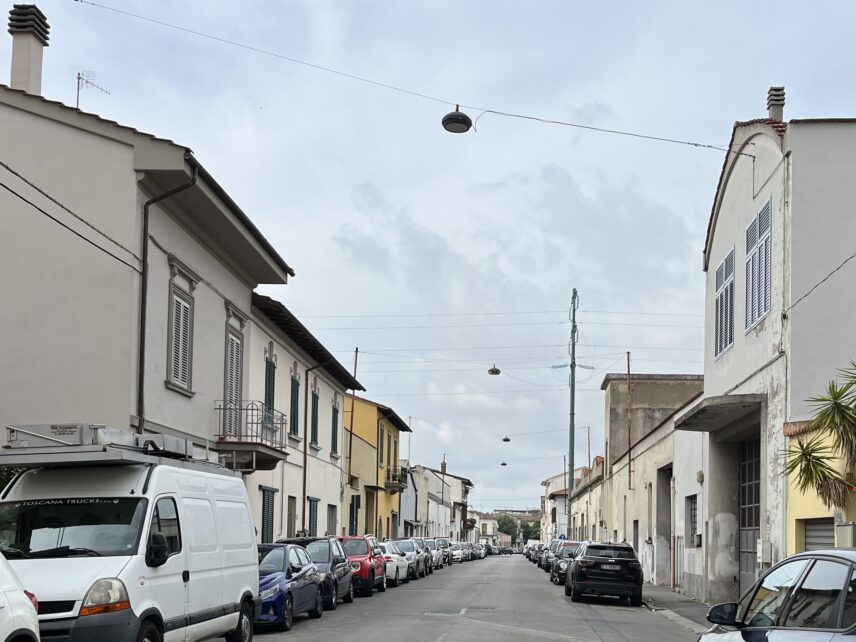
Much like the Italian firms they once worked for, Chinese fashion firm entrepreneurs in Prato maintain legal compliance largely by shifting both production and illegality downward onto more precarious subcontractors, such as Mei and her husband. Some Chinese-run fashion firms also operate as subcontractors for luxury brands, passing production further down the supply chain. As one Chinese entrepreneur remarked sarcastically: “We learned all the tricks from Italians!” In this production landscape, legality and compliance emerge as fluid and relational. Illegality does not disappear, but is unevenly redistributed along supply-chain hierarchies, reproducing global fashion logics that relocate risk and liability to less regulated tiers, often in the Global South.
Chinese workers and subcontractors I spoke with commonly preferred piece-rate pay to hourly wages, as it allowed faster accumulation, even though many hoped to eventually leave the industry, move up the supply chain, or retire early. “We came to Prato to earn more through hard work,” one subcontractor told me. Many workers viewed labor laws, often grounded in Eurocentric ideals of decent work and the good life, as obstacles to these aspirations. It is at the bottom of Prato’s fast-fashion supply chain that Mei, her husband, and many other Chinese migrants strive to build better lives through transnational labor and everyday maneuvering within fluid legality.
Maneuvering Fluid Legality for a Family Future
Mei and her husband arrived from rural China in the late 2000s, when several of their relatives had settled in Prato. One relative, who ran a sewing workshop, sponsored their labor visas. They left their two-year-old son with grandparents in China, hoping to reunite the family in Italy when it became possible. Their early years in Prato mirrored the trajectory of many Chinese newcomers. They worked fourteen-hour shifts in a relative’s workshop, seven days a week during peak seasons, with board and lodging included. This arrangement allowed them to save most of their earnings and learn sewing skills despite speaking no Italian. Over the following six years, they also learned about how the industry operated and how to navigate legal regimes through kinship ties, hometown networks, and expanding Chinese connections in Prato. However, childcare was impossible within the rigid rhythms of workshop labor. Shortly after Mei gave birth to her second son in Italy, the couple, like many parents in similar circumstances, sent him back to China for his grandparents to raise.
Although Mei and her husband were documented migrants and did not need to undergo regularization, their legal stay required a residence permit that was contingent on employment and income under Italian immigration law. To meet these requirements, their relative-employer reported part of their labor, just enough to satisfy the minimum thresholds for obtaining and renewing their residence permits. A portion of the income was deposited into their bank account as “formal” earnings, with the rest paid informally in cash. In this way, their piece-rate payment and excessive hours became bureaucratically invisible. It was these false but compliant-on-paper contracts that kept them “legal” in Italy. Here, legality, operating through what Anna Tuckett calls “compliant rule-bending,” becomes a shifting bureaucratic field in which everyday rule-breaking coexists with strict paperwork compliance.
Mei and her husband opened a small workshop in the mid-2010s and moved into their own rent apartment. “We did this mainly to bring our two sons to Italy,” Mei explained. “Running our own workshop gives us more flexible time to manage the kids.” They registered the business under Mei’s husband’s then-“clean” name and rented a 2000-square-foot workspace, equipping it with four sewing stations. To offset the costs, they sublet three stations to other Chinese couples, listing them on paper as employees even though each couple operated as independent subcontractors. This subdivision and co-working arrangement, which is popular among couples balancing work and childcare, further blurred the boundaries between employer and employee, stretching them beyond rigid legal and bureaucratic definitions.
Running their own workshop, however, exposed her husband’s “clean” name to risk. After nine years, a surprise inspection revealed unpaid taxes, unreported orders and income, and unpaid social security contributions for their paper “employees.” Although common in Prato’s garment industry, these infractions triggered heavy fines. “The fees were too high to pay off,” Mei told me. They declared bankruptcy, and with it, her husband’s “clean” name was lost. “We were lucky,” she reflected. “Many went bankrupt after only two or three years.” This luck, however, was hinged on the fluid and unpredictable nature of inspection and enforcement. As Mei explained, workshops were subject to inspection by immigration, labor, environmental, health, tax, and other authorities—and “they can always find something.” Violations tolerated one time might trigger fines the next, and penalties varied widely, often “depending on the inspector’s mood.” Mei was also aware of Italy’s periodical tax amnesties, which waive or reduce overdue fees and taxes, making timely compliance feel “pointless.” In this environment, a workshop’s survival depended less on strict compliance than on navigating constant yet unpredictable legal scrutiny.
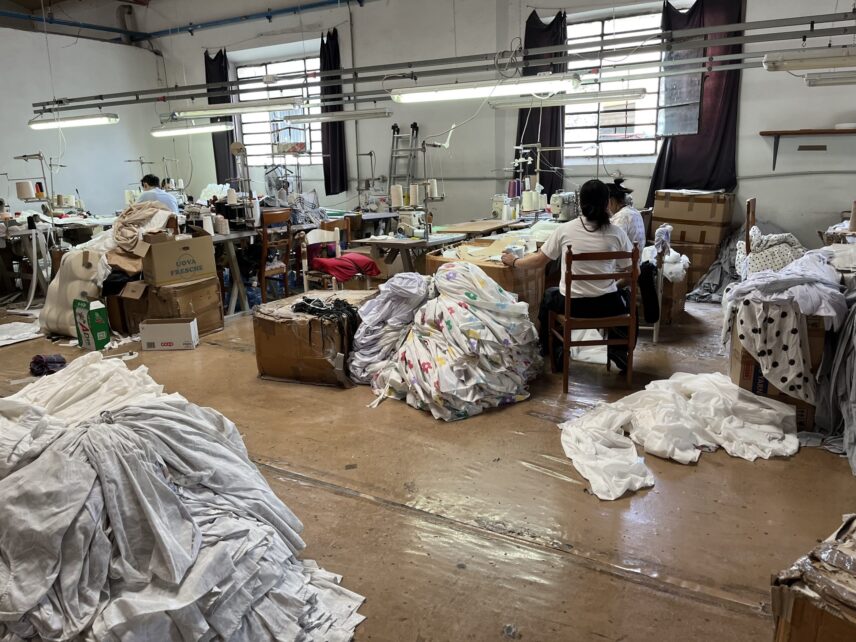
After declaring bankruptcy, the couple faced a choice between becoming hired workers again or continuing as self-employed subcontractors. They chose the latter, as it allowed them to keep their children with them. They continued sewing for the same fashion company, but now entirely off the books. All transactions were in cash. They rented a single workstation in another Chinese-run workshop, shared by six couples with young children. On paper, they were wage workers; in practice, they were independent subcontractors. The rent covered both the sewing station and the minimal paperwork needed to maintain residence permits. This arrangement protected Mei’s remaining “clean” name and preserved the family’s future. At the same time, they lost the rental income they had once earned by subletting workstations, worsening their financial situations. Ironically, their effort to maintain a facade of legality pushed them further into informality and precarity.
For many Chinese migrants, obtaining or maintaining a “clean” name was closely tied to their broader migration plans. Some undocumented workers I spoke with, especially those with family in China or without intentions to settle in Italy, chose not to invest in regularizing their status. A single man in his early thirties, who had remained undocumented for seven years, described regularization as “a waste of money,” since he “only wants to earn some money here, then goes back to China and finds a wife.” Others, who possessed a “clean” legal identity but had no caregiving responsibilities in Italy, sometimes “lent” their names to friends or relatives in need, earning a fee in return. As one long-time workshop worker in his forties put it, “Otherwise it’s a waste!” In this context, a clean legal identity became a convertible asset, circulating within kin and community networks. Its value lay precisely in its fluidity. These exchanges blurred boundaries between worker and entrepreneur, and between legality and illegality. They revealed migrant subjectivities forged through continuous negotiation with Italian bureaucracy.
A Moral Economy of the Clean Name
The stories of Mei and other Chinese migrants in Prato demonstrate a moral economy of the “clean” name as a family project stretched across generations. While many of my interlocutors leveraged their own clean names to survive Prato’s fast-fashion economy, none of them were willing to risk their children’s. No subcontractor or worker I met, documented or not, imagined their children remaining in workshop labor that they described as “at the bottom.” Mei sent her seventeen-year-old elder son to train as a hairdresser, picturing the day he might run his own hair salon. Her younger son, who was “good at school,” enrolled in a private Italian school in hopes he might one day attend university. A shared aspiration among the parents I met was that the next generation’s name must remain “clean,” untouched by the legal ambiguities and precarious work that defined their parents’ lives. A clean name, in this sense, was an imagined pathway to social mobility in an otherwise constrained legal landscape.
In Chinese, qingbai also describes a person, not just a name. To be qingbai carries moral weight, connoting integrity, trustworthiness, and the capacity to fulfill obligations to family and kin. For Mei and many others, maneuvering around the law therefore constituted a moral practice grounded in work ethics, kin obligations, and community reciprocity. Hard work justified bending rules and bureaucracy, especially when those rules threatened family stability, and circulating a “clean” name or overlooking informal practices became ethical acts of mutual support. Mei and other Chinese migrants in Prato formed alternative imaginaries of the good life that both contested state-defined norms of legality and reproduced classed and neoliberal ideals of self-reliance and accumulation. Rule-bending appeared less as defiance than as a pragmatic response to uneven access to legality and its fluid enforcement. A “clean” name that migrant families cultivated, protected, and sometimes sacrificed was not a stable condition, but an ongoing practice of survival, as they moved through porous boundaries between clean and tainted, legal and illegal, compliance and rule-bending. In this sense, the “clean” name made visible the liquid nature of legality itself. This liquidity, in turn, enabled these aspirational migrants to continually develop strategies for pursuing what they understood as a better future within shifting legal currents.
Alex Wolff and Yanping Ni are the section contributing editors for the Society for East Asian Anthropology.