

Article begins
“Two young men died here [in 2021] because of the police. Because they stopped them from seeking medical help. So, obviously we can’t depend on the police, […] the city, the state […], we got to depend on ourselves to take care of ourselves.”
Diego (pseudonym), a shipyard worker and ex-inmate in his thirties, was one of many Latino men seeking to overcome the trauma of racist state violence whom I met during my ongoing fieldwork on grassroots security practices in the California borderlands. His feelings of injustice and ethos of self-reliance were amplified by living amid stark social inequalities. Notably, institutional and interpersonal violence intersected in his life story. Diego’s eyes started welling up when he shared that his father, who did not raise him, had forced him to fight with his cousins in Mexico as a young boy, “like dogs.”
Diego was not the only interlocutor whose life stories included both episodes of neighborhood violence and complicated relationships with seemingly unloving fathers. For example, Bob (pseudonym), a self-described “O.G.” (original gangster) and businessman in his early seventies, told me that his father, an army man, had sent him to a Central American country after Bob, then in seventh grade, almost killed a boy for insulting his mother. Bob expressed no remorse.
These conversations had me wondering: Were these men feeling lovecidal?
The Vietnamese-American artist-theorist Trinh T. Minh-ha coined this concept to describe the spiritual, affective, and material effects of a confluence of war, imperialism, grief, and mourning. Lovecidal, a portmanteau of love and suicide, denotes the systemic destruction of love as a consequence of violence alongside political cruelty of the “global Patriarchal Empire”—a civilization organized not around love as “a creative state of being” but around subjugation, exploitation, and a constant state of war. Minh-ha’s main examples are the post-9/11 U.S. “war on terror” and China’s occupation of Tibet. Intersecting structures and experiences of violence kill the capacity for loving care in many individuals and their cultures.
I am applying this concept to current expressions of masculinity to elucidate their affective structure. I argue that living in contexts marked by violence alongside warped understandings of love promotes particularly destructive behavior and attitudes. This phenomenon is not new or unique to a particular context—however, lovecidal masculinity has become an increasingly global concern, due to social media algorithms spreading this structure via so-called “manosphere” influencers.
“Manosphere” is a word associated with controversial public figures from heterogeneous backgrounds, such as Andrew Tate, Nick Fuentes, and Jordan Peterson, who have made misogyny their profession. They are online personalities (e.g., on YouTube, podcasts, and social media) who produce antifeminist content about masculinity and dating, while monetizing their misogyny via subscription content and through affiliate marketing for cryptocurrencies, fitness-related products, and more. There is also considerable overlap between the manosphere and white nationalist groups. The viral 2026 Netflix documentary “Louis Theroux: Inside the Manosphere” depicts “manfluencers” as compensating for troubled childhoods, often marked by poverty, absent fathers, and marginalization, with luxury lifestyles and beautiful young women: symbols of “masculine capital.” The documentary does not explicitly explore the structural factors, an omission that risks blaming this industrialized misogyny on specific individuals and promoting stereotypes.
Reacting to past trauma with efforts to secure masculine capital is not unique to the manfluencers. For example, I found that some of my interlocutors’ capacity for violence and harm in underserved Latino neighborhoods of San Diego coincided with a difficult relationship with love. This suggests that lovecidal masculinity can be used to explain the behavior and attitudes of men in very different social positions within the hierarchy of masculinities. By comparing these two examples—influential manosphere men and marginalized Latinos—I intend to show how the lovecidal masculinity concept might travel across different contexts, without flattening the important differences between them.
A major difference is that, although violent behavior and language can be observed in both cases, structurally marginalized men cannot profit from it in the same way. In addition, the men I worked with expressed a paternalistic, protective attitude towards women, rather than explicitly misogynist views. While the manfluencers are admired by their vast following for what they present as aspirational lifestyles, U.S. Latino men’s masculinity is already read as “inherently criminal”—a pervasive, stigmatizing image that bears no correlation with actual crime rates. Racialized men are constantly negotiating their masculinity in response to these perceptions. This “borderland masculinity” manifests in many ways, all of them subject to symbolic violence. Due to its stigmatization, Latino masculinity occupies a near-opposite position to the aspirational masculinity of the manosphere in public discourse about men.
Manfluencers are not average men, but they have outsize social influence; similarly, the men whose perspectives I am discussing here should not be viewed as representative of their neighborhood, where the large majority of people “keep their heads down,” leading non-violent, crime-free lives. However, men like Diego and Bob are arguably representative of lovecidal masculinity in their neighborhood. Key to constructing and enforcing this masculinity is the repeated experience and witnessing of interpersonal and political violence, such as that inflicted by the police or family members, in the perceived absence of love. Some of my interlocutors had also perpetrated violence in their youth. While sitting at one of the picnic tables in Chicano Park, Diego told me:
“I remember when I was a kid, I told my mom to plan for my funeral instead of my Sweet Fifteen because a lot of my friends were getting killed. […] I didn’t really have my parents around growing up, so I was kinda looking for my own family, and I found the wrong people.”
Looking back on his youth, Diego explained that he grew up in violent structural conditions that he described as a “school-to-prison pipeline,” meaning that he was policed at school as well as having friends who exposed him to violent situations. Bob highlighted an “old-school” understanding of justice, passed down from his family, that called for responding to disrespect with physical violence in response to disrespect, or the threat of it: “don’t push me.”
In my interviews, love was a salient theme. Over lunch, Bob spoke about the time his fiancée, his dream woman, died in an accident. Thereafter, he shunned marriage for decades and never had children. Despite emphasizing the power of violence over love, Bob still appeared to yearn for love when he played me his favorite romantic songs on his phone.
The men I worked with often highlighted their search for respect and belonging. Some found this in becoming members of male-centric groups, such as armed community defense organizations. Others, like Diego and Bob, were invested in youth programs, acting as surrogate fathers to troubled teenagers in their neighborhood by helping them access education and better opportunities than they had growing up. Bob said he felt motivated “when I see young people and that smile, you can tell, comes right from their soul.”
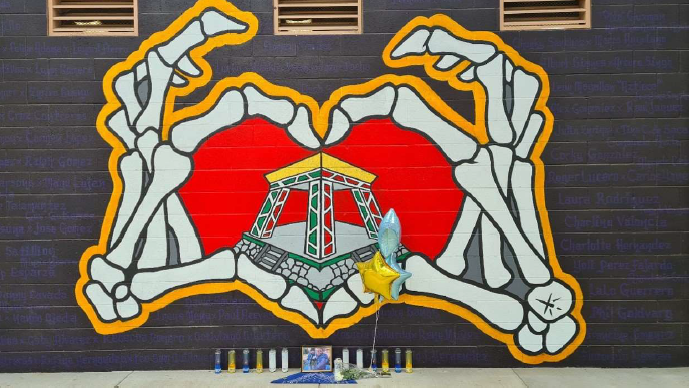
Yet Bob struggled to shield his protégés from violence. A young neighbor who used to call him “Dad” had just been killed in Chicano Park. A recent mural there commemorates deaths in the park, as bony fingers arranged in the shape of a heart frame the park’s pyramid-shaped kiosko. Below, there is a small altar. This mural represents “a symbol of love, unity, and respect to our community, and our neighborhood,” according to the artist, Giovanni “MEX” Cerda.
Another element of lovecidal masculinity is a conflicted relationship with love. Love was important to many of the men I interviewed, but they often distrusted it because of experiences of loss and abandonment. Moreover, love did not automatically change their capacity for violence. This resonates with the Black feminist author bell hooks’ insight that confused definitions of love allow abuse and care to coexist in relationships. Instead of conflating love with a strong emotional attachment or with care, hooks insisted on defining love and violence as mutually exclusive.
Why do Diego and Bob’s relationships to love matter? Understandings of love arguably play a powerful role in men’s lives but are often warped by mutually reinforcing feelings of lovelessness and violent experiences, on both a structural and interpersonal level. That does not mean pitying abusers or making excuses for them. Recognizing the lovecidal masculinity behind destructive behavior is compatible with a systemic, change-oriented approach.
Diego took anger management classes in prison. It was a turning point. Making himself take a step back when he felt pressure building up inside did not heal him, but it allowed him to become a better father to his young daughter. When Diego fell in love sometime later, he found it challenging to explain his sudden panic attacks to his partner. Slowly, they built a healthy relationship, and eventually a marriage. Is Diego lovecidal no more?
Minh-ha argues that to overcome lovecidality, compassion and a daringness to love must be stronger than the “inner fear” that makes people “unafraid to kill.” Although they cannot change the conditions that contributed to their violent pasts, Diego and Bob’s long paths to healing include letting love into their lives and bearing witness to the injustice endured by young men in their neighborhood. If manfluencers are teaching young men to be misogynists, other men need to teach them how to love without violence.
Maja Jeranko and Anika Jugovic-Spajic are section contributing editors for the Association for Feminist Anthropology.