
Article begins
This piece is part of a collection of Anthropology News articles on Climate Governance. Click here to read other articles in the collection.
In early October 2023, I arrived in Tokyo for the first time, as a financial professional and a graduate student in anthropology studying sustainable finance. Somewhere along my fieldwork journey, my attempts at breaking into the exclusive circles of finance paid off, and I got a job as a sustainability communications advisor at a well-known sustainable finance institution in Norway, FjordFuture (pseudonym). On this trip, I would represent my employer as part of a three-person delegation at the sustainable finance industry’s flagship conference, Principles for Responsible Investment in Person, also known as PRI in Person.
PRI was launched in 2006 as a United Nations body to unite and guide financial institutions in their pursuit of ethics and sustainability within investment practices. In the two decades since its launch with 63 founding members, the initiative dropped the UN title to reflect its independence as a private-sector-led entity and expanded its membership to 5,000 signatories from over 80 countries, which collectively represent approximately USD 140 trillion assets under management. It is currently the world’s largest investor forum for sustainable finance. The 2023 edition of PRI in Person gathered more than 1,400 sustainable finance professionals with the tagline “Moving from Commitments to Action.”
Although I attended PRI in Person conferences before as a researcher to gain insights into the industry by looking at how its professionals present themselves at such venues, arriving as an industry insider had its own unique perks: I had the means to stay at the conference hotel instead of the cheapest option I could afford on my PhD stipend. I was more conversant in the unique and often grotesque banter and jokes of financial professionals. I was there to get things done in the name of my employer—I had a literal agenda!—instead of trying to network with potential interlocutors who rarely had the time to chat with researchers like myself. I knew more people who attended the conference, since I was now working in finance, and I could step into a room, spot an acquaintance, and start a warm conversation. Even my blazer felt more fitting. Now, I was also carrying the air of a sustainable finance worker who had a lot to do during a jam-packed week!
On the first morning of PRI in Person Tokyo, I met one of my colleagues for breakfast. Kate (pseudonym) was a sustainability analyst at FjordFuture, who was primarily responsible for undertaking engagement meetings with portfolio companies. In these meetings, she would try to influence the company to become more sustainable—for example, by installing new low-carbon furnaces or paying living wages to their employees. Sometimes several financial institutions came together to conduct these meetings to use their resources more efficiently and compel better compliance from the companies.
Before I met Kate that morning, I overheard a few conference participants mentioning that PRI would launch a new collaborative engagement initiative during this conference. When I mentioned the news to Kate, she was exasperated: “Not another initiative!” Seeing my surprise, she went on to explain that while it was good to have these initiatives and their more orderly structures in place, she felt that what we needed was more effective action.
“Sometimes I feel like we are drowning in the bureaucracy of it, rather than going out there and changing corporations for real,” she told me before turning to her phone to draft an email to one of the companies we would visit later on our trip.
It can be said that Kate is at the coalface of sustainable finance, as she is tasked with organizing engagement activities and making sure that they run smoothly and reach their goals. As someone deep in the trenches of engagement, her reaction contrasted the fanfare that sustainable finance often presents towards engagement.
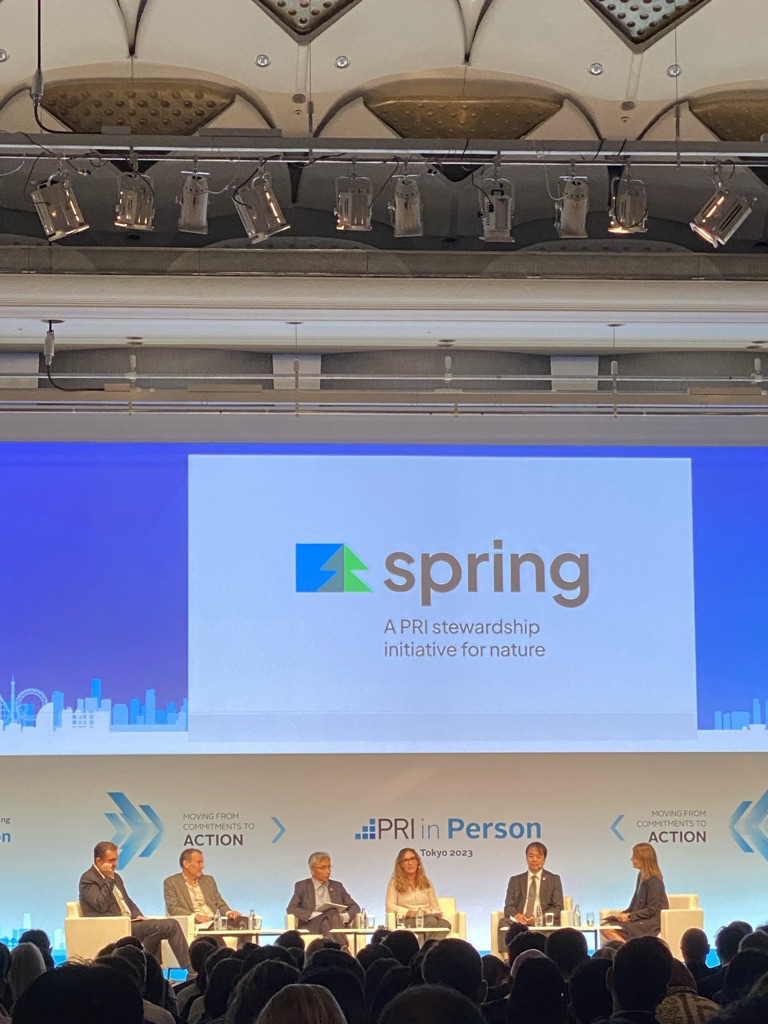
Fittingly, just a few days later, when PRI did launch its new engagement initiative on nature, rather cheekily named “Spring,” the celebratory mood was complete with drumrolls and flashlights crescendoing into the grand announcement. The initiative aimed to address the systemic risks entailed by biodiversity loss through engagements with “influential companies to improve their nature-related corporate practices.” Their ultimate goal was to halt and reverse biodiversity loss by 2030, and they needed a lot of hands on the deck. The prestigious PRI in Person launch would ensure the needed interest by financial firms.
PRI as the Executive Branch of Climate Governance
Despite their similar scale, prestige, and exuberance, and even their shared roots going back to the United Nations, PRI in Person is significantly different from the COP meetings organized by the UNFCCC. As opposed to COP meetings and other more traditional sites of global climate governance, sustainable finance industry conferences like PRI in Person do not host high-level multilateral negotiations to determine transnational sustainability and transition goals and pledges.
Rather, industry events like PRI in Person operationalize the commitments, expectations, and regulations put forth in fora like the COP meetings. In settings like PRI in Person, sustainable finance professionals gather to discuss intricacies of sustainability reporting. They take stock of their successful and not-so-successful engagements and launch new engagement initiatives or sustainability-related metrics. They discuss potential targets and roadmaps for their own practices. All of this is done to fulfill their responsibilities as investors per laws and regulations, which are rooted in meetings like the COP. Put simply, if we liken the COP meetings to the legislative branch of global climate governance, PRI in Person represents its executive branch.
That PRI in Person might be the executive arm of global climate governance became particularly apparent to me through two instances in Tokyo: one about how policymakers themselves appear in these spaces and present their activities, and the other about how sustainable finance makes sense of its own interactions with policy.
On the first morning of PRI in Person, Japan’s then Prime Minister Fumio Kishida kicked off the conference with a keynote address. At its core, the keynote served as a platform for announcing unprecedented changes in Japanese financial policy, including those in favor of sustainability. Emphasizing that “sustainable growth required unlocking the immense powers of finance,” Kishida heralded—among others—increased investments and subsidies into renewable energy and other “green” industries, as well as an asset management reform that would channel country’s massive household savings into more competitive, sustainable, and impactful investment options. The idea behind these changes “exactly aligns with the principles of the ‘New Form of Capitalism,’” Kishida declared, which he “keenly advocate[d].”
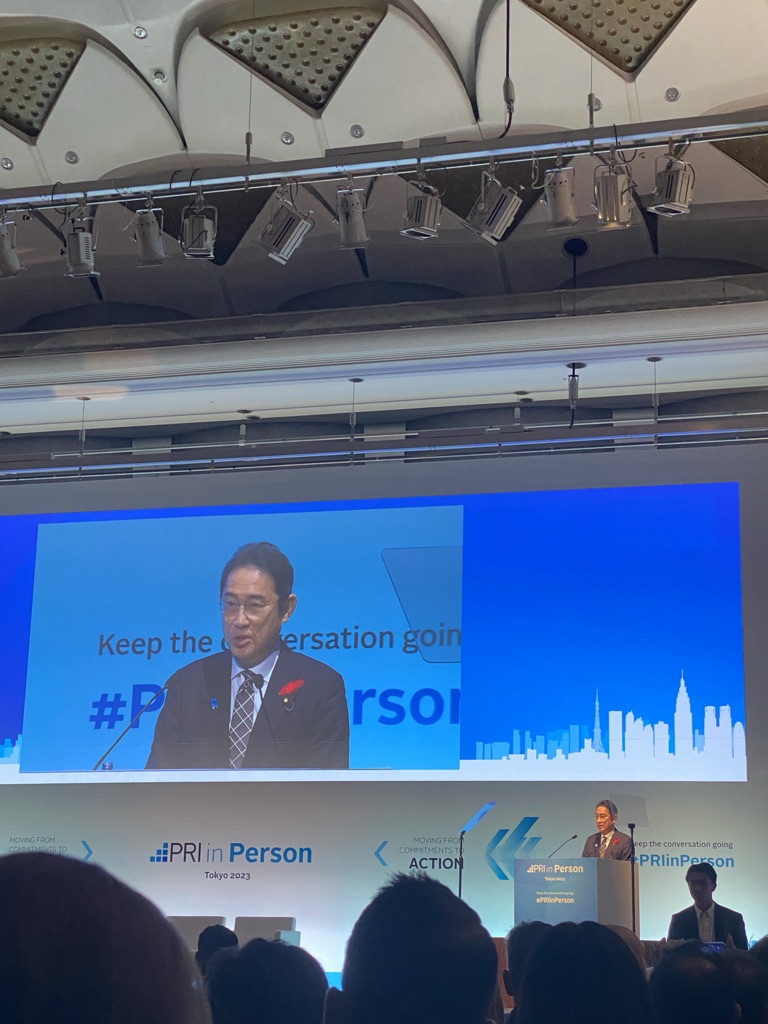
By announcing these extensive policy changes during a global investor conference, Kishida did not only position global capital markets as his primary audience; he also demonstrated how the sustainable finance industry became enrolled in global climate governance. The policymakers announce the changes they aim to make, describing from their own perspective how finance’s powers can be harnessed to drive sustainable growth. In doing so, they are giving the financial industry a mandate to figure out how to achieve these goals. In other words, policymakers announce the goals, and sustainable finance gets to plan the steps to reach these goals. And PRI in Person is a good place to gather with other practitioners to figure out exactly what to do when they get back home.
In response to policymakers’ positioning as legislators of global climate governance, sustainable finance itself takes on the role of implementers. During PRI in Person 2023, in different conference sessions or during networking breaks, many participants emphasized that sustainable finance could support commitments by governments and the transnational community. Investors were ultimately bound by policy in how much they could pursue sustainability, meaning that they could not oppose or contradict policy, but they were the ones that could really make the policy shine through, through their tools, models, or engagements.
Months after PRI in Person 2023, I had the chance to listen to Martin Skancke, the chair of PRI from 2014 to 2024, at another industry conference. Echoing his colleagues from PRI and elsewhere, Skancke framed finance as the implementor of sound policy and juxtaposed it with policymaking: “Decisions that impact the trajectory of transition are taken outside of the markets; they are taken in the public sector. Efficient public and private cooperation is of course needed because financial system can amplify the effects of policy [on sustainability and transition], [but] only if the policy is good”(emphasis mine).
Skancke’s statement reflects the larger sectoral understanding that finance carries a big potential in contributing to the achievement of policy goals that are taken outside of financial markets. Finance can do this through its influence and monetary power to implement these policies, especially through its capacity to financially sanction noncompliance down the value chain, that is, on corporations. With its policy implementation responsibility (that is both ascribed and self-proclaimed at the same time) and its sanctioning powers, finance does act as the executive function of global governance for sustainability. And conferences like PRI in Person are the primary avenues through which information and know-how is exchanged.
However, there are also ongoing concerns about sustainable finance’s legislative and operational shortcomings and academic discussions about how finance struggles to demonstrate tangible impacts on the ground. As such, beyond these exchanges of information and know-how, we still do not know how sustainable finance can actually achieve its goals and commitments. Just like the PRI in Person back then, we are facing the obligation to move “from commitments to action.” The real question lingers—but, how exactly?