

Article begins
COP30 beyond the Documents
This piece is part of a collection of Anthropology News articles on Climate Governance. Click here to read other articles in the collection.
20 November 2025. The eve of the final day of COP30 in Belém do Pará. The heat was intense. I was in the Country Pavilion in the Blue Zone, an area reserved for official delegations to the United Nations Framework Convention on Climate Change (UNFCCC). Suddenly, I saw a crowd of people running and shouting for everyone to leave the tents. I stood up and ran. Thick black smoke was billowing through the pavilion. What would happen to COP30, the world’s largest climate summit? What did that fire represent?
The heat had already left its mark on the whole COP experience in Belém. Inside the tents, it mingled with the constant flow of people and the profusion of events. Meetings and schedules proliferated by the minute. Many people were also moving around the city and between the different conference venues, including members of official delegations, negotiators, scientists, private sector employees, members of non-governmental organisations, Indigenous peoples, local communities and social movements. Diplomacy, science and activism merged under a constant sense of urgency. It was as though many COPs were taking place simultaneously.
Some of the events that most caught my attention happened outside the Blue Zone, though, or in the gaps between its institutional boundaries. While delegations negotiated the documents that would revise and renew the commitments made under the Paris Agreement, social movements occupied the streets and institutions across Belém, formulating denunciations and demands. In the process, they created other political arenas and challenged the terms in which the climate crisis was being discussed.
I began to think of these mobilisations as “social fires,” points of protest flaring up across Belém, testing the boundaries of international climate governance. Some remained outside the official spaces; others reached the entrances to the Blue Zone and crossed its barriers, disputing official access and representation. Accompanying this movement—from the streets and spaces of mobilisation to the conference’s more restricted corridors—made it possible to tell another story of COP30, beyond the documents produced at the negotiating tables.
Social Fires outside the Blue Zone
The People’s Summit, held at the Federal University of Pará (UFPA) from 12 to 16 November, was attended by more than 25,000 people a day and became one of the world’s largest voices for climate justice and against environmental racism, a counterpoint to the institutional language dominating official negotiations. More than 1,000 organizations from over 60 countries called for a change in the language of climate politics, moving the focus of climate governance away from the rhetoric of “resilience” and “adaptation” towards substantive debates about reparations, territorial rights and climate justice.
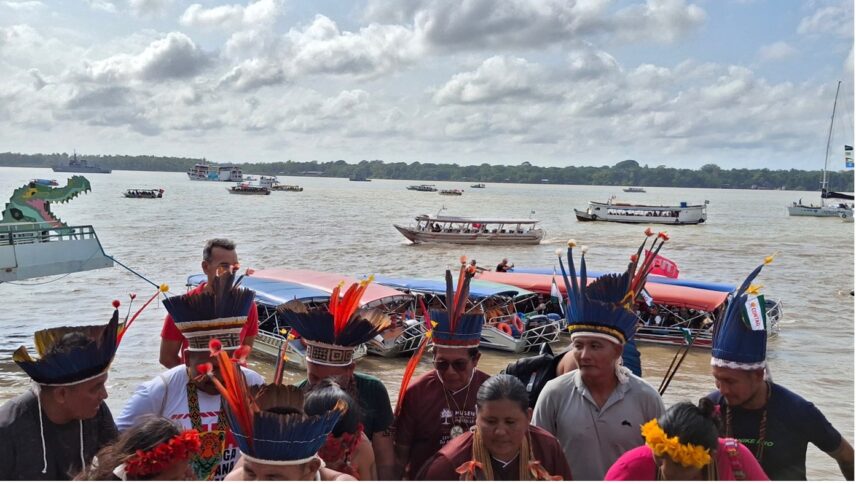
But the mobilizations were not limited to the university campus. They spread across Belém, occupying other spaces in the city, including streets, squares and even boats. Some created their own arenas to put on trial those responsible for environmental destruction. At the Autonomous and Permanent Peoples’ Tribunal against Ecogenocide and the International Feminist Tribunal, communities brought cases involving sensitive issues such as mining, the expansion of agribusiness, deforestation, pesticides, slave labour and forced displacement. Denunciations from the Amazon were placed alongside violations in occupied Palestine, Bangladesh and peasant territories across Latin America and Africa. Wars also emerged there as an environmental problem.
Indigenous peoples created another arena of this kind. At the Ancestral Jury, organized by the Articulation of Indigenous Peoples of Brazil (APIB), development projects themselves were placed in the dock, including mining, hydroelectric dams, railways and even a TikTok data centre. The Brazilian state and private companies were held responsible for environmental crimes and violations of Indigenous rights.
These different “social fires” culminated in the Climate March. The protest wound through the streets of Belém, bringing together movements, organizations and peoples who brought to the COP conflicts experienced far beyond the conference spaces. At that moment, climate politics had clearly spilled beyond the boundaries of the Blue Zone.
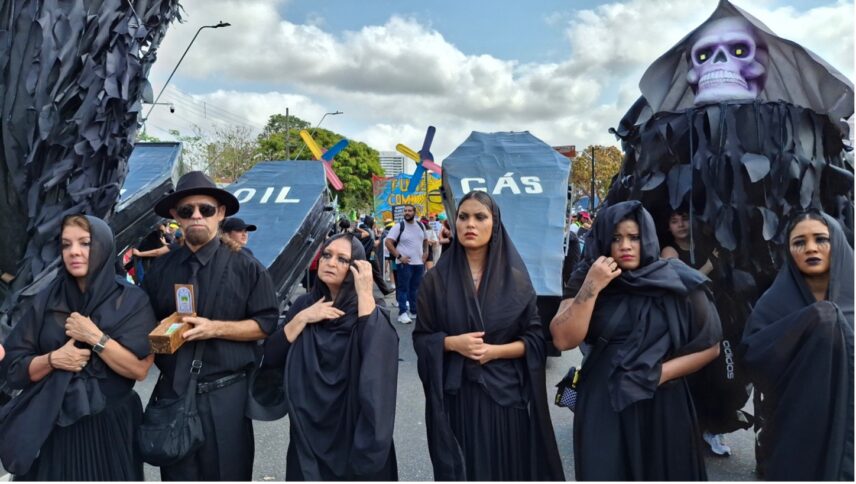
But these movements would not remain on the outside. In the following days, one of these “social fires” would reach the entrance to the Blue Zone itself.
At the Entrance to the Blue Zone
A line of Munduruku Indigenous peoples blocked access to the Blue Zone. For a while, the scene disrupted the carefully organised flow of the conference. To reach the official negotiations, delegates and registered participants had to pass through a boundary zone occupied by those demanding a direct say in decisions affecting their own territories.
At the forefront of the mobilization was Alessandra Korap Munduruku, a Munduruku leader from the Middle Tapajós region and one of the best-known voices in the struggle for Indigenous land demarcation and against illegal mining. During the blockade, she denounced the COP for turning into a space for “business deals and partying,” far removed from the conflicts faced by Indigenous communities every day in their territories.
The Indigenous presence was impossible to ignore. COP30 had the largest Indigenous participation in the history of the climate conferences. Headdresses, images, beadwork and body paint became omnipresent in the corridors and on the bodies of participants from all social backgrounds. They were even appropriated by the Brazilian delegation, which launched a clothing collection inspired by Marajoara designs. This provided a clear example of how Indigenous cultures are used as an aesthetic language compatible with the development agenda.
During the blockade, Alessandra Munduruku met with COP30 president André Corrêa do Lago. It was after this meeting that an image began circulating of the ambassador holding an Indigenous baby, presented as a sign of openness to dialogue with Indigenous peoples. The mobilization that had begun outside the Blue Zone had thus managed to open a channel for dialogue within the conference space.Some time later, I saw Alessandra again. This time, she was inside the Blue Zone. She was giving interviews in the conference’s reserved media areas. The shift was significant. She had moved beyond the barrier set up in front of the delegations to the corridors of the Blue Zone. The Munduruku mobilisation had crossed one of COP30’s most tightly controlled boundaries.
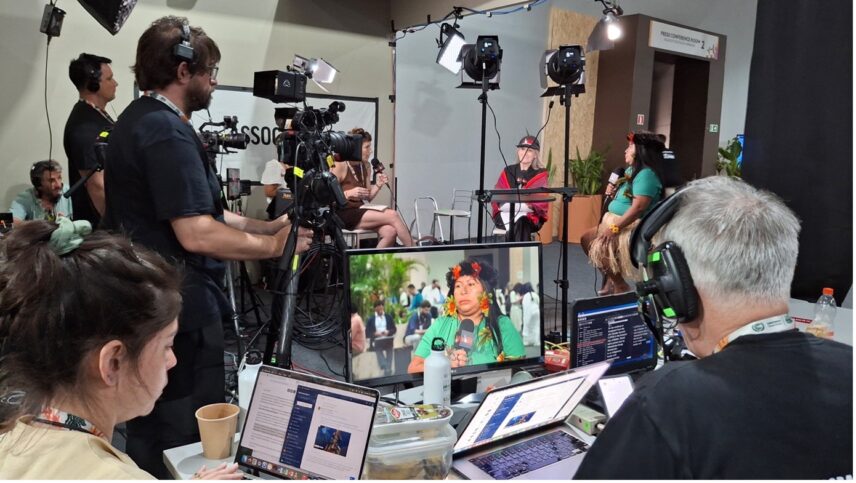
Crossing this boundary, though, did not mean that everyone had equal access to the spaces where decisions were made.
Passport to the Blue Zone
Entrance to the Blue Zon required an ID badge. Even before COP30 began, these badges had already become a source of dispute. They determined who could cross the boundary between the conference’s many public spaces and the area restricted to official delegations.
The distribution of the ID badges revealed inequalities among the social movements themselves. The National Coordination for the Articulation of Rural Black Quilombola Communities (CONAQ), for example, requested 50 badges but received far fewer. Around 360 Indigenous people from Brazil, meanwhile, were given access to the Blue Zone, making this the largest Indigenous presence ever recorded at a COP.
But obtaining the “passport” did not mean being able to move freely through all areas of the conference, or protest freely within them.
In the Blue Zone, demonstrations were subject to specific rules. A UNFCCC manual stipulated where and how they could take place. Protests were confined to designated areas and frequently took the form of performances, costumes, placards and slogans easily turned into photographs and videos for social media. Political protest had entered the Blue Zone, but there it encountered an infrastructure designed to organize it, contain it and make it compatible with the running of the conference.
Even so, these spaces were used strategically. At press conferences, movements and organisations raised conflicts that were unlikely to reach the negotiating tables. It was there that I accompanied criticism of the dependence on fossil fuels and the efforts to build an international coalition against this energy model.
Other denunciations reached even closer to the institutional heart of the conference. At the People’s Plenary, cases of ecogenocide in Sudan and Palestine were brought into the Blue Zone. But the plenary itself showed the limits of this openness: access was controlled and the press was not allowed in.
The “social fires” had thus crossed the boundaries of the Blue Zone. They were in the corridors and at the press conferences, demonstrations and even plenaries. But the closer they came to the spaces where agreements were negotiated, the more evident the limits placed on participation became.
It was in this space between openness and control that the fire finally invaded the tent.
Fire in the Blue Zone
On the day of the fire, as I escaped the smoke-filled tent, I saw hundreds of people gathered outside, still dazed and trying to make sense of what had just happened. A column of black smoke rose into the sky above Belém. For a few hours, it seemed like COP30 had ended there and then.
Negotiations were suspended. When they resumed, the discussions continued until the final documents were released, compromised though by flimsy commitments and the difficulty of addressing some of the issues that had dominated the conference. Among them was the global dependence on fossil fuels.
But the documents tell only part of the story.
During those days in Belém, other disputes over the future of the climate had occupied public spaces. They had created tribunals, put development projects in the dock and brought thousands of people onto the streets. Indigenous peoples had blocked the entrance to the Blue Zone. Movements demanding the right to badges and access had managed to bring their complaints to press events, corridors and plenaries inside the conference.
The “social fires” that began on the outside traversed the inner boundaries of the COP, exposing conflicts that the final documents were unable to resolve and bringing voices and territories into climate governance that otherwise remain, even today, confined to its margins.