

Article begins
This piece is part of a collection of Anthropology News articles on Climate Governance. Click here to read other articles in the collection.
Since 1995 world leaders have descended each year on a chosen city to discuss the fate of the biosphere at the annual “Conference of the Parties” to the UN Framework Convention on Climate Change. But this time they were worried. After the closing of the previous year’s summit in Azerbaijan, climate gurus the world over flung into a panic when they discovered that the selected host for COP30—a mid-sized city in the Brazilian Amazon called Belém do Pará—might be short on hotel rooms. AirBnB markets went haywire, with bunk bed-lined condos batting up to the thousands per night, US dollars. Soon enough, talking heads were airing their anxieties about the reality of hosting a big, important UN conference in a developing city in the Amazon.
In response, the Brazilian government opened a well-known playbook. Love motels were converted into “COP hotels” to accommodate the fifty thousand gringos expected to attend the event. With contracts to fix and concrete to pour, new investments filtered through the dreams and aspirations of the city’s economic elites. Rubber boom-era docks and weigh stations were renovated to host pizza joints, brewpubs, tacacá bars, and other gastronomic curiosities. To alleviate the housing problem, the government contracted two ocean cruise liners to anchor north of Belém. Floating on the horizon like a diplomatic layer-cake, their presence was eerily reminiscent of the nineteenth-century steamships that once plied the Amazon for rubber latex. Now the cargo was COP30.
The irony. A tropical city whose once-primary export ignited the Global North’s love affair with the automobile was now piquing the housing anxieties of its climate ambassadors. Yet amid the panic, most English-language outlets neglected to mention an important detail about the developing city in question: it happens to host one of the largest annual pilgrimages in Latin America and is, in fact, quite adept at receiving visitors. Five weeks before COP30, over 2.5 million people—double the city’s population and twice as many tourists as attended the climate summit—descended on Belém to pay promises to Our Lady of Nazareth, a small wooden saint housed in the Virgin’s namesake basilica. Pilgrims travel by bus and river ferry from throughout the Amazon, hanging up hammocks and rolling out sleeping pads in the city’s popular neighborhoods. They come in search of miracles, offering stacks of books from university entrance exams, model houses, and wax statues of ailing body parts. Others crawl on their hands and knees in devotion.
When the idea of holding the UN climate summit in the Amazon was first conceived in November 2022, it echoed with the weight of resurrection. COP30 was the “Second Círio.”

The Círio de Nazaré occurs each October and draws a growing pool of international tourists. Infused with a spirit of folk Catholic Marianism and Carnivalesque rebellion, it provides a compelling counterpoint to the otherwise dour state of global climate politics. Belém’s Círio is a point of convergence for the thousands of rural saints’ festivals celebrated throughout the Amazon since the basin’s Iberian colonization. Legend holds that the festival originated in 1700 when Plácido, a working-class “caboclo” discovered a wooden statue tucked between the rocks of a streambed on the city’s outskirts. After he constructed a makeshift altar for the Virgin, she disappeared into the night, returning to the place where she was first discovered.
Each year pilgrims reenact the miracle. On the day of the festival, Nazinha’s statue is taken from the basilica and paraded from the town center by a crowd of devotees. Barefoot Catholics propel one another along the avenue while Protestant congregations organize at the margins, dousing water on the overheated masses. Círio hymns blast from bleachers while balloons and advertisements remind onlookers of the event’s corporate sponsors: logistics firms, cosmetic companies, and the world’s largest producer of iron ore and nickel—the blood-stained Vale do Rio Doce.
At the festival’s accompanying nightlife, Catholic paraphernalia and odes to corporate sponsorship find their inversions reflected in the enchanted realm of the spirits: a refrain uttered into an animatronic speaker system outfitted as a crocodile, a drag queen whose antlers shine like diamonds in the night, or a dolphin lover in a white cap. Tugging them along the procession, hidden beneath the fiber cable that pulls the saint’s carriage, is the cobra grande—the “big snake”—whose underwater writhing reshapes the Amazon river system. At the popular Círio Pageant, streets crawled with Carnaval outfits, including three boney specters who pronounced the death of fossil fuels. “Our Lady of Nazareth, Illuminate the Struggles of Amazonian Peoples!”—the performance’s 2025 theme.
During the first Círio, these brilliant, ghastly figures followed the procession’s well-oiled symbolic machinery. But when COP30 came, they were unleashed upon the delegation.
After the summit, an organizer-friend of mine quipped that COP30 had been an abysmal failure for climate action. But it did wonders for tourism. Brazilians watching from their cell phones witnessed German climate activist Alicia Regova’s rise to social media stardom at Belém’s late night sound system parties. She donned an iconic outfit: button-up beige shirt—one side tucked in, the other tucked out—and a captivating, gringo-style dance. A technobrega DJ dedicated a song to her: Dança Lá Gringo. “She doesn’t get intimidated. Gringo turns it up, in the middle of COP30.” A landslide of Instagram followers ensued, which Regova diligently parlayed into a strike debt rally against “financialized colonialism.”
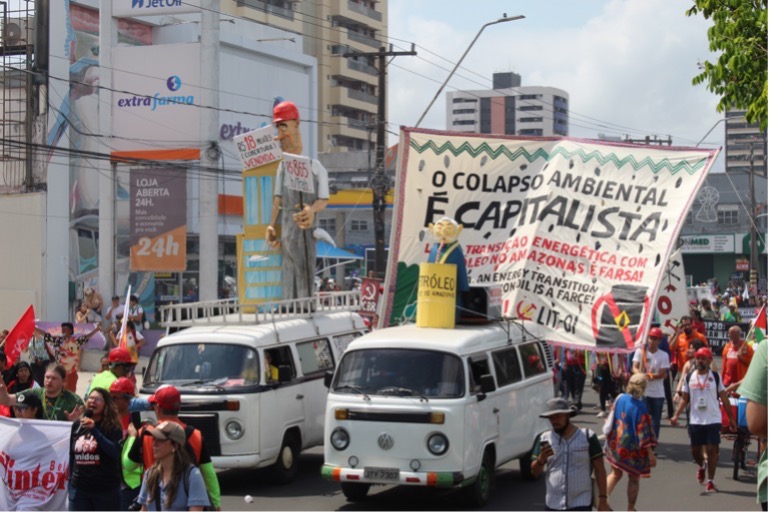
Barring a few frustrated delegates (who could have lifted a page from Regova’s book), it appeared as if COP30 attendees had a good time in the Amazon. Protesters cycled in and out of the UN-sponsored Green Zone and Blue Zone, where policymakers hammered out the details of the Belém Package. But the real action was at the side events. In the old city, a citizens’ tribunal charged governments and companies for their environmental crimes, while a giant cobra grande descended the Amazon with an activist flotilla. It beached at the Bay of Guamá to participate in the parallel Peoples’ Summit, where leaders drafted a manifesto for a just green transition. At the designated “Freezone,” enchanted sound systems spun pan-Caribbean bops like Dança Lá Gringo until the morning sun.
Of course, public policy and a global path towards rapid decarbonization a tropical EDM party does not make. But even in the diplomatic arena, the spirits made their presence known. Negotiations at the UN Blue Zone were presided over by the Curupira—a small forest being who, in Amazonian folklore, lures his victims into the jungle using his backwards feet as they try to run away from his footprints. Rebranded with a Dragon Ball Z-style hairdo and a vaguely Polynesian skirt, the trickster was transformed into a “guardian of the rainforest,” printed on conference totes and aluminum water bottles.
But wasn’t the trickster myth more accurate? COP30 was a trap. Fossil fuel lobbyists outnumbered all national delegations except Brazil, and one of every twenty-five attendees was a petro-lobbyist. Exxon Mobil, British Petroleum, and Volkswagen circulated among the forums and side events where they were joined by other purveyors of environmental and humanitarian crimes—big and small. At the state-sponsored “Agrizone,” a rancher accused of organizing the 2005 murder of the US missionary and Amazonian environmental activist Dorothy Stang attended a barbeque in broad daylight while Brazil’s congressional agribusiness lobby took advantage of the summit to push through the so-called “devastation bill.” The measure unravels many of Brazil’s environmental protections for the Amazon, threatening a key legislative bulwark against runaway climate change. Back at the conference, COP president André Corrêa do Lago gaveled through a meager political package that removed any binding language for reversing deforestation or phasing out fossil fuels.
Thus concluded the travels of the second Círio’s most devoted pilgrims—with a tropical hangover and the promise of a green transition still out of reach. Exhausted from two weeks of sweating and negotiating in the Amazon, their rallying cries still seemed far removed from the people whose wax statues each year fill the Básilica of Nazaré with a much more concrete set of aspirations. How were lofty demands for climate justice to compare with money for schools, medical appointments, or a new water tower for a community center? Yet the truth is that both groups of pilgrims—those of the second Círio and those of the first—had met once before. It’s arguably where the story first began.
In 1992, the United Nations convened the first ever Conference on Environment and Development in Rio de Janeiro, drafting the UN Framework Convention on Climate Change and chartering its annual Conference of the Parties. It occurred amidst a profound political upheaval. Under the control of a US-backed military dictatorship (1964-1985), the Brazilian government had transformed the Amazon into a violent deforestation frontier, stoking a mass movement for democratization and a new environmental coalition that began to exercise an outsized influence on public policy. After failures, setbacks, and a decade of destruction, deforestation rates began an impressive decline, falling 70-80% between 2004 and 2012. This was the so-called “Amazon success story”—a narrative that has played a central, if hotly contested, role in Brazil’s image as a global environmental leader.
Scholars debate the proximate and ultimate causes. Was it a revolution? Sound policymaking? A public-private partnership? Yet from the point of view of Nazinha, the picture was clear. In the 1970s, a cohort of progressive clergy and student organizers took advantage of a growing rift between church authorities and Brazil’s military regime; they hitched their wagons to the Liberation Theology movement’s “preferential option for the poor.” In rural villas, prayer-masters and saintly guardians mounted speaker systems on top of river boats, distributed pamphlets, and held meetings around plastic tables and chairs. They transformed the old saints’ festivals into community organizations, launching a bid to take over the region’s boss-run rural workers’ unions. They did what many Global North environmentalists don’t do. They talked to working people about the struggles they confronted on a day-to-day basis: the chainsaws that had cut down their açaí groves or nets that routed their fisheries. In 1988, they participated in the creation of Brazil’s new social democratic constitution, codifying a legal framework through which—argues geographer Susanna Hecht—all subsequent environmental policy was implemented.
These organizers succeeded where the world has failed, and they have also now failed where they first succeeded. But perhaps there is something to be learned from the space between two failures—between tragedy and farce. Beneath the glistening carriage of Tia Nazinha and the underwater writhing of the cobra grande is the story of a regional social movement that—albeit only temporarily and with ample problems and contradictions to learn from—succeeded in linking the everyday concerns of working people to an environmental politics of global significance.