

Article begins
This piece is part of a collection of Anthropology News articles on Climate Governance. Click here to read other articles in the collection.
“In the past, a lot of money for capacity building has been spent on foreign consultants who fly in for a week and stay at five-star, air-conditioned hotels.” The audience, a group of environmental professionals, academics, and embassy staffers in Dhaka, Bangladesh, cheered heartily at this critique of the amenities provided for past consultants. Offering a speech to open a capacity-building summit in preparation for COP29, the speaker, an environmental activist and researcher, continued. “But now, for us, the big question is changing the system, system building, and strengthening local capacity.” Throughout the session, the figure of the foreign consultant in the air-conditioned hotel was invoked as the past of climate governance, a past that was now being left behind with the turn to localized system building. Ironically, it went unremarked that we were ourselves sitting in an air-conditioned room in a five-star hotel.
The capacity workshop reflected the growing aspiration by the government and development agencies to position Bangladesh as a global site of climate adaptation and governance. However, why does air conditioning feature so prominently in the past of climate governance, and not in the future, when it is increasingly clear that in a warming world access to air-cooling technology is a health and social-equity issue? Why, in other words, does the possibility of local climate governance hinge on the disavowal of AC? Moreover, how is it that AC specifically has such affective charge, and not other technologies with similar detrimental environmental effects?
I open with this anecdote as an invitation to consider these questions, inspired by rising calls for an anthropology of heat in a globally warming world. I am sympathetic to the speaker’s desire to mock the privilege of those with AC. AC indexes deep global inequalities of wealth, consumption, and access to comfort; AC seems to materialize the dramatic differences in responsibility for and consequences of climate change between the Global South and North. For Bangladeshi climate professionals, going without AC is a way to present (or strive to live) as one with the people—those who cannot access cooling technology and can thus tough it out in the heat—and one who has not been adapted to foreign tastes. Throughout my research, I heard stories from urban, middle-class environmental activists refusing to use AC as a mark of their commitment to the environment. I too felt an internal pressure to forgo AC during my fieldwork. Of course, the history of air-cooling technology is replete with harmful environmental effects, from the history of Freon to the high (often fossil-fuel-based) energy use required for AC systems. And according to the International Energy Agency, cooling is the fastest growing use of energy in buildings, and is projected to triple by 2050.
However, I suggest there is some danger to casting the air conditioner as a bad object within climate governance. Why do certain kinds of relief or pleasure get cast as morally suspect indulgences, and others as legitimate needs? In the US, research suggests the moral framing of AC as a luxury good reduces support for public provision of cooling, and individuals are more likely to support subsidies for heating than cooling. Such casting of cooling as a luxury can thus have dangerous health effects.
Indeed, it was my experience that in the very areas the academics and activists were speaking for at the capacity-building summit, AC is increasingly an aspirational good, something to desire, save, and work for. While I was studying renewable energy and electricity in southwestern Bangladesh, in the low-lying coastal areas figured as a climate change hotspot in both international media and Bangladeshi organizations, I found that heat and access to electricity are intertwined and impossible to untangle. In the middle of the night, when the electricity cut off, I could hear the family I was staying with exclaim “ki jontrona!” (what suffering!) as the fans stopped. While the majority of people in the area do not have access to air conditioners (estimates range from less than 1% to 7% of households in Bangladesh having AC, with a strong divide between rural and urban areas), the rising heat is changing perceptions of air conditioners from a luxury good and status symbol to a more mundane object of need. As historian Ramachandra Guha puts it, “Ecosystem people want to be omnivores.”
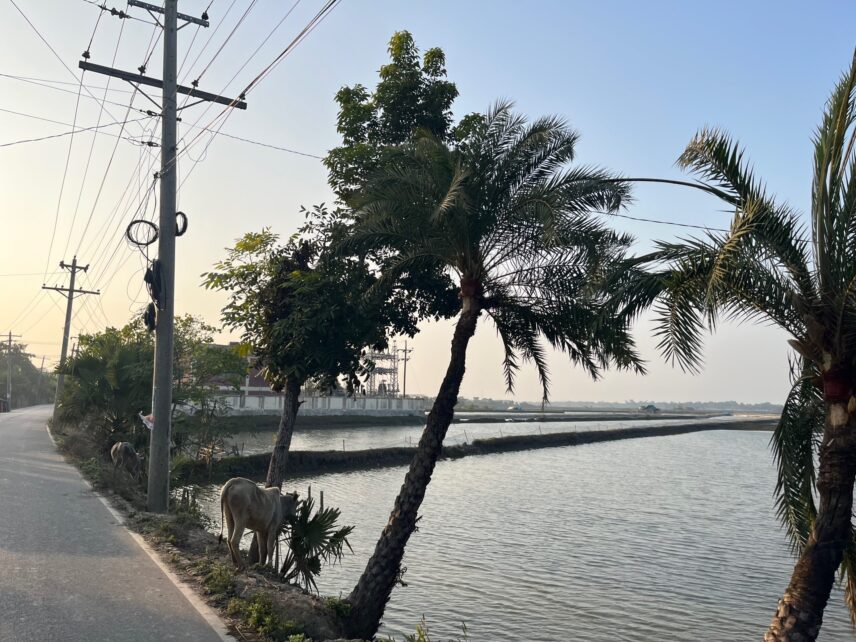
During my fieldwork, Bangladesh’s longest heat wave on record occurred, with sustained days above 40 degrees Celsius (104 degrees Fahrenheit). When a friend texted about fieldwork, I replied I was spending most of my day sitting with people as everyone complained about the heat. It was all anyone could talk about; my planned research with electricity technicians was put on pause as they too stopped work to avoid the sun. One common refrain was that normal ways of coping with the heat no longer provided any relief; a neighbor would take a bath in the pond and then complain there was no point as immediately after drying off he would be soaked in sweat again. After a brutal day, a member of the family I was staying with called out to me, “Come, Dana, we are going to go sit in the air conditioning.” He brought me over to a spot of land where the positioning of three large ghers (salt-water-shrimp ponds) produced a minor wind-tunnel effect. He laughed at his own joke, hinging on my foreignness and thus greater taste for the cold, exclaiming, “This is our air conditioner!” A cluster of people from the neighborhood were sitting in the windy spot, exchanging pieces of fruit. Joking or not, he was right; as the sun lowered, the salt-water wind felt almost like relief after a day cooped up inside in the energy-sapping heat.
Previously, I had encountered strongly held beliefs in the area that AC causes sickness. I heard several stories of shock from coastal residents when they went to the city hospital (in Khulna, around two or three hours away) because the AC was so cold they felt it made them sicker. Others had found work at a frozen-shrimp export-processing plant and described the incredibly strong AC as one of the hardest things to adjust to. Residents blamed my own minor sicknesses on my exposure to AC in the city.
Yet these beliefs are being challenged as rising heat makes the need for relief more desperate, and as exposure and access to air conditioning increases. In Bangladesh, AC manufacturers are pushing loan-based repayment plans for air conditioning, making air conditioners more accessible than ever before, especially given the drop in prices and growth in domestic manufacturing. As intermittent electricity supply improves, investing in the appliance becomes more appealing. Moreover, even for those for whom an air conditioner is out of reach financially, many people have greater exposure to it in offices, stores, factories, or hospitals. In the port town of Mongla, the market and industry hub at the border of the Sundarbans and coastal areas, new showrooms gleam with rows of air conditioners for sale. AC in Bangladesh indexes elite-ness, wealth, and status; it is not uncommon in offices for the main working area to have only fans, while the (often empty) office for the boss or visitors is kept cold with AC. In a similar context in urban India, author Shrayana Bhattacharya reports a story of a woman paying a premium for an air-conditioned taxis to arrive without sweating; arriving sweaty marks one’s status as having taken a bus. Given their ubiquity in contemporary life, the relative sparseness of ethnographic study on air conditioning itself is surprising.
To return to the capacity-building summit, I question the laughable figure of the air-conditioned-dependent foreign consultant and I wonder how to square such humor with the increasing desires for cooling technologies in climate-change-effected areas. Even as such desires are not neutral, climate governance cannot ignore them. For the upwardly mobile environmental professionals in Bangladesh—the ones who implement programs and request the international funding that demands the “spice” of climate change—I suggest air conditioners are a useful object to disavow as they seem to materialize the difference between their upwardly mobile professional aspirations and the environment, ecologies, and localities they must speak for. Air conditioners embody the social divides of comfort; the awkward discomfort surrounding such desires for thermal comfort speak to enduring frictions of who is speaking for what in claims of the “local” or “the environment.” Yet climate governance increasingly needs to build systems to provide cooling in multifaceted ways. Rather than mock the comfortable consultant, we might instead ask: How can we embrace the need for cooling (even for comfort) in ecologically sustainable ways? What if we embraced limits on cooling for capitalist imperatives of consumption and labor productivity (such as malls and offices) and prioritized access for safety and health, such as the ability to sleep through the hot night? What would climate governance look like if it did not hinge on oppositions between comfort and system building?
This material is based upon work supported by the National Science Foundation under grant no. 2342813