

Article begins
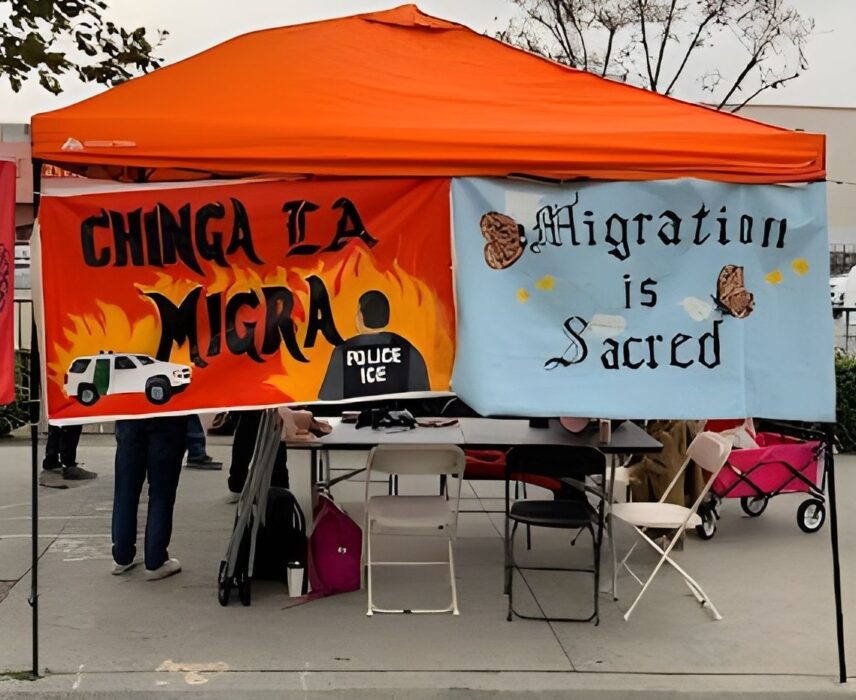
At the peak of the summer of 2025, the world watched in horror at what unfolded in Los Angeles. Federal immigration agencies arrested 4,310 people in Southern California alone between June and July. The Trump regime had started an ongoing campaign of terror that was to spread to cities like Washington, D.C., and Chicago. Through racial profiling sanctioned by the U.S. Supreme Court, these agencies unleashed operations to detain and deport Latine migrants, particularly those working in public spaces and living in poor neighborhoods. They followed a logic of racialized criminalization that required not only the state’s enforcement of its monopoly over violence but, simultaneously, the reification of migrant lives into an illegal object deserving of this violence.
The highly publicized persecution of migrants quickly became a source of fear for those communities most affected by the raids; however, for those not so vulnerable, such as citizens and English-speakers, it became a source of resistance. Despite suppression by federal forces and local police, the people of Los Angeles fought back. Yet, while the question of defending migrants was significant for many, some could not disentangle it from another: how can poor migrants, made hyper-vulnerable in this moment, also become politically engaged by it? In what follows, I explore the trajectory of a neighborhood committee affiliated with the L.A. Tenants Union (LATU). I pay special attention to their attempts at overcoming the challenges of migrant political engagement in this conjuncture.
Union de la 8: Tenant Organizing in the Barrios of L.A.
While in the field, I conducted most of my ethnographic research with the neighborhood committee “Union de la Ocho” (“8th Street United”). Founded in January 2023, the committee started as the tenant association of a 40-unit building undergoing displacement. The building is in Koreatown, a large, densely populated district in Central Los Angeles, famous for its Korean eateries, karaoke bars, and rapid gentrification. The latter has been primarily motivated by the 2008 Great Financial Crisis and the COVID-19 Pandemic, two events that enabled corporate landlords to purchase depreciating rental properties in state-abandoned urban peripheries.
Veronica lived in one such property, in a poor area of Koreatown near 8th Street known for its street vendors and Oaxacan businesses. I met her in early 2023, a couple of months after the tenant association was founded. Before Vero and her neighbors—all of them migrants from Mexico and Central America—organized, they were the target of harassment by their new landlord, K3 Holdings, a firm with a vast portfolio of recently acquired rentals in the city. After refusing an insignificant amount of cash to self-evict, Veronica and her neighbors received frequent visits from K3 staff who threatened them with calling immigration if they did not leave. Repairs soon stopped, and the building and its units rapidly deteriorated.
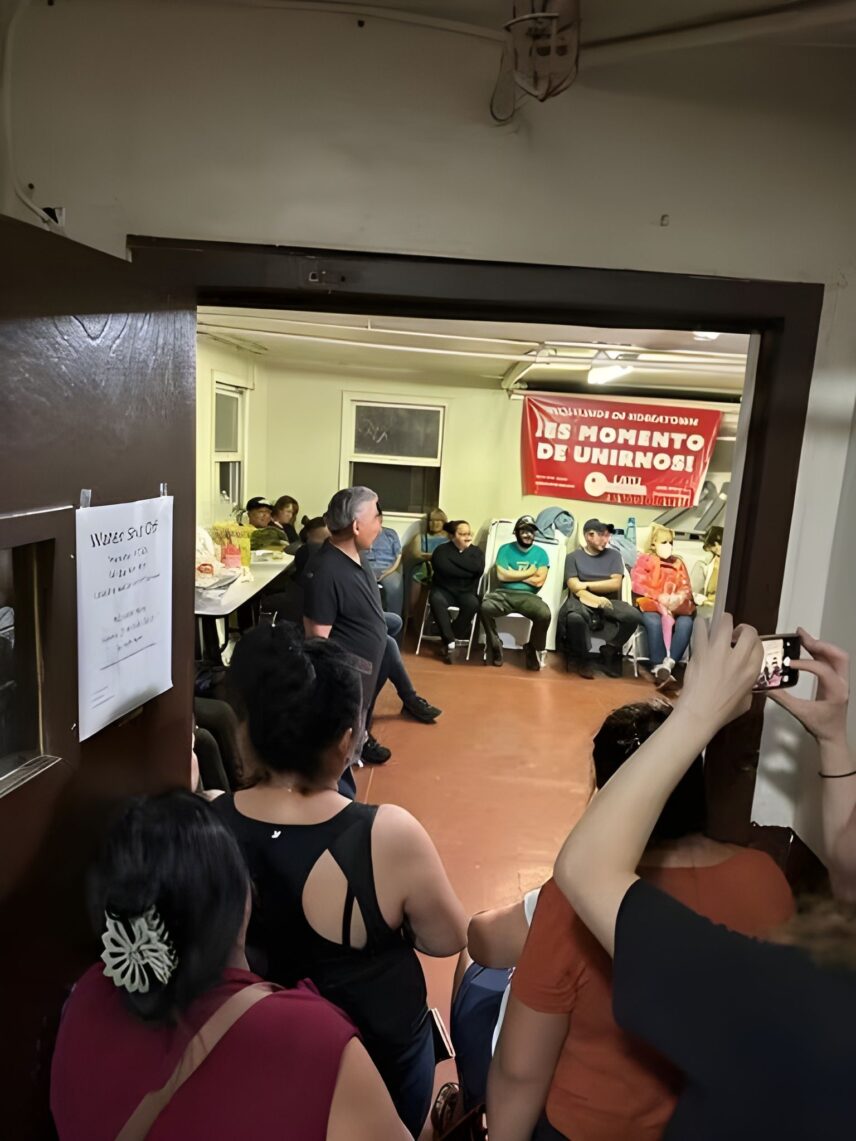
At Vero’s request, LATU organizers arrived at her building. There, they were received by representatives of every unit. Tenants and organizers had their first of many meetings in the building’s laundry room. Together, they ate Salvadoran pupusas, described and analyzed their problems, and hatched a plan to solve them. When organizers returned the following week, a K3-hired security guard stood by the building’s front door. He would not allow them entrance, yelling that they were trespassing on private property. The tenants came out to defend their guests, citing what they had learned a week before: their right to organize without retaliation. Their numbers easily overcame the guard. With this victory under their belt, the tenant association continued to pressure, deploying a range of tactics, from letters to collective confrontations with K3 managers. Gradually, the landlord conceded, the harassment stopped, and tenants’ homes received much-needed repairs.
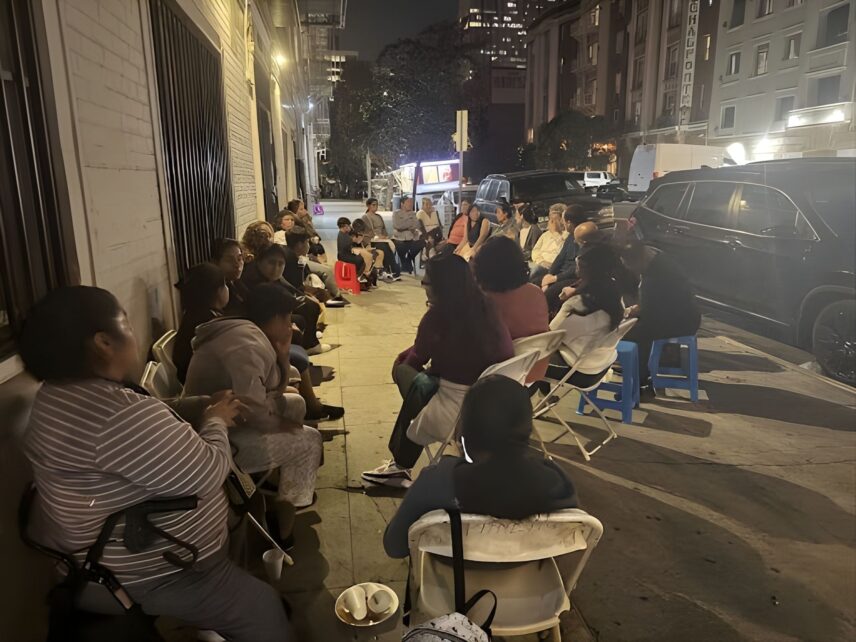
As new neighbors joined the group, members and organizers decided to form a committee that remained affiliated with LATU but sought to engage the community through its identification with the 8th Street neighborhood. “Union de la 8” continued to fight against displacement but now expanded this struggle from the home as housing to the home as a territory. The committee reclaimed its streets by putting together food distributions, fundraising parties, and street cleanings. They successfully contested development projects whose versions of community improvement excluded them, such as the opening of a luxury karaoke bar. Members also invited more neighbors to join in making their community a better place to live. By early 2025, Union de la 8 started holding some of its meetings on the street.
“Guerra Psicologica”: Confronting Trump’s Immigrant Object
Unfortunately, nothing had prepared us for what unfolded that summer. I remember the shift in the atmosphere of the meetings. Almost every week, our conversations started with something we had heard on the news or social media about Trump’s speeches or the raids across the city. Eventually, the committee decided to resume meetings in the laundry room. The risk of being in public was too big. Rosario, a new member who had helped her neighbor fight her eviction, cried during one of these meetings. She feared a bounty hunter might catch her while on her way to the Westside, where she cleaned houses. She had to go; otherwise, she would not be able to pay rent. Organizers often reminded the group of all the times we had overcome our fear of landlords’ authority. Yet the sense of powerlessness was overwhelming, as if the magnitude of this enemy could not be compared.
There was one meeting when Vero, Rosario, and others mentioned ads they’d watched on Univision, the most well-known Spanish TV channel in the US. Standing in front of several American flags, Secretary of Homeland Security Kristi Noem addressed not just the general viewer but specifically a migrant public:
“President Trump has a clear message: if you are here illegally, we will find you and deport you. You will never return. But if you leave now, you may have an opportunity to return and enjoy our freedom and live the American Dream… If you come here and break our laws, we will hunt you down. Criminals are not welcome in the United States.”
One of the members, Doña Alma, reacted with her characteristic wit, “You know what? From now on, I’m gonna go out with my suitcases ready. That way, if they catch me, the ride is free!” The room burst into laughter. Alma continued with a more serious tone, “They treat us like criminals. They want us to be afraid. But they’re the ones afraid, hiding behind that screen and all their goons.” Doña Alma recognized the military and mediatic forces from which these authoritative figures derived their power. This is what allowed them to objectify the heterogeneity of migrant lives into the reified figure of the criminal. From this vantage point, they could wage what another neighbor, Fermino, called a “psychological warfare” against migrants. As he put it, “Trump is a greedy entrepreneur. He knows what he’s doing. He spends some money on ICE, yes. But the real profit comes from our fear. Fear is cheap.” As much as the meetings allowed for a shared vulnerability, this was always entangled with moments of collective analysis.
La Misa Popular: Producing a New Immigrant Object
Committee members often noted that other neighbors were experiencing similar feelings but did not have a space, such as Union de la 8, to reflect together. Aware that many didn’t come to the meetings because they found it “useless”, members decided to organize something that would appeal to the community. The group set out to plan what they called a “Misa Popular” (“popular mass”). Everyone agreed that the intention of the Misa was twofold: 1) to honor the migrants detained and 2) to get migrant neighbors to come out of their homes and gather. In these two ways, “our community will confront the fear,” explained a member. It was not enough to reclaim the space, but to do so in confrontation with the moral panic surrounding Trump’s immigrant object. The Misa honored the lives objectified as criminal or, in other words, rendered possible a different objectification under which the undocumented immigrant is worthy of honor for their labor, life, and sacrifices.
With these two objectives in mind, the second major decision was to hold the Misa on the street. “We have to lead by example,” affirmed a member. They could not ask people to leave their homes if they were not willing to do the same. Thus, the group took things a step further and decided to resume their regular meetings on the street. Once together and back in the neighborhood’s public eye, committee members each offered to contribute food, drinks, images, decorations for the altar, and music. A group organized to clean the street the morning before the mass, while another prepared to deliver the readings during the mass.
Finally, all members agreed we needed to plan an outreach. A team of us canvassed around the neighborhood on two different occasions, while others got some flyers and shared them on their own time. I had the chance to hear the members explain to neighbors the two purposes of the mass, frequently sparking lengthy conversations about the plight of migrants and the importance of a public event like the Misa. Despite the seeming immediacy of these conversations, they were always already mediated by the object of the criminal immigrant. Here, however, this figure clashed with the articulation of a new immigrant object—one that confronts its fear, cares for each other, and unites in community.
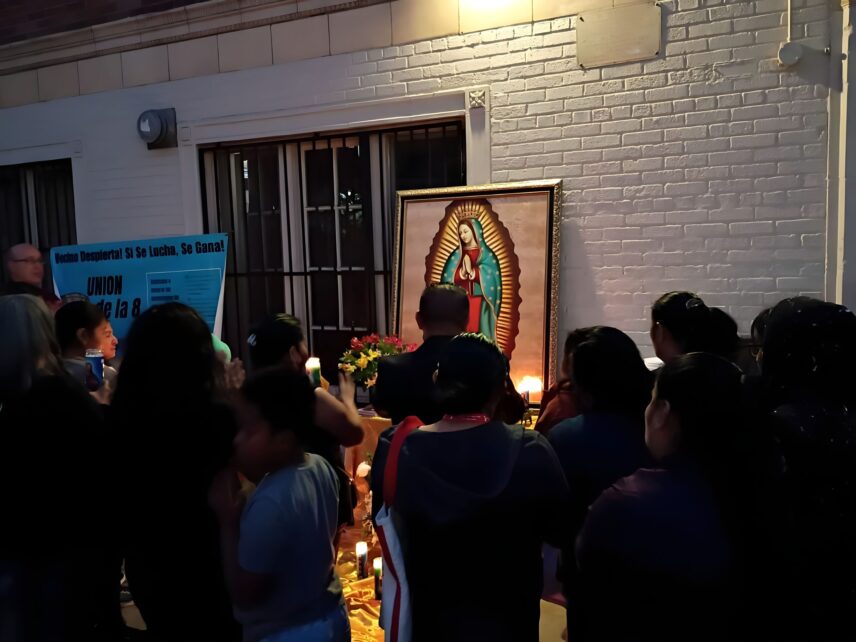
The Misa welcomed almost one hundred people to the committee’s street. More watched from their balconies and windows. Under the lights of tall candles and the image of the Guadalupana, members gave speeches and shared reflections on their experiences as migrants. They sought to inspire their audience to join the fight against their deportations and to not give in to the fear spread by the current American regime. In the face of this conjunctural interregnum, Union de la 8 offered an alternative immigrant object in discourse and in practice, while inviting people to join in its production.
Sergio Lemus and Jerry Hernandez are section contributing editors for the Association of Latina/o & Latinx Anthropologists.