

Article begins
“The first night, the kids just cried,” Priya told me. “They didn’t stop.”
We were speaking a few weeks after February 28, 2026, when the escalating US-Israel-Iran conflict reached UAE airspace and interceptor missiles broke across the sky above Abu Dhabi. A couple in their thirties, originally from the UK, Priya and Prashant had moved to the Emirates for work years earlier. For their children, the crisis was terrifying: loud emergency alerts, house-shaking explosions, all of them sleeping in one room. The questions were continuous. When can we go out to play? What was that noise? Mum, why are you scared?
“We couldn’t explain what was happening,” Priya said, “because we didn’t really know what to expect or when this would end ourselves.”
As strikes tripled and interceptions followed, the what-ifs multiplied. What if a missile got through? What if a drone struck their plane if they left? When would there be normalcy?
Prashant settled on a single word: “Uncertainty.”
That word shaped every worry. Most nights were sleepless; stepping outside was a calculation; the children were never out of sight. Prashant explained, “While everyone across the world kept living, we were thrown into memories of COVID—but this time a lockdown in which we felt more out of control.”
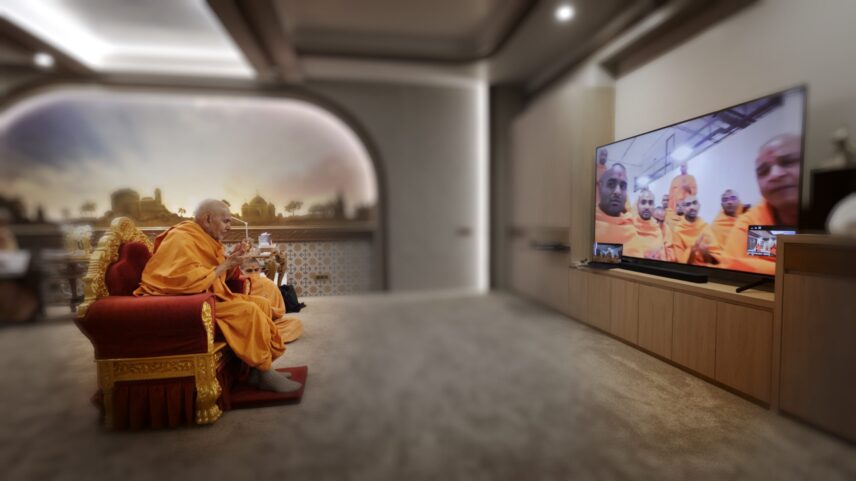
It was at that point, Priya told me, that the temple steadied them. Within days, the BAPS Hindu Mandir in Abu Dhabi, the Middle East’s most prominent Hindu temple, began organizing online gatherings for the congregation. Its swamis, ordained monks of the Swaminarayan tradition, led the effort. Families could log on, hear prayers, and see familiar faces. From India, Mahant Swami Maharaj, the tradition’s ninety-two-year-old guru, joined these assemblies. Pastoral calls followed, swamis checking on families individually. There were dedicated online sessions for children, with stories and devotional songs. From the mandir kitchen, hot meals were cooked and carried out to families across the city by volunteers.
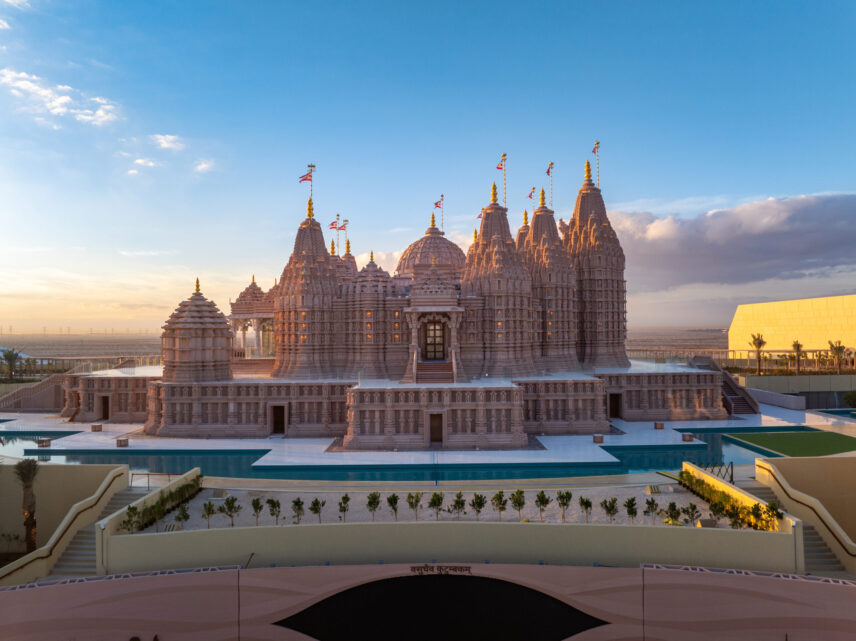
For Priya, these online assemblies became part of the rhythm of life under crisis. Mahant Swami Maharaj’s messages were “the highlight of the day” for her. Through him came “messages of faith, hope, and service,” bringing “a certainty that was welcome and positive amidst all the uncertainty and fear.” What mattered was not only the content but the steady repetition, arriving when little else felt dependable. In moments of collective rupture, spiritual leadership can function as an anchor of continuity, offering adherents a stable interpretive frame to absorb and endure disorder.
Prashant spoke especially about the children. The dedicated sessions steadied them in disorienting days. Priya added, “The swamis created a space just for them. It gave them something fun to look forward to every week, and honestly it gave me something too.” Their accounts do not describe the disappearance of uncertainty but the way it was interrupted. The calls with swamis, the daily prayers, and the language of faith created a different atmosphere inside the home, one in which fear remained, but was no longer quite so total.
I sat with these accounts for some time after the call ended. They pressed upon me a long-standing anthropological question: how people go about living when the familiar no longer holds. Anthropology often turns to moments of rupture to understand how people inhabit social worlds, make meaning, and sustain relations. War is one such moment. Across many settings, religion has been among the most recurrent ways people have responded, offering theological frames, ritual practices, and communal solidarities through which uncertainty can be faced. What drew my attention here was not simply religion’s place in how the family met the war, but the form it took under crisis, and what made it possible.
The family’s account gave me a view “from below”: what it felt like, inside the apartment, to stay in contact with the mandir. To see the same formation from the other side, I shifted the ethnographic lens toward the temple itself, to those initiating the contact.
When I joined Brahmaviharidas Swami, the head swami of the temple, on Zoom, he spoke from the basement. Behind him lay orange mattresses where the swamis had been sleeping for safety while the strikes continued. The setting spoke before he did. Temple life had been pushed underground.
The swamis had been due to fly to India for Holi, one of their key festivals and one of the few occasions they returned each year. “Everyone was looking forward to it,” he said. When I asked why they had decided not to go, Brahmaviharidas Swami said they had called Mahant Swami Maharaj. The guru, as he recalled it, affirmed what the swamis were already feeling: that they lived for the community, and their place in this moment was with it. They canceled their flights.
From this Zoom interview, the support Priya and Prashant described began to look different. Brahmaviharidas Swami laid it out step by step. Online assemblies had to be scheduled, announced, led. One-to-one calls drew on accumulated records of names, numbers, locations, and notes—who had children, who was elderly, who had been reached, who still needed reaching. The children’s sessions called for a different kind of care. He explained: “You cannot speak to children in the same way. They are feeling fear, asking questions. So we had to think carefully about what to say, and how to bring them joy too.” The same organized effort shaped the practical help. Meals had to be cooked, packed, and sent along routes across the Emirates, especially for members stranded in transit.
He also described what held the effort together. Daily meetings reviewed what had happened, what needed attention, and what had to be coordinated with civic authorities. Through it all, Mahant Swami Maharaj called constantly. “He called every day, two, three times,” Brahmaviharidas Swami said. “Sometimes at six in the morning, sometimes at eleven at night, even at ninety-two years old. His leadership and love kept us in good spirits to keep serving.” If the guru is conventionally associated with direction, here he was closer to a companion.
These details brought something into view: infrastructure. The certainty Priya spoke of, the children’s sessions, and the meals that traveled across the Emirates did not arise spontaneously or rest on goodwill alone. They rested on an institution with trained volunteers, established structures, and the capacity to act quickly under strain.
Infrastructure becomes most visible when strained. We notice water systems when pipes burst, grids when the power fails, transport networks when they stop. In ordinary time, these systems recede from view precisely because they function.
Religious infrastructure operates in the same way. The mandir’s physical facilities, including its kitchen, internet access, and meeting rooms, were already in place, as were its volunteer networks, communication channels, and lines of leadership, long before the missiles crossed the sky. The crisis did not generate these forms; it revealed them to me by placing them under pressure. What Priya and Prashant knew in peacetime through ordinary congregational life reappeared in wartime in altered form. The weekly mandir visit became regular online assemblies. The availability of swamis became one-to-one phone calls.
At the same time, this infrastructure was itself under strain. The mandir was closed to the public, the monks slept in the basement, volunteer capacity was reduced, the response unfolded in a conflict zone. Yet it continued to function, stretched and adapted.
The swamis understood this work through the language of sevā, service offered as part of devotional life. The idiom matters because it shows how the response was understood from within. “The mandir was shut, and we ourselves were under threat,” Brahmaviharidas Swami said. “But we were trying our best because of our sevā and our devotion to God and devotees.” For the swamis, sevā was not external to the infrastructure but the devotional logic through which it was activated and sustained.
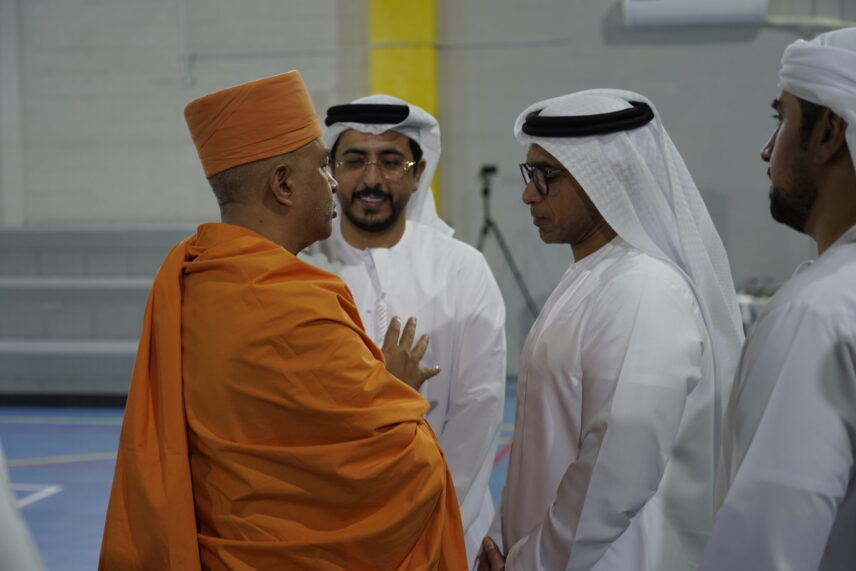
This infrastructure also extended beyond the immediate congregation. A family traveling from the US to India and stranded in Kuwait was located and helped onward through volunteers linked to the Abu Dhabi temple. Swamis visited worker housing compounds, speaking with people of different nationalities and faiths about fear, endurance, and mutual care. In a Muslim-majority country, a Hindu mandir was functioning as part of a wider social infrastructure whose reach exceeded its own religious boundaries.
Religion is often imagined as a matter of private belief or personal piety. Anthropology and history have shown, however, that religion also inhabits public and civic forms. What the Abu Dhabi case brings into focus is something further: the infrastructural dimension of religion. Under a secular gaze, databases, buildings, and leadership structures may look only administrative. But for the swamis and families, this infrastructure was not external to religiosity. The term “organized religion” has lost favor in recent decades, frequently associated with institutional rigidity or treated as a foil to more individualized forms of spirituality. Here, organization is intrinsic to faith: sevā requires structure to be enacted, and under conditions like these such structure materializes as religious life. The organizational form of the mandir was constitutive of religion as they lived it. Religion here operates as infrastructure: the organized, durable apparatus through which care was made possible.
What stays with me, ultimately, is not the mandir’s grandeur, nor the carved stone through which such places are usually seen, but the basement. While Priya and Prashant were trying to calm frightened children in their apartment, monks below ground were giving spiritual discourses, making home visits over video, leading children’s sessions, and coordinating the deliveries, and briefings through which the response moved. The war did not create that infrastructure. It made it visible.
Angie Heo is the section contributing editor for the Society for the Anthropology of Religion.