

Article begins
On June 19, 2022, newly elected President Gustavo Petro addressed thousands of followers in Bogotá who were celebrating his victory. This was the first time in modern Colombian history that a left-wing candidate had won the nation’s highest office. His victory came after years of corruption scandals, violence against environmental defenders and signatories of the peace accord, street protests, and growing discontent with previous center-right governments.
Backed by a range of Indigenous, Black, peasant and workers’ organizations, Petro and the vice-presidential candidate Francia Márquez—an acclaimed Afro-descendant environmental activist—emphasized throughout their campaign the need to reimagine the relation between nature, the economy, and Colombian society. Among other things, they promised to ban fracking, place a moratorium on new oil exploration contracts, and boost renewable energy production. During his speech that evening, Petro reaffirmed his intention of leveraging a “just energy transition” in the Americas and disentangling Latin American progressivism from its reliance on fossil fuels, a harmful legacy of the Pink Tide of the 2000s.
The wind rush
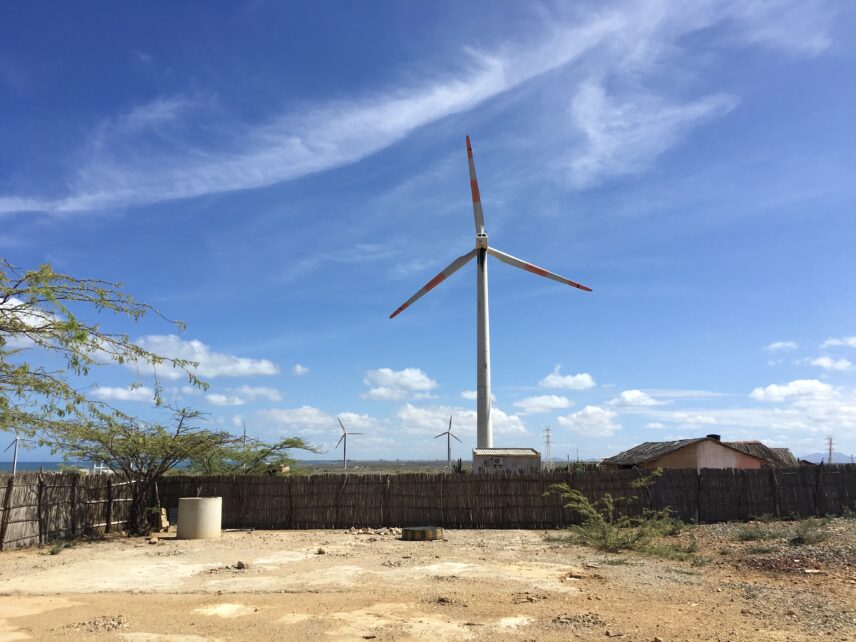
Colombia, despite its negligible carbon footprint, has suffered the effects of the coal and oil industries in profound though uneven ways. To break away from this legacy, Petro has envisioned a plan that depends heavily on the wind of La Guajira—a coastal region located in the northernmost tip of Colombia. This is one of the windiest places in South America and is also the ancestral territory of the Wayuu, the largest Indigenous people in Colombia and Venezuela (with a combined population of about 790,000).
The Wayuu are almost evenly split across urban and rural areas of the dry tropical forest that spans through most of La Guajira. Their main economic activities go from goat grazing, fishing, artisanal salt mining, small-scale agriculture to cross-border commerce and salaried jobs in the tourist industry, bureaucracy, and energy and mining companies. They speak Wayuunaiki and have about 30 matrilineal clans that shape their heavily decentralized political life. As dwellers of the poorest department in Colombia (with a poverty rate of 67 percent), the Wayuu have insufficient access to basic infrastructure, including electricity, as well as drinking water, food, and healthcare.
La Guajira has a layered history of natural resource extraction, from the colonial capture of pearls to recent coal mining and natural gas ventures. Undoubtedly, centuries of extractivism have left a painful mark on Wayuu land. Such undertakings have not just unleashed forms of dispossession and violence against Indigenous communities. They have also perpetuated the view that La Guajira is a sacrifice zone, whose main function is to provide natural resources for the rest of Colombia and the globe. Now, amid the urgency of the climate crisis and the vulnerability of the country’s hydropower network (which sustains 70 percent of the electricity demand), La Guajira has been assigned a new task: leading the country’s transition to renewable energy sources.
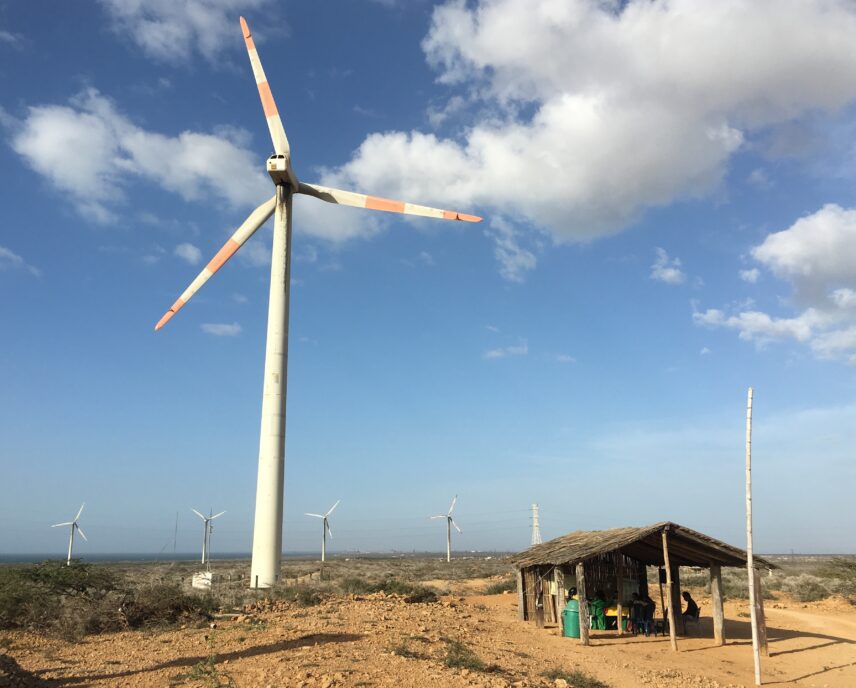
To capture this eolian “resource,” the previous government of Iván Duque (2018–2022) approved the construction of 16 wind farms in 2022, but another 41 are being planned. According to a report by the NGO INDEPAZ, the wind farms are backed by 19 national and transnational companies whose total investment amounts to six billion US dollars. Nearly all of the 2,500 wind turbines will sit on Wayuu land.
Colombia is not alone in its vigorous push for renewable energy. Latin America has been a world leader in low-carbon energy and, according to the International Energy Agency, wind power will likely generate between a quarter and a third of global energy by 2050. Yet what distinguishes the Colombian case is that most of the low-carbon infrastructure will occupy the Resguardo Indígena Wayuu de la Alta y Media Guajira, one of the largest Indigenous territories in that nation (with a little over one million hectares). While these spaces are collectively owned and cannot be privatized, the scale of the infrastructure, the corporate nature of the projects, and the sweeping indifference toward Indigenous transition agendas could trigger a new form of climate colonialism over the Wayuu’s territory and wind.
So far, the evidence is not encouraging. Human rights organizations have decried that prior consultations are being carried out hurriedly, without the adequate support from independent experts and under deeply unequal conditions (including an epidemic of child malnutrition). The wind rush has also brought about internal conflicts and physical violence. Wayuu families have experienced a spike in disputes over who deserves to have a seat at the table when negotiating with energy companies. Threats against Indigenous environmental defenders have also proliferated, while proposals have recently been put forth (so far unsuccessfully) to militarize Indigenous land to shield energy infrastructure.
Wind turbines are also entangled in other forms of environmental harm. The anticipated deforestation of tracts of the tropical dry forest will not only hamper biodiversity and disturb the penninsula’s mythical geography, but will likely affect pastoralist Wayuu communities and their valuable goat herds. The colossal turbines also portend other radical transformations to the landscape such as greater aural and visual pollution (e.g., flickering lights and shadows), affecting peoples’ sleep and the culturally meaningful practice of dreaming.
The rush has ignited collective forms of resistance, from stoppages that have paralyzed entire wind farms to everyday blockades of vehicles and company workers that operate in Wayuu land. The Guajira 1 Wind Farm, inaugurated in June 2022, was mired by protests from neighboring communities who accused ISAGEN—the owner—of excluding persons with legitimate territorial claims from the consultation meetings. In 2021, community members near the village of Wüimpeeshi also blocked the road that leads to the city of Uribia, demanding greater respect for the right to free, prior, and informed consent. Such conflicts underscore the tensions between global calls for decarbonization and the autonomy of Indigenous peoples.
Towards a just transition?
Unlike Duque, who pushed for regulations favorable to companies, Petro has proposed a transition “based on respecting nature, social justice, and sovereignty.” His plan contemplates democratizing energy resources and designing energy policy in tandem with impacted communities. Such a vision has, in principle, opened up the possibility of imagining the wind as a force that could bolster socio-environmental justice (rather than being anchored in green capitalism).
A first key promise stemming from his plan is to make communities partners or co-owners of energy infrastructure, a shift that is not insignificant. Currently, only one of the 57 future wind farms adheres to a community-owned business model (though it is years behind schedule). For all other ventures, companies simply offer payments to Wayuu communities for using their land and compensations for environmental damages. Thus, for some Wayuu organizations, co-ownership or partnership alternatives are an essential step for addressing the humanitarian emergency that ravages the peninsula, as well as for including Indigenous perspectives on climate justice in Colombia’s energy future. A second promise is to grant centrality, within the Ministry of Mines and Energy, to the lifeways, territoriality, and environmental ethics of the Wayuu, which are all too often dismissed.
One example of this kind of knowledge are the plural forms of relationality with the wind. For the Wayuu, the wind is not a monolithic force. Fisherpersons recognize at least eight types of wind, which have their distinct names, biographies, and agencies. They are multiple, ambiguous, and mobile nonhuman beings. The trade wind from the northeast, Jepirachi, is known to be a loving character, the father of Wayuu fisherpersons who ameliorates the tenacious heat of the long, dry months. Mythical stories narrate the romantic encounters between Jepirachi and the Kamaishi Hill. Other winds, such as Joutai (blowing from the east), are associated with famine and drought. A ruthless being, Joutai is responsible for driying up the soil, driving boats away from the coast, and depriving goats of their food.
Due to the ontological contrast between the plural winds of the Wayuu and the wind animating the renewable energy rush, the former have tended to be relegated to a subordinate role in debates about Colombia’s transition. Yet Petro’s plans could potentially alter this course and open the door for thinking more seriously about the place of Wayuu ontological politics and wind-centric sociality in a decarbonized future. If the wind is a multiple being endowed with subjectivity, what arrangements would be appropriate for wind farms to exist in a just way? If rivers, the Amazon, and other sentient beings have been declared subjects with rights in Colombia, why not the wind?
Petro’s transition agenda puts two key elements on the table: co-ownership of renewable infrastructure and an institutional disposition to grapple with Indigenous cultural, epistemic, and ontological worlds. While this has stirred some degree of optimism on the ground, there is still a long and uncertain road ahead.
An uncertain future
One of the looming challenges that risk derailing these plans are the numerous territorial conflicts that exist in La Guajira, a byproduct of decades of friction between Wayuu forms of territoriality and the politics of recognition of the Colombian state. Such tension is reflected in the disawoval of Wayuu ancestral cemeteries, one of the most decisive markers for organizing Indigenous land. Condensing a mesh of memories, migration stories, and kinship bonds that span multiple generations, cemeteries are essential for affirming which families have political authority over specific parts of the peninsula. Yet for decades the Colombian state has relied on other spatial criteria that disregard Wayuu norms and practices. Government agencies have recognized the authority of younger leaders whose power does not always stem from the geneaological relations crystallized in the cemeteries. As most energy companies adhere to state guidelines, this has escalated or sparked new internal conflicts among communities living near eolian infrastructure and could stymie future plans to turn the Wayuu into partners or co-owners of low-carbon developments.
A second barrier is related to the scant number of environmental protection measures for the nascent offshore projects (crucial for Petro’s plan), which are moving forward despite the concerns voiced by Wayuu coastal communities. While the sea is not legally part of the Indigenous resguardo (reservation), the Wayuu claim jurisdiction over this aquatic space and possess copious knowledge about marine beings, ecosystems, and submerged landscapes that could be threatened in the near future.
A third pressing issue is the opacity that still haunts the entire wind rush. Despite Petro’s ratification of the Escazú Agreement, which enshrines the right to access environmental information, public access to environmental impact studies is still highly restrictive (and not available in Wayuunaiki) and these documents continue to overlook Indigenous ways of knowing as they relate to land, the sea, and the wind.
One of the aims of a just transition is to reduce social inequalities. This is achieved by recognizing those human groups that have historically been affected or ignored by energy developments. Yet, despite the promising steps taken so far, many energy companies in Colombia continue to insist that Indigenous peoples are the obstacle standing in the way of the country’s decarbonized future. They also continue to perceive the wind of La Guajira as nothing but “cheap nature”: lacking subjectivity, sociality, and agency. Altering this course demands bringing to the fore the decolonial visions of decarbonization of people like the Wayuu, which go beyond both state and corporate desires.
Vientos Wayuu
El 19 de junio de 2022, el recién electo presidente Gustavo Petro se dirigió a los miles de seguidores en Bogotá que celebraban su victoria. Ésta era la primera vez en la historia moderna de Colombia que un candidato de izquierda ganaba el cargo más alto de la nación. Su victoria se produjo luego de años de escándalos de corrupción, violencia contra defensores ambientales y firmantes del acuerdo de paz, además de protestas callejeras y un creciente descontento hacia los gobiernos previos de centro y derecha.
Apoyado por un abanico de organizaciones indígenas, afrocolombianas, campesinas y de trabajadores, Petro y la candidata vicepresidencial Francia Márquez — una afamada activista ambiental afrodescendiente — enfatizaron a lo largo de su campaña la necesidad de reimaginar la relación entre la economía, la naturaleza y la sociedad colombiana. Entre otras cosas, prometieron prohibir el fracking, imponer una moratoria a nuevos contratos de exploración de petróleo e impulsar las energías renovables. Durante su discurso esa noche, Petro reafirmó su intención de apalancar una “transición energética justa” en las Américas y de desentrañar el progresismo latinoamericano de su dependencia de los combustibles fósiles, un legado pernicioso de la llamada Marea Roja de los años 2000.
La fiebre del viento
A pesar de su huella de carbono mínima, Colombia ha sufrido los embates de las industrias del carbón y el petróleo de manera profunda y desigual. Para romper con este legado, Petro ha diseñado un plan que depende en gran medida de los vientos de La Guajira, una región costera ubicada en el extremo norte de Colombia. Esta zona, una de las más ventosas de Sudamérica, es el territorio ancestral de los wayuu, el pueblo indígena más numeroso de Colombia y Venezuela (con una población combinada de alrededor de 790,000 personas).
La población wayuu está distribuida en proporciones casi iguales en áreas urbanas y rurales del bosque tropical seco que se extiende por la mayor parte de La Guajira. Sus principales actividades económicas van desde el pastoreo de chivos, la pesca, la extracción artesanal de sal, la agricultura de pequeña escala hasta el comercio transfronterizo y los trabajos asalariados en la industria turística, la burocracia y las empresas energéticas y mineras. Son hablantes del wayuunaiki y poseen alrededor de 30 clanes matrilineales que dan forma a una vida política fuertemente descentralizada. Como habitantes del departamento más pobre de Colombia (con una tasa de pobreza del 67 por ciento), los wayuu están profundamente excluidos del acceso a la infraestructura básica, incluyendo la electricidad, el agua potable, los alimentos y la atención médica.
La Guajira posee una compleja historia de extracción de recursos naturales, que va desde la captura colonial de perlas hasta los recientes megaproyectos de minería de carbón y gas natural. Sin duda, siglos de extractivismo han dejado una huella de dolor en el territorio wayuu. Tales emprendimientos no sólo han desatado formas de despojo y violencia contra la población indígena. También han perpetuado el imaginario de que La Guajira es una zona de sacrificio, cuya principal función es surtir de recursos naturales al resto de la sociedad colombiana y el mundo. Ahora, en medio de la urgencia por la crisis climática y la vulnerabilidad de la red hidroeléctrica (que cubre 70 por ciento de la demanda eléctrica nacional), a La Guajira le ha sido asignada una nueva tarea: encabezar la transición del país hacia fuentes renovables no convencionales.
Para aprovechar este “recurso”, el gobierno anterior, encabezado por Iván Duque (2018–2022), aprobó la construcción de 16 parques eólicos y existen otros 41 que están en fase de planeación. Según un informe de la ONG INDEPAZ, los nuevos parques eólicos son impulsados por 19 empresas nacionales y transnacionales, cuya inversión total asciende a 6 mil millones de dólares estadounidenses. Casi todos los 2,500 aerogeneradores estarán ubicados en tierra wayuu.
Colombia no es el único país que está impulsando vigorosamente las energías renovables. América Latina ha sido un líder mundial en energías con bajas emisiones de carbono y, según la Agencia Internacional de Energía, se estima que la energía eólica genere entre un cuarto y un tercio de toda la energía mundial para 2050. Sin embargo, lo que distingue al caso colombiano es que gran parte de la infraestructura “verde” se instalará en el Resguardo Indígena Wayuu de la Alta y Media Guajira, uno de los territorios indígenas más extensos de esa nación (de más de un millón de hectáreas). Si bien estos espacios son inalienables y de propiedad colectiva, el tamaño de la infraestructura, la naturaleza corporativa de los proyectos y la indiferencia generalizada ante propuestas indígenas sobre transición energética podrían desencadenar una nueva forma de colonialismo climático sobre el territorio y el viento de los wayuu.
Hasta ahora, la evidencia no es alentadora. Varias organizaciones de derechos humanos han denunciado que las consultas previas se están haciendo de forma precipitada, sin el debido acompañamiento de expertos independientes y en condiciones de profunda desigualdad (incluyendo una epidemia de desnutrición infantil). La fiebre del viento también ha provocado conflictos internos y violencia física. Las familias wayuu han experimentado un aumento en las disputas sobre quién merece ser incluido o no en la interlocución con las empresas. Las amenazas contra defensores ambientales indígenas también se han elevado, al tiempo que se ha propuesto militarizar fracciones del territorio indígena para custodiar infraestructura eólica (un esfuerzo que hasta ahora ha sido infructuoso).
Además, los aerogeneradores están implicados en otras formas de daño ambiental. La deforestación prevista de segmentos del bosque tropical seco de La Guajira, que se pronostica como un efecto de la presencia de esta infraestructura, no sólo menoscabaría la biodiversidad y perturbaría la geografía mítica de la península, sino que afectaría a las comunidades de pastores wayuu y sus valiosos rebaños de chivos. Las colosales turbinas también auguran transformaciones radicales al paisaje con una mayor contaminación sonora y visual (por ejemplo, a través de luces y sombras parpadeantes), afectando la práctica de soñar, que tienen significancia cultural para los wayuu.
La fiebre del viento ha dado lugar a formas colectivas de resistencia, desde paros que han detenido parques eólicos enteros hasta bloqueos cotidianos a vehículos y trabajadores de las empresas que operan en el territorio wayuu. El parque eólico Guajira 1, inaugurado en junio 2022, estuvo permeado por protestas de comunidades vecinas, que acusaron a ISAGEN – la empresa propietaria – de excluir de las reuniones de consulta a personas con derechos territoriales legítimos. En 2021, en el corregimiento de Wüimpeeshi, miembros de la comunidad también bloquearon la vía que conduce a la ciudad de Uribia, exigiendo mayor respeto al derecho al consentimiento libre, previo e informado. Tales conflictos subrayan las tensiones entre los llamados globales a la descarbonización y la autonomía de los pueblos indígenas.
¿Hacia una transición energética justa?
A diferencia de Duque, quien impulsó un marco regulatorio favorable a las empresas, Petro ha propuesto una transición “basada en el respeto a la naturaleza, la justicia social y la soberanía.” Su plan contempla la democratización del acceso a los recursos energéticos y el diseño de la política energética en conjunto con las comunidades que serán afectadas. Tal visión ha abierto, en principio, la posibilidad de pensar el viento como una fuerza que podría robustecer la justicia socioambiental (en lugar de estar anclado en el capitalismo verde).
Una primera promesa derivada de su plan es convertir a las comunidades en socios o copropietarios de la infraestructura energética, un cambio que no es menor. Actualmente, sólo uno de los 57 futuros parques eólicos se adhiere a un modelo de negocio de propiedad comunitaria (aunque lleva años de retraso). Para todos los demás, las empresas simplemente ofrecen pagos a las comunidades wayuu por el uso de la tierra y compensaciones por daños ambientales. Por esta razón, para algunas organizaciones wayuu, alternativas como la copropiedad o asociación son un paso imprescindible no sólo para atender la emergencia humanitaria que asola a la península, sino también para incluir perspectivas indígenas sobre justicia climática en el futuro energético de Colombia. Una segunda promesa consiste en otorgar mayor protagonismo, dentro del Ministerio de Minas y Energía, a las concepciones culturales sobre la vida, la territorialidad y la ética ambiental de los wayuu, las cuales suelen ignorarse.
Un ejemplo de esta clase de conocimiento son las formas plurales de relacionalidad con el viento. Para los wayuu, el viento no es una fuerza monolítica. Los pescadores reconocen al menos 8 tipos de viento que poseen nombres, biografías e intenciones diversas. Se trata de seres no humanos múltiples, ambiguos y móviles. Por ejemplo, el viento alisio del nordeste, Jepirachi, es conocido por ser un personaje amoroso: el padre de los pescadores wayuu, que refresca el calor tenaz de los meses secos. Los relatos mitológicos narran los numerosos encuentros románticos entre Jepirachi y el cerro Kamaishi. Otros vientos, como Joutai (que sopla desde el este), están asociados con el hambre y la sequía. Joutai es un ser despiadado, responsable de secar el suelo, alejar a las lanchas de la costa y privar a los chivos de su alimento.
Debido al contraste ontológico entre los vientos plurales de los wayuu y el viento que anima la bonanza eólica, los primeros han sido invisibilizados en los diálogos sobre la transición energética en Colombia. Sin embargo, los planes de Petro podrían alterar este curso y abrir la puerta a la política ontológica wayuu y sus formas de relacionarse con el viento en un futuro descarbonizado. Si el viento es un ser plural dotado de subjetividad, ¿qué tipo de acuerdos serían apropiados para que los parques eólicos existan de manera justa? Si los ríos, la Amazonía y otros seres sintientes han sido declarados sujetos de derechos en Colombia, ¿por qué no el viento?
Los planes para la transición de Petro ponen sobre la mesa dos aspectos cardinales: la copropriedad de la infraestructura energética y el llamado a reconocer institucionalmente los mundos culturales, epistémicos y ontológicos de los pueblos indígenas. Si bien esto ha generado cierto optimismo, todavía queda un camino largo por recorrer.
Un futuro incierto
Un desafío inminente que puede descarrilar estos planes es la gama de conflictos territoriales que existen en La Guajira, una consecuencia de décadas de incongruencia entre las formas de territorialidad wayuu y los criterios de ordenamiento espacial del estado colombiano. Tal tensión se refleja en la falta de reconocimiento de los cementerios ancestrales wayuu, uno de los marcadores más importantes para la organización de este territorio indígena. Al condensar una mezcla de memorias, historias de migración y lazos intergeneracionales de parentesco, los cementerios son esenciales para demostrar qué familias tienen autoridad política sobre partes específicas de la península. Sin embargo, durante décadas, el estado colombiano ha utilizado otros criterios espaciales que ignoran las normas y prácticas wayuu. Ha reconocido, por ejemplo, la autoridad de líderes jóvenes cuyo poder no siempre deriva de las relaciones genealógicas cristalizadas en los cementerios. Como la mayoría de las empresas eólicas se adhieren a las pautas estatales, esto ha intensificado conflictos internos o provocado nuevos en las comunidades aledañas a la infraestructura eólica y podría menoscabar los planes futuros de convertir a los wayuu en socios o copropietarios de los proyectos.
Una segunda barrera está relacionada con el escaso número de medidas de protección ambiental para los nuevos proyectos costa afuera (cruciales para el plan de Petro), que avanzan a pesar de las preocupaciones expresadas por las comunidades costeras. Si bien el mar no forma parte del resguardo indígena legalmente, los wayuu han exigido el reconocimiento de su jurisdicción sobre este espacio acuático y poseen un conocimiento exhaustivo sobre seres marinos, ecosistemas y paisajes sumergidos que podrían verse amenazados en un futuro cercano.
Un tercer asunto apremiante es la opacidad que aún acecha la bonanza eólica. A pesar de que Petro ratificó el Acuerdo de Escazú, que consagra el derecho a la información ambiental, el acceso público a los estudios de impacto ambiental sigue siendo muy restrictivo, incluyendo el hecho que rara vez suelen estar disponibles en wayuunaiki. Estos documentos, además, siguen restándole importancia a las formas indígenas de conocimiento vinculadas a la tierra, el mar y el viento.
Uno de los propósitos de la transición energética justa es reducir las desigualdades sociales. Esto se logra reconociendo a aquellos grupos humanos que han sido históricamente afectados o ignorados por los desarrollos energéticos. Sin embargo, y a pesar de los pasos prometedores que se han tomado hasta ahora, muchas empresas de energía en Colombia continúan insistiendo en que los pueblos indígenas son la principal traba para el futuro descarbonizado del país. También siguen considerando al viento de La Guajira como una “naturaleza barata”: desprovista de subjetividad, vida social y agencia. Alterar este rumbo amerita poner en primer plano las visiones decoloniales de la descarbonización de grupos como los wayuu, que transcienden las aspiraciones estatales y empresariales.
Weildler Guerra Curvelo es un destacado antropólogo wayuu y ganador del Premio Nacional de Cultura y Colombiano Ejemplar. Ha escrito extensamente sobre ontología, ley y territorialidad wayuu. Actualmente enseña en la Universidad del Norte en Barranquilla, Colombia.
Steven Schwartz es profesor asistente de antropología en Colorado College, EE.UU. Su investigación rastrea las formas en que las energías renovables transforman las relaciones ambientales, las prácticas de resistencia y la vida política y económica de las comunidades wayuu en La Guajira, Colombia.