

Article begins
As I neared the end of my doctoral degree in early 2025, celebration felt inappropriate. News of federal attacks on research programs and withdrawn funding streams occupied conversation at the center for humanities where my graduate fellowship would soon expire. That year, my doctoral program went into indefinite abeyance. Of the fourteen full-time faculty employed by the anthropology department when I started my degree six years prior, only seven remained. Absent justifiable proof of marketability that determines university budget allocations, the department did not receive new hiring lines to fill these vacancies. Instead, non-tenure-track faculty had their contracts terminated after decades of service. I graduated with a limited network of support, into a desiccated job market.
The myth of academic meritocracy has long been critiqued for obscuring realities of precarity and un(der)employment that more accurately reflect the career futures experienced by the majority of anthropology PhDs. After seven years spent studying queer organizing and sharpening skills specific to this discipline, I was confronted with a sense of my utter disposability. It only worsened as months passed and I continued to receive automated rejection letters citing the hundreds of applications mine fell among. When I asked tenured faculty to keep me in mind for any opportunities, they often replied “I’ll add you to the list.” I sought advice through career readiness workshops, mentor programs, and hired a job coach—they all told me similarly to cut my losses and just find any work. Most gender justice nonprofits are being defunded too, I was told in informational interviews, making it nearly impossible to change careers, which is what my CV would suggest I was doing.
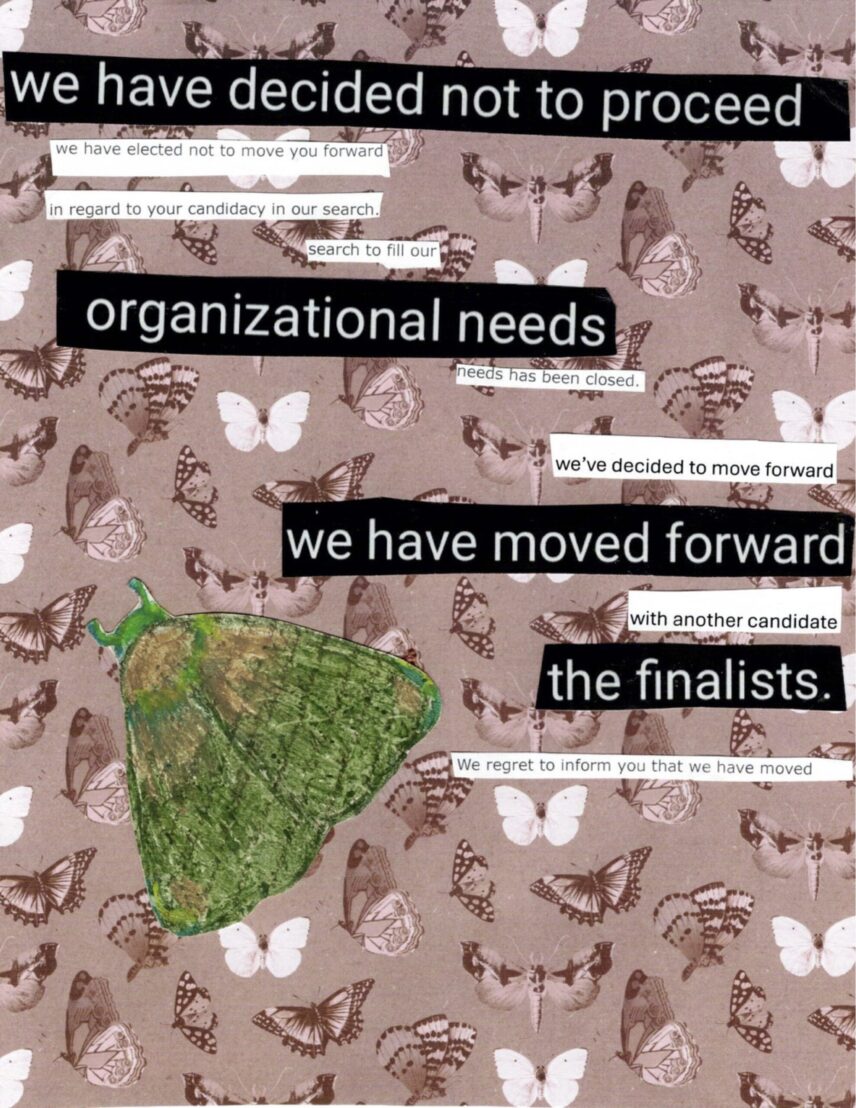
What happens to a queer anthropologist at a time like this? Upon securing a contract to teach an evening class at a local university, I was added to a listserv with 37 other adjunct faculty employed by the sociology and anthropology department. When I interviewed for the position, my research interests were tangential to my obvious ability to teach an introductory class, and so went unaddressed. My data grew old and untouched as I managed multiple courses and onboarding packets, applied for parking passes while looking for additional part-time work. I spoke with my peers about their post-doctoral decisions to seek out university administration roles to stay connected with students, or prepare to leave the country post-graduation, anticipating their inability to obtain the requisite employment for visa renewal. We shared our remorse, not just for our career futures, but for our research on gendered urban mobility, Muslim feminisms, and trans kinships that would effectively conclude with our graduation ceremonies.
A sense of deviant failure haunts my indefinite precarious un(der)employment, one seeded by meritocratic mythos of academic work ethics and common doctoral emphasis on demonstrable CV outcomes over learning processes. Success is said to come to some lucky few because they are uniquely hard-working, but the ability to achieve the outputs required for employment in such an acutely competitive and undermined job market are dictated by intersecting structural dis/advantages of race, class, gender, ability, and more. Scholars who study these arrangements of power are also often those who are most affected by them. As their projects are excised from the discipline, so too are those whose lived realities depend upon and motivate their investigation. The impact is both personal and political.
While recent acts of censorship present more immediate foreclosures, they also accelerate longer-term trends of precarity, adjunctification, and unemployment—material conditions that increasingly constrain academic livelihoods and therefore possibilities for knowledge production. Beyond direct bans on subject matter, a soft silencing occurs as early-career scholars face hiring markets characterized by striking scarcity, where topics of gender and race are eradicated from job listings and their desired specializations. Our research programs and careers are defunded before they can even begin.
Perhaps this moment of foreclosure incites a transformation, where we are forced to take back the means of our own knowledge production. The circumstances certainly make it clear that, at least for now, queer anthropology will not be a way to make a living. I wonder with hope, what might we make instead?