

Article begins
We write at a moment when the violence of war is reverberating across regions, institutions, and everyday life. Ongoing wars in the Middle East have laid bare the genocidal tendencies of both global and regional powers. In Gaza, Israel’s ongoing assault—enabled and sustained by Western military and financial support—has involved the systematic destruction of the conditions of life, forcing us to confront a genocide unfolding before our eyes. At the same time, escalating attacks against Iran expose the violence and persistence of imperialist domination and control. While these developments are sometimes cast as a so-called clash of civilizations, they more forcefully reveal violent struggles over the restructuring of global relations of domination and political economy. These are not isolated crises. They are bound up with authoritarian forms of rule, expanding border and policing regimes, the rise of the far right, and the intensification of racial and nationalist projects across the globe. Simultaneously, these developments are inseparable from transformations in political economy. We are witnessing the emergence of new and aggressive forms of capital accumulation, the reorganization of labor, and deepening inequalities—all of which are shaping how violence is distributed and experienced. The growing dominance of digital capitalism and monopolistic control over communication infrastructures reconfigure how value is produced, extracted and captured. These dynamics are intensified by shifts in labor regimes, increasingly marked by informality, migration, racialization, and the erosion of social protections. These transformations place increasing pressure on households, communities, and already strained infrastructures of care. In this sense, violence is not only enacted through war or repression, but also through the slow and uneven processes by which populations are rendered disposable, exploitable, and differentially exposed to risk.
Our editorial work begins from this intersection of spectacular military violence and the slower violences of political-economic restructuring. Over the two years that we will co-edit the APLA section of Anthropology News, we are interested in contributions that engage the contemporary conjuncture of war, governance, and political economy. This includes analyses of ongoing conflicts in the Middle East and beyond, as well as their everyday reverberations—how the violence of war seeps into daily life and shapes lived experience in both expected and unexpected ways. Attending to these diffuse and enduring forms of violence also directs our attention to how war-like logics are extended and routinized through institutions of governance. Alongside the spectacular forms of violence that wars expose us to, we are therefore interested in work that examines the expanding reach of border-, carceral-, and enforcement-regimes, including new policing practices and the criminalization of migration across different contexts. At the same time, we would like to incorporate contributions that situate these dynamics within broader transformations in political economy, including shifting labor regimes, welfare restructuring, housing crises, and contemporary forms of accumulation, from extractive industries to digital capitalism and financialization.
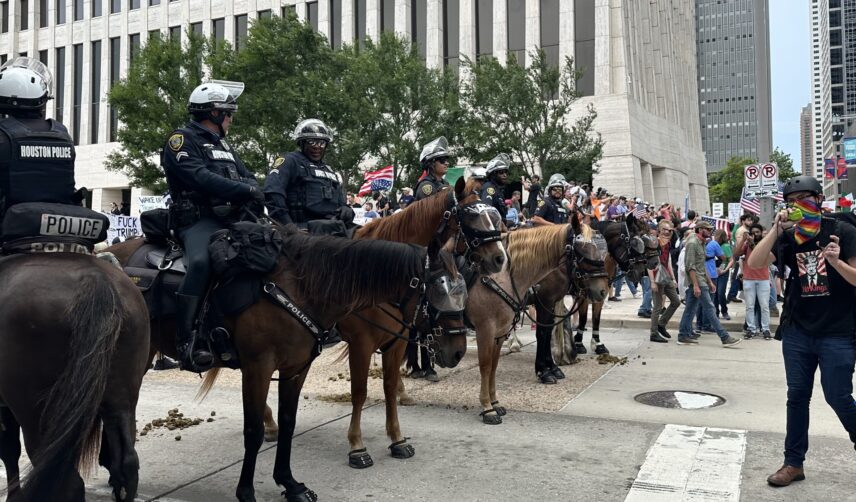
If this moment is marked by intensifying violence and precarity, it is also one in which diverse forms of mobilization emerge. Across different sites, we see migrant justice organizing, labor struggles, mobilizations against genocide, and a wide range of grassroots efforts that seek to contest, rework, or endure within existing political, economic and legal orders. We are particularly interested in contributions that attend to these practices not as simple resistance to violence, but as forms of collective life and prefigurative politics that take shape within and in response to the very conditions that make them necessary.
Our Vision for the APLA Section
Given the profound and interconnected challenges around the globe, it becomes even more crucial to foster platforms for deep anthropological engagement and collaborative scholarship. Collaboration stands as the cornerstone of our vision for the Association for Political and Legal Anthropology (APLA) Section within Anthropology News (AN). This emphasis is partly driven by the editorial direction of AN. Each of the 38 sections of the American Anthropological Association (AAA) is allocated space to contribute to each quarterly issue. When all these articles are combined, they show how broad and deep anthropology is, adding rich, scholarly-backed stories to AN. It’s wonderful to see all the different sections contribute to this shared storytelling.
This collaborative framework, which brings diverse anthropological insights to the forefront, has been powerfully shaped by the work of our predecessors, Taras Fedirko and Whitney Russell. We would like to thank the former editors for showcasing anthropology’s ability to illuminate complex global issues, focusing on the human impact of toxic development, climate change, and urban fraud. These works also delved into the complexities of technoscientific futures, the ethics of investigation, political contestation of natural resources, and how communities build trust and navigate contested spaces during conflict. Each piece showcased anthropology’s power to illuminate contemporary challenges across various regional contexts. Our aim is to honor the legacy of fostering scholarly innovation and inclusion that has been passed down to us. We plan to do this by collaborating closely with authors on their submitted work, helping them refine their research to spark the most compelling and expansive conversations for the future.
Publishing in AN is a great way for APLA members to translate their research for a wider audience and join this collaborative effort. We also encourage writing on themes relevant to current events to encourage readers to see the impact of anthropology beyond the academy.
Forms of Writing
With those themes in mind, we are keen on publishing a variety of engaging formats, and we believe that compelling and visually impactful stories are key to making anthropology even more accessible and understandable to the public.
To achieve this, we invite section members to develop compelling pieces such as stories, photo essays, or interviews. These should be grounded in interesting research, fieldwork experiences, current events, career advice, or hot topics relevant to APLA’s interests. We’re here to work with authors to develop these pieces effectively.
Following the AN editor’s guidelines, here are the specific forms of writing we hope to publish:
- Story: This is a short-form exploration of a compelling topic, offering both detail and depth. Submissions should be up to 1,600 words (not including captions or image descriptions) and include one to three visually compelling images.
- Photo Essay: This format features six to eight high-quality, visually compelling images, accompanied by up to 750 words of introductory text.
- Interview: We are looking for conversations up to 1,600 words. The goal is to create truly engaging, first-person dialogues on important issues.
If you are interested in any of these formats, please reach out to us with a brief proposal so that we can guide your submission.
We are incredibly excited to continue this collaborative journey to make APLA’s anthropological insights vibrant and accessible to a wider public. We eagerly await your compelling stories, photo essays, and interviews, and look forward to working with you to spark engaging conversations for the future.