

Article begins
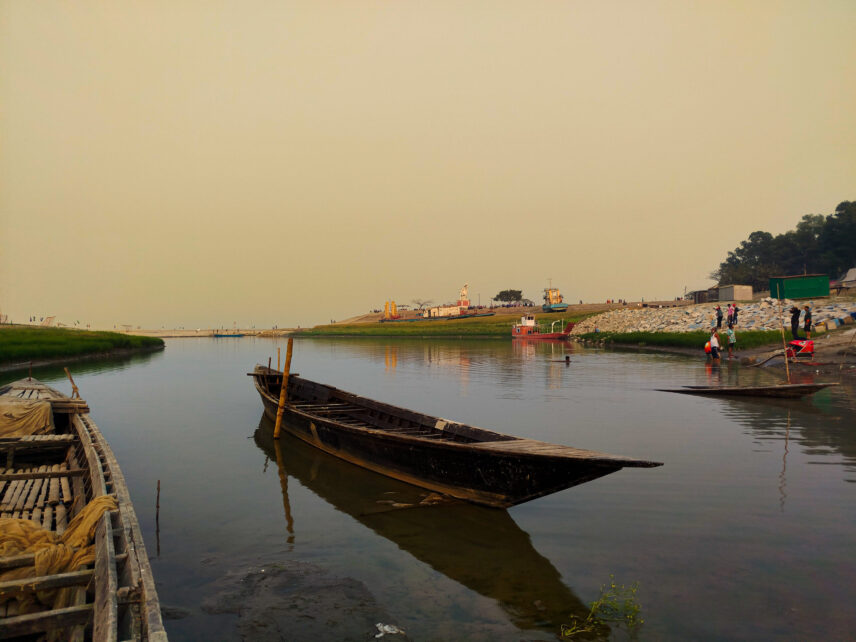
Rivers in their largeness only came into view in the twenty-first century with the rise of satellite technology. While there is no one definition of large rivers, it is clear that they unfurl over tremendous distances, traversing territories, crossing boundaries, while gathering many environments to themselves. So it is with the river known as the Yarlung Tsangpo in Tibet, the Siang/Dihang in the disputed state of Arunachal Pradesh claimed by both China and India, the Brahmaputra in India, and the Jamuna in Bangladesh. In fact, the Tsangpo in Tibet and the Brahmaputra-Jamuna in India and Bangladesh were only recognized as the same river as late as in the nineteenth century.
The source of the river is the Tibetan Plateau, often called the “Third Pole,” the largest freshwater reserve outside the polar regions, providing the water resources for several billion people in East, South and Southeast Asia. In addition to serving as a conduit for this much needed water, the river transports considerable sedimentation, the product of earthquakes past as well as ongoing erosion upstream, which help with replenishing the deltaic region downstream. And, this river with its many names traverses some of the most geopolitically fraught terrain in the world, with 1600 km in Tibet, 900 km in India, and the remaining 400 km in Bangladesh.
In this short contribution, we juxtapose the river’s upstream and downstream segments, with a specific focus on China and Bangladesh, with India looking both up and down the river, to illuminate how the control over the river flow varies by location. Those in the upper reaches of the river exert greatest control, engaging in competitive power play through their infrastructural projects. Those at the lower, who are intrinsically in the weaker position, strategically deploy their weakness to stay the powers at play. Upstream the river is viewed as the next frontier in China’s massive hydropower sector, with India competing to keep up. On the downstream reaches of the river in Bangladesh, key concerns include flooding and erosion, both of which threaten the lives and livelihoods of precarious people. It necessitates their anxious orientation to the political games afoot upstream. We end by speculating on how the challenges posed by climate change may affect this somewhat frozen tableau, if it does at all.
Upstream / China-India
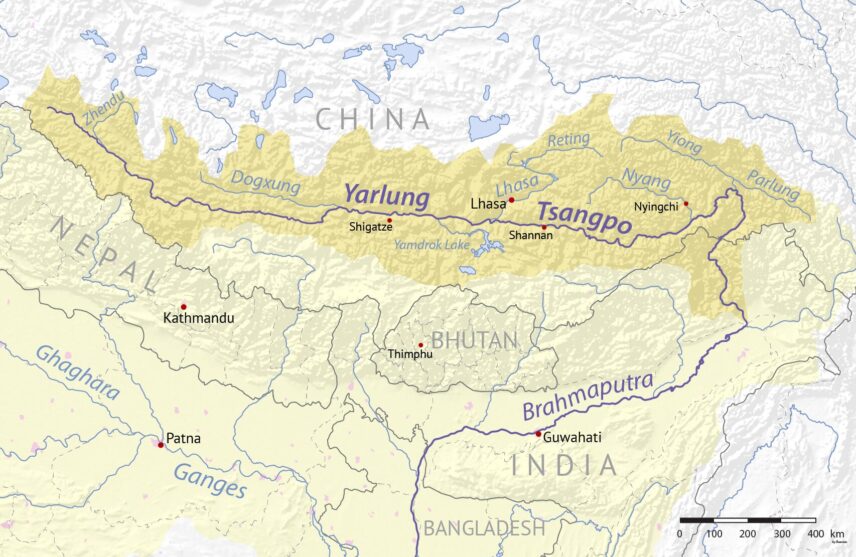
The upper reach of the river, the Yarlung Tsangpo, originates in the glaciers of southwestern Tibet, flows more than 1,500 km almost due east through arid steppe, cutting through the world’s deepest river gorge, before turning southwest through the Indian states of Arunachal Pradesh and Assam, where it is known as the Brahmaputra.
In China, water engineering projects have been part of the state agenda since early dynastic times, as a mechanism for economic development, a desire for ecological control, and a symbol of national power. India, too, has a history of state-sponsored irrigation and flood-control projects stretching back several thousand years. In the twenty-first century, as China’s hydropower sector has matured with the construction of dams at nearly every feasible site in its mountainous southwest region, government officials and hydropower corporations have looked westward to the Yarlung Tsangpo. Two axes of control are particularly important for China when it comes to regulating the Yarlung Tsangpo for strategic advantage: material control and discursive control.
In terms of material control, China’s enormous hydropower sector, by far the largest in the world, represents a key arena in which the competing rationalities of economic development, energy production, biological conservation, social welfare, and geopolitics collide. On the Yarlung Tsangpo (China) and Brahmaputra (India), more than 300 hydropower projects are in various stages of planning, making it the world’s most important site of future dam development. Several dams have already been completed on the Chinese side of the border, and officials recently approved plans for the massive, 60-gigawatt Medog Dam (called Motuo Dam in Chinese), spurring the Indian government to announce its own plans for hydropower expansion in the region. Among the dams already completed by India are the Rangadani Dam in Arunchal Pradesh, Ranjit III Dam located in the Indian protectorate of Sikkim, and Karbi Langpi Dam in Assam, suggesting active dam-making for energy generation, irrigation and drinking water supply.
Chinese hydropower development in this region is also linked to ethnic and geopolitical control over Tibet’s territory and its citizens; a new dam project on the Jinsha River (the upper reaches of the Yangzte, located east of the Yarlung Tsangpo) sparked public protests in 2024 over population displacement and loss of cultural heritage. Sparse media coverage and tight government control over information make it difficult to assess the outcome of these protests. For its neighbors, the most obvious effect of this form of river regulation is to alter the river’s hydrograph (its flow rate over time), with substantial impacts on the environment of northeast India, which is considered a biodiversity hotspot, and on the fishing and farming livelihoods of people in India and Bangladesh alike.
Along the axis of discursive control, China has sought to regulate the flow of information and the narrative about how the Brahmaputra should be managed, despite the existence of several bilateral agreements with India. (Poor data-sharing is a symptom of tense relations between the world’s two most populous nations, which have escalated to the point of active border disputes several times in this region). All riparian states rely on timely data regarding flow management, storage, and flood control, but Indian officials have been particularly concerned about data-sharing since floods on the Brahmaputra in 2017 caused widespread damage in the state of Assam. Indian officials worry too about the potential to divert flow from the river, affecting the northeastern states of India, Arunachal Pradesh and Assam. No plans currently exist for such a project, but these fears are not unfounded. China is known for massive inter-basin transfer schemes such as the South-North Water Transfer Project, the eastern and central portions of which have sent vast amounts of water from the Yangtze River to comparatively water-scarce regions in northern China since 2014.
Downstream/ Bangladesh
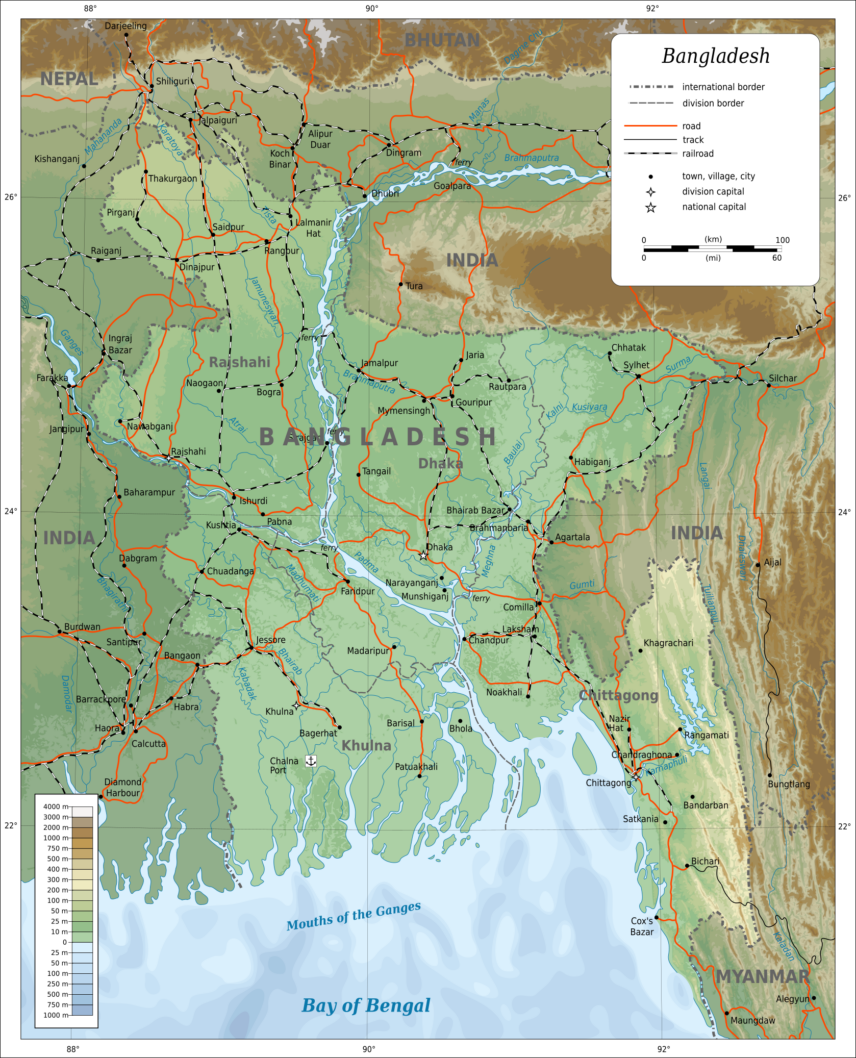
The fact that the Jamuna River in Bangladesh is most often referred as the Brahmaputra-Jamuna suggests that they are structurally the same along this segment. The Brahmaputra-Jamuna changes from its designation as a meandering river to being a braided one on the Assam Plains before entering Bangladesh in the north. In Bangladesh, the Teesta tributary draining the Himalayas feeds into the Brahmaputra-Jamuna, which then merges with the Ganges-Padma and the Meghna Rivers to feed into the Bay of Bengal through the country’s southern coast.
The river shows its largest tendency to flood in the Assam Plains downwards, with floods ranging in severity and temporality, characterized as the 100-year flood, 25-year flood and 2.5-year flood. The damage by floods and attendant erosion to life and property has increased over the course of the twentieth century due to the growth of settlements in the natural areas of water retention within the floodplains, along with efforts at river training by first British colonial administrators and later postcolonial authorities. Encouraged by foreign funders of national development, the Bangladesh state’s orientation remains in favor of river training and flood control through the building of embankments to secure banks once and for all, while those living alongside rivers have long adopted to changing bank lines and the philosophy of living with floods.
While Bangladeshis have learned to live with the river, they were not quite prepared for the floods that devastated the country in August 2024. The elderly who were affected claimed that they hadn’t experienced such floods their entire lives. The country had just gone through a revolution in its politics, with the 15-year autocratic government of Sheikh Hasina toppled by a student-led mass movement. Just as the interim government, composed of academics, activists and policy wonks, was figuring out what it meant to lead a country, it was faced with flooding in the northeastern and southeastern parts of Bangladesh impacting 6 million people, with 70 fatalities. The flooding may be chalked up to the Brahmaputra-Jamuna waters overspilling the banks. However, it was clear that the Dumboor Hydroelectric Plant, built upstream in Tripura by India, had opened, leading to a precipitous increase in the volume of water in the Brahmaputra-Jamuna. India took no responsibility for this disaster, claiming that the release of water was the outcome of their system’s automatic response due to pressure build up. Commentators maintained that the action indicated India’s withdrawal of support of Bangladesh at the loss of its preferred leader for the country, who had long been under its control.
In August 2024, Syeda Rizwana Hasan, the advisor newly entrusted with the environmental affairs of Bangladesh, openly criticized India for not providing advance warning of the opening of the gates. She charged India with not complying with an agreement to this effect. And even if there was no agreement, she suggested that surely international law dictated that countries not harm others, that they come to the aid of others. However, her tone was much muted by July 2025 when at a public gathering to launch a new digital platform for flood forecasting and warning, she simply stated that countries upstream leave Bangladesh unprotected for floods. She made a single mention of the fact that India continued to give a mere two hours warning before opening its floodgate. Instead she reiterated the need for Bangladesh to have real-time data if it was to be alone responsible for its fate. And she took upon the country the sole responsibility for putting in place an effective emergency warning system and plans for the evacuation and rehabilitation of those impacted. There was no talk of a multilateral agreement on water sharing as in the nature of other such agreements in the region and elsewhere. This seemed to not exist as a possibility, possibly given the stalled talks between India and Bangladesh over the sharing of the Teesta waters, a discussion ongoing since 1947. Advance warning and data sharing were the most of what Bangladesh could hope to get from upstream countries. But it was noteworthy that this event took place in the Bangladesh-China Friendship Conference Center. Newly built to mark a renewal of bilateral relations between the two countries, the location suggested that Bangladesh may be circumventing those in control of the midsection of the river to speak to those in control of its headwaters.
In Closing
Looking to the future, climate change is an important variable regarding fluidity and control in the Himalayan region. It will undoubtedly add glacial melting plus greater variability in precipitation to the enormous river system from its headwaters in Tibet to the delta in Bangladesh. We warrant such climate-influenced physical dynamism may introduce political dynamism into the tableau of the three, frozen in their respective gestures of competition and deference. The national security of each nation is becoming more reliant upon providing assurances of water security for drinking, irrigation, and municipal uses. Unpredictability in river flows raises questions about the long-term feasibility of hydropower and water security throughout the Himalayan region. Given this situation, the three may attempt to capture as much of the river for their own national interests as they can, or they may come to the bargaining table to build institutional capacity through river basin organizations, treaties, and similar mechanisms. Either way, this large and unquiet river will continue to shape the region’s ecology and inhabitants in consequential ways.
Taras Fedirko and Whitney Russell are section contributing editors for the Association for Political and Legal Anthropology.