

Article begins
A District under Air Pollution
In the early 2000s, my daily minibus commute between my village and high school in the Söke district of Aydın Province, western Turkey, was often interrupted by smoke and dust emitted from the chimneys of a cement factory. Built in the 1950s at the district’s entrance along the main road to the village, the factory had long emitted pollutants that obscured views of the mountain range opposite it. Sometimes cloaked in greenery and at other times adorned with a small waterfall gently cascading over the stones, the range seemed to be suffering from the smoke. I am not sure whether it was the pollution or the public cemetery near the foothills of the mountain that made me think of death and disease during my commutes.
The cement factory was adjacent to an organized industrial zone, established in 1996, where factories now produce cement, aerated concrete, energy (biomass), plastics, textiles, ceramics, paper, agricultural technologies (including machinery, seeds, and organic and chemical fertilizers), fish feed, pharmaceuticals, packaging, and dairy products. Residents in the district long complained about smoke, dust, strong odors, and wastewater discharge from the factories, and expressed concerns about deaths from cancer and upper-respiratory conditions caused by pollution in their everyday conversations, on social media, and in local news. But their concerns intensified with the establishment of a paper mill in the zone in 2021, following the cement factory’s increased production in 2017. The paper mill was promoted as “the largest in Europe,” offering jobs to local families, contributing to the national economy by reducing imports and increasing exports, and providing environmental benefits through recycled paper production. However, even prior to its establishment, residents met with representatives of the mill to ask questions and share their concerns, and environmental organizations and local branches of national political parties came together to discuss with the public the mill’s potential contribution to pollution. They also collected signatures in an effort to stop its construction. Along with the factory’s impact on human health, another prominent question was how nearby agricultural lands would be affected—particularly given the risks of excessive groundwater extraction and pollution of the Meander (Menderes) River, a vital source of irrigation that has already suffered from drought and industrial waste.
While some advocated for the paper mill and the industrial zone, saying that it would provide income for local families, others saw the mill as the climax of air and water pollution. Having witnessed the devastating environmental and socioeconomic consequences of mines and geothermal energy plants in the neighboring districts, and having heard complaints of air pollution in another city caused by a paper mill owned by the same company, residents have sought to make pollution, especially air pollution, visible and hold those responsible for it accountable. However, as I discuss below, this effort requires encountering or moving between various visibilities and invisibilities of air pollution.
Making Air Pollution (In)visible?
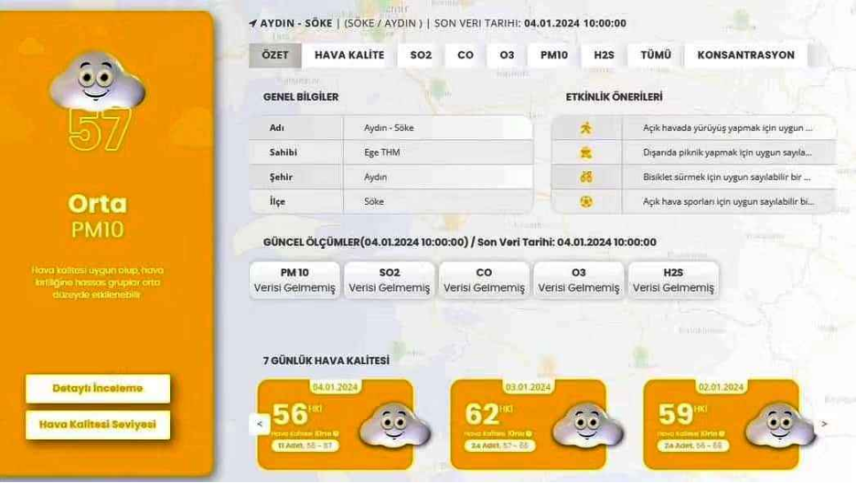
In the 2020s, as the residents complained about the smoke, dust, and odor, especially during the summer or during windy weather, local newspapers ran headlines such as “Pollution in Söke is at a dangerous level” or “What is polluting the air?” occasionally accompanied by comments from the scientists. Yet, in January 2024, some local newspapers shared a social media post from the organized industrial zone announcing good news about air pollution. The post reported, “According to the data obtained from the Air Monitoring Station located in the district of Söke on 04.01.2024 at 10:00 AM, the air quality is at a moderate level, with PM10 (particulate matter) identified as the main pollutant. Especially during the winter months, PM10 levels tend to increase in residential areas where coal and fuel oil are used for heating,” and included the image in Figure 2.
For nearly two decades, the Turkish Ministry of Environment, Urbanization, and Climate Change (MEUCC) has been measuring air quality through stations located across the country and sharing the data with the public via their online platform. Since 2008, as part of Turkey’s (currently frozen) European Union accession process, the stations have been measuring particulate matter (e.g., PM10, referring to particulate matter smaller than 10 microns in the air), as well as nitrogen oxides, ozone, carbon monoxide, among others. While resident complaints usually focused on observable matter, such as smoke, smells, and dust, the zone measured particulate matter, especially PM10, to make air pollution/quality “visible.”
However, the publicly accessible air quality data here serves not only to make the pollution visible but also to constitute the zone as “legitimate, safe, efficient, and cost-effective, and so on” in the eyes of the public. With the visual and quantitative data showing moderate-level air pollution, the zone aimed to contribute to easing or deflecting the residents’ criticisms. Moreover, we know that datafication in general, as well as the datafication of air pollution, in particular, “valorizes some points of view and silences others.” While in the MEUCC’s Air Quality Bulletin of 2024, PM10 is expected to be sourced from “factories, power plants, incineration facilities, construction activities, fires, and wind,” the zone’s post suggested the use of coal and fuel oil for heating as the reason for the moderate level of pollution, rather than emissions from the industrial zone.
In response to such “affective and aesthetic work” of air pollution data, some communities may turn to their own monitoring technologies to collect data and measure air pollution. However, in Turkey, using the same data from the official stations with cautions about its reliability, the Right to Clean Air Platform has been publishing an annual “Dark Report,” highlighting the rise in air pollution in Aydın and across the country. Based on the average PM10 levels in 2023, the report ranked Aydın as the fifth most polluted province in the country. Besides these efforts, in the comments beneath the post by the zone, the residents expressed distrust in the data from the stations. They believed that the “real” pollution they were breathing every day originated from the industrial zone and/or the cement factory, but was not captured by official measurements and thus remained invisible.
By asserting that the zone and the cement factory, located amid residential and agricultural areas, are “killing life” in the district, the comments legitimize distrust of official data through various explanations. One post pointed to the broader political context, where the citizens have widespread suspicions about the accuracy of inflation and other official statistics released by state institutions (e.g., the Turkish Statistical Institute). Some also considered the potential publicly alleged clientelist ties between the zone, factory owners, and state officials as a reason for keeping air pollution data at moderate levels. Other comments pointed out that the monitoring station was located in a neighborhood where residents had already switched from coal and fuel to natural gas, thereby refuting the blame placed on them for the pollution. Even in the past, when people primarily used coal and fuel for heating, air pollution was not as much of an issue as it is today.
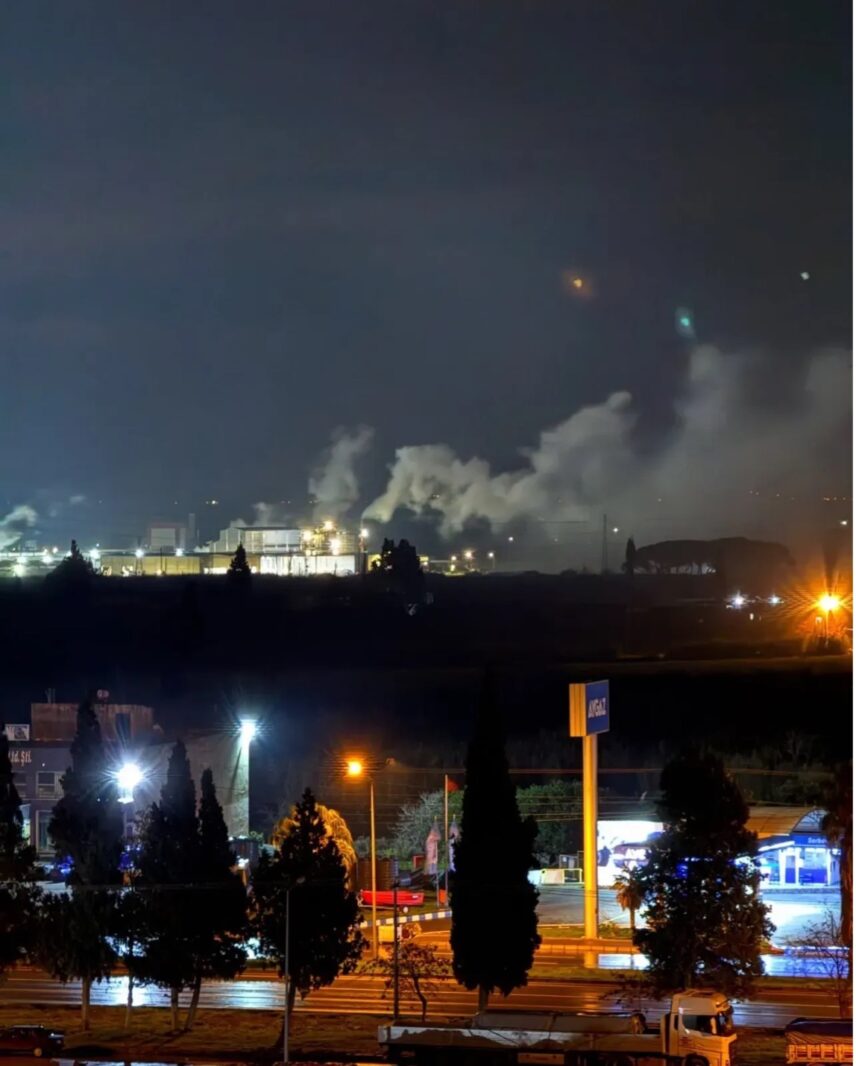
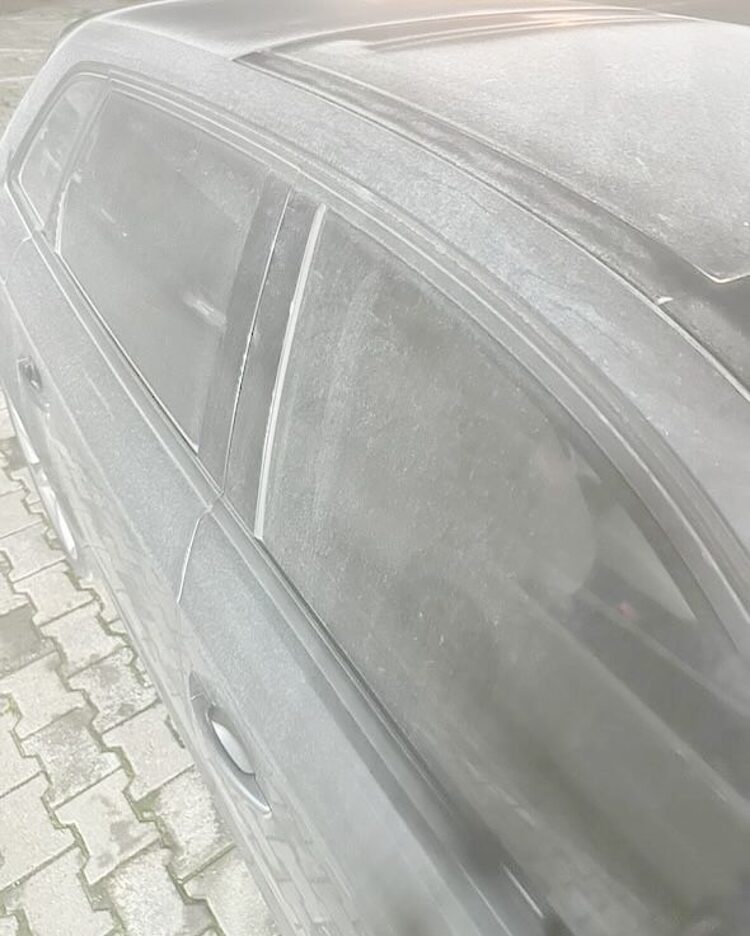
Instead of quantified data, the social media comments underlined embodied experiences of air pollution to make it visible. For instance, residents as well as local newspapers’ social media accounts have pointed to bird’s-eye night photos showing the district blanketed in smoke, alleging that the factories are turning off filters at the night to save costs. As a result, residents are having trouble breathing. A rotten smell lingering in the air also prevents them from opening their windows or enjoying fresh air on their balcony. Moreover, their cars, house windows, and balconies are covered with a sticky residue, forming layers on these surfaces, particularly every morning. The residents believe this is a mixture of dust, ash, and smoke emitted from the factories. Some even note water alone is not enough to clean it off; vinegar, other chemicals, patience, and effort are required. They see this sticky layer as tangible “real data” about the air quality, contradicting claims of “moderate air quality.” Now, they worry about what kinds of diseases they might have, since their lungs have already been exposed to these substances.
However, making air pollution visible is not the only strategy evident in these critiques. Two days after the organized industrial zone’s post, a local news outlet’s social media account shared several aerial “instant” photos showing smoke blanketing the district. Although the accompanying hashtags referred to “clouds” and “travel” rather than air pollution, residents again highlighted the poor air quality in the district in their comments. Some continued to emphasize the tangible signs of pollution, urging others to file complaints with state institutions—particularly MEUCC—or to take to the streets in protest. Others, however, expressed a sense of hopelessness. One comment pinned by the author argued that efforts to make air pollution visible by talking about the residues on cars, balconies, and windows are important but ultimately insufficient, emphasizing the dangers of what remains invisible and intangible yet still inhaled. In fact, the intangible and unseen air pollution may be even more hazardous. Reading the comments, I recalled everyday conversations with my fellow villagers, who would often say, “Who knows (or God knows) what we are inhaling?” At the time, I didn’t fully understand why they focused on the unknown aspects of air pollution, especially when their embodied experiences were so evident and there was a growing emphasis on quantifying and visualizing pollution. But these comments made me see that the invisibility of air pollution is not only used by polluters as a means to shape “a new form of everyday perception and governance” among citizens. Nor is the desire to render pollution visible—through both quantified and unquantified means—the only response among those affected. Along with efforts to make the pollution visible—especially given the risks of manipulation through visible, quantified air pollution and other kinds of data produced by state institutions amid the escalating authoritarian tendencies—the residents leverage its invisibility to draw attention to the severity of the issue as well as urge people to take action.
What Is Next? More Data, More (In)visibility?
Reading social media posts, comments, and newspapers from Texas, where I currently am, and speaking with my parents on the phone, I have been anxiously watching the days-long fires that broke out a couple of times in the paper stockpiles at the paper mill in 2024 and 2025. Believed to have broken out due to negligence, the fires have worsened the smoke and ash in the district. In the meantime, complaints about the pollution have reached the Grand National Assembly through one of its members and the Presidential Communication Center (CİMER) via residents. In response, the Minister of Environment, Urbanization, and Climate Change has promised that funds were allocated for the wastewater treatment facility in the zone, while emissions were monitored regularly and administrative penalties were imposed on the factories found to be non-compliant with the regulations. While representatives of the cement factory publicly claimed that they were not responsible for the air pollution and “completely at ease with their conscience,” the Ministry increased the use of technologies for more data-driven visualization of air quality. A mobile air quality monitoring vehicle was sent to Söke to measure pollution levels over a two-and-a-half-month period. Expecting the results to be released within a month, a local news outlet’s social media account posed the question with a picture of the district under the smoke: “What do you think the outcome will be?” (Sonuçlar ne çıkacak dersiniz?). The question and comments hoping for “fair figures” connote some anticipation of manipulation. They show that the focus is more on anticipation than actual data measurements. It thus seems that even more data has not dispelled the existing distrust that air pollution might stay invisible between data.
I would like to thank Izem Aral for her valuable comments on the early draft, as well as the editorial team of Anthropology News.