

Article begins
Last month, while finalizing our forthcoming volume Anthropology and AI, my co-editors Lora Koycheva, Angela VandenBroek, and I found ourselves debating the AI Winters of the past, periods when artificial intelligence research faced skepticism and funding cuts. While we discussed anthropology’s engagement with these historical periods, I realized we were missing a more urgent parallel: anthropology itself is experiencing its own winter, driven by systematic displacement by positivist disciplines in an increasingly computational world. This competitive displacement has left academic programs and professional organizations vulnerable to political attacks and funding cuts, creating a crisis that demands strategic repositioning for long-term viability.
Mounting Pressures
The warning signs have been accumulating for years, but it was at the Society for Applied Anthropology (SfAA) annual meeting in Portland this past March that these long-standing concerns finally seemed to reach a tipping point. Conversations both inside sessions and in hallway encounters repeatedly returned to mounting departmental pressures and an existential sense of crisis.
Two months later, the American Anthropological Association (AAA) hosted an emergency town hall titled “Defending Anthropology: Strategies for Sustaining Our Departments.” Following the town hall, the AAA released an “Anthropology Department Crisis Toolkit,” while the American Anthropologist published a section in Volume 127, Issue 2, titled “Vital Topics Forum: Ethnographies of a Dying Discipline,” where scholars confronted the reality of a discipline facing significant challenges, confirming what the data already showed.
U.S. anthropology bachelor’s degrees declined by about 19% between 2013 and 2016, dropping from 11,270 to 9,135 students. By 2017, half of all anthropology departments graduated fewer than 13 majors annually. Further, only 21% of anthropology PhDs secure tenure-track positions, while fewer than 8% of all anthropology graduates find jobs within the field each year.
The U.S. Bureau of Labor and Statistics estimates only 8,700 employed anthropologists in the entire United States, far below anthropology’s annual degree production of undergraduate and graduate programs. These numbers help explain why anthropology consistently ranks among the worst-paying majors, with median starting salaries around $40,000.
The combination of declining enrollment, poor job prospects, and low salaries has made anthropology programs particularly vulnerable to elimination. Since 2010, numerous institutions have attempted to alter, reduce, or eliminate anthropology programs, including Howard University, Ithaca College, Illinois Wesleyan University, and UNC-Greensboro. And this attack isn’t only happening in the U.S. Anthropology departments around the world, including at the University of Western Australia, the University of Sheffield, and Goldsmiths University of London, have faced cuts or closure in recent years. These attempts to reshape the discipline represent more than budget cuts: they signal systematic questioning of anthropology’s institutional and societal value.
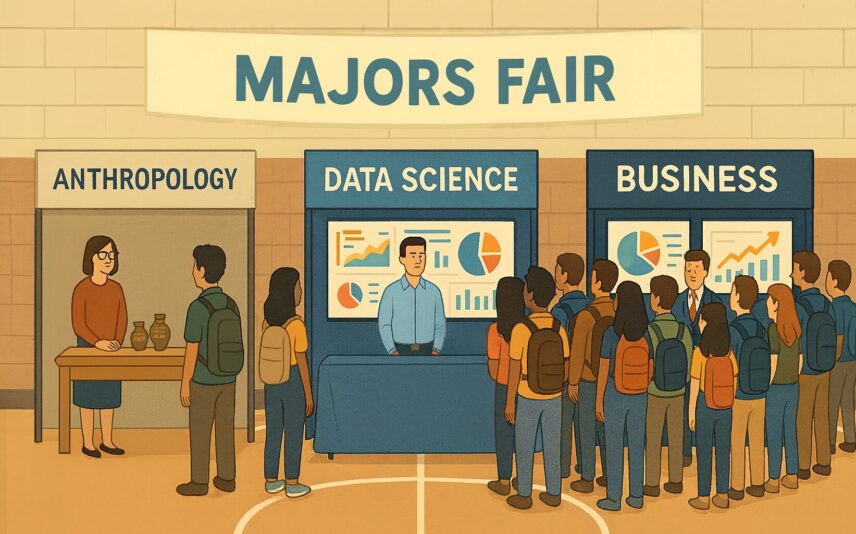
Meanwhile, fields like data science and business have captured anthropology’s traditional value propositions while offering dramatically better career prospects. Data science program completions increased by 700% between 2012 and 2021, while AACSB-accredited business schools enrolled over 660,000 master’s students in the 2023–24 academic year, representing a 30% rise over the past decade. These explosive enrollment trends translate into economic advantages: data scientist roles grew 339% from 2012 to 2021, with median salaries well above $100,000. MBA graduates command median starting salaries of around $120,000. By contrast, anthropology’s median starting salary remains around $40,000. These computational and business disciplines haven’t just claimed anthropological domains—they’ve made them far more lucrative and institutionally supported.
The Limits of Tactical Responses
The conversations and institutional responses emerging from SfAA and the AAA represent important and necessary work. The Crisis Toolkit offers valuable resources for departments facing immediate threats. Departments facing closure need template letters and legal guidance. Faculty confronting budget cuts benefit from advocacy networks and proven tactics. These efforts are necessary, but they are insufficient.
UNC-Greensboro’s closure illustrates this limitation perfectly. As Susan Andreatta and Keri Vacanti Brondo document in “But we met expectations! Why us?” UNCG faculty did everything right by traditional metrics, increasing enrollment 28%, securing external funding, and building community partnerships. The program was eliminated anyway.
Their analysis reveals why: fiscal austerity, outcomes-based funding, and culture-war optics combined to make anthropology “low-hanging fruit.” The program wasn’t cut for underperformance, but because anthropology no longer matched the university’s political-economic priorities. Under enrollment-driven funding and polarized politics, excising anthropology was the easiest way for administrators to appear fiscally responsible and culturally safe.
This highlights anthropology’s expendability compared to positivist disciplines. Universities seldom close business schools, computer science departments, or economics programs during budget crises because these are seen as essential to institutional survival and economic competitiveness.
The UNCG case demonstrates that tactical execution alone cannot overcome a fundamental positioning disadvantage. Long-term survival requires rethinking anthropology’s relationship to the systems reshaping society and the field’s willingness to engage with disciplines that now enjoy institutional protection through their perceived economic necessity.
A Framework for Strategy
Drawing on my time in higher education and 17 years as an entrepreneur and consultant, where I’ve guided organizations through strategic pivots in competitive markets, I suggest that U.S. anthropology programs could benefit not only from improved tactics but also from a winning strategy. And I don’t mean strategy in the colloquial sense, which is often used as a stand-in for a plan, or even framed as “strategies,” which are tactics. Nor do I mean a collection of good intentions, action lists, or aspirational statements that assume a program’s positioning remains viable.
Rather, I’d argue remaining a viable program or organization is less about creating documents filled with initiatives and feel-good statements and more about performance. Performance in this strategic sense means establishing a sustainable competitive advantage that delivers unique value that competitors (other programs and professional organizations) cannot easily replicate.
Strategy, then, is a theory of how to win. It requires an integrated set of choices that collectively create sustainable competitive advantage. It requires making tough decisions about where to compete and what to sacrifice in pursuit of winning, not so that others must lose in a zero-sum game, but so that organizations can establish a clear, defensible position that adds value and enables them to flourish.
Anthropologists may find this language troubling, and understandably so. The discipline has historically positioned itself in opposition to corporate logics, viewing market-based thinking as antithetical to humanistic values. This discomfort is understandable and, in many contexts, appropriate. However, this resistance to competition may be one factor in why the discipline is losing ground to other programs that embrace these realities more directly. Accordingly, the current crisis may require finding ways to productively engage with the institutions determining anthropology’s fate, given that they operate according to these logics. The choice isn’t between preserving anthropological values and thinking strategically—it’s between strategic positioning that creates space for our valuable work and principled resistance that risks eliminating that space entirely.
If anthropology programs hope to avoid the fate of UNC-Greensboro, they may need to move beyond tactical improvements such as increasing enrollment or renaming courses to fundamentally reposition themselves to deliver differentiated and indispensable value in a socio-political context that increasingly values computation and positivist approaches.
Programs seeking to develop such strategic positioning might benefit from established frameworks. Business strategist and former academic administrator Roger Martin, who helped turn the University of Toronto’s Rotman School of Management into an internationally recognized institution, developed a set of strategic questions designed to help organizations clarify their strategy and competitive positioning. The following questions are based on Martin’s framework, though slightly adapted for anthropology programs:
- What should this program’s aspirational goal be?
- Where should this program focus its efforts?
- How can this program create distinctive value?
- What capabilities does this program need to develop?
- How should this program organize itself professionally?
These questions represent just one possible framework for thinking about strategy, and many others exist. I draw on Martin’s framework here, given his experience developing a leading academic program. But I would encourage each program to work through these questions or other frameworks with their specific contexts and institutional realities in mind. A well-resourced R1 institution will face very different strategic choices than a regional university with limited resources, and both will differ from community colleges or liberal arts schools. The value lies not in following a particular framework or thinking that all programs need to do the same thing. Instead, each program needs to define its distinctive value by engaging critically with strategic choices about positioning and competitive advantage that make sense for its context.
The challenges facing anthropology programs need not spell the discipline’s demise. Like the AI Winters that preceded periods of remarkable innovation, such as the one we are in now, this Anthropology Winter may prove fertile ground for strategic renewal—but only if programs and professional organizations are willing to think strategically about their unique value proposition. The AAA meetings in New Orleans this November offer an ideal opportunity to begin this critical conversation.
Thanks to Lora Koycheva for her incisive feedback on this piece and for countless conversations about charting a different path forward for the discipline.