

Article begins
Boom bap-bap boom-bap.
The batucada drums struck our ears, pulling us into the room. Around 80 people packed into a patio in Bogotá, gathered for the rough-cut screening of a short film, Entre Luz, built from the testimonies of youth protesters who had lost their eyes to police bullets during Colombia’s 2021 national strike. The drumming, a style born in Brazilian streets, has since led millions in dozens of protests across Latin America.
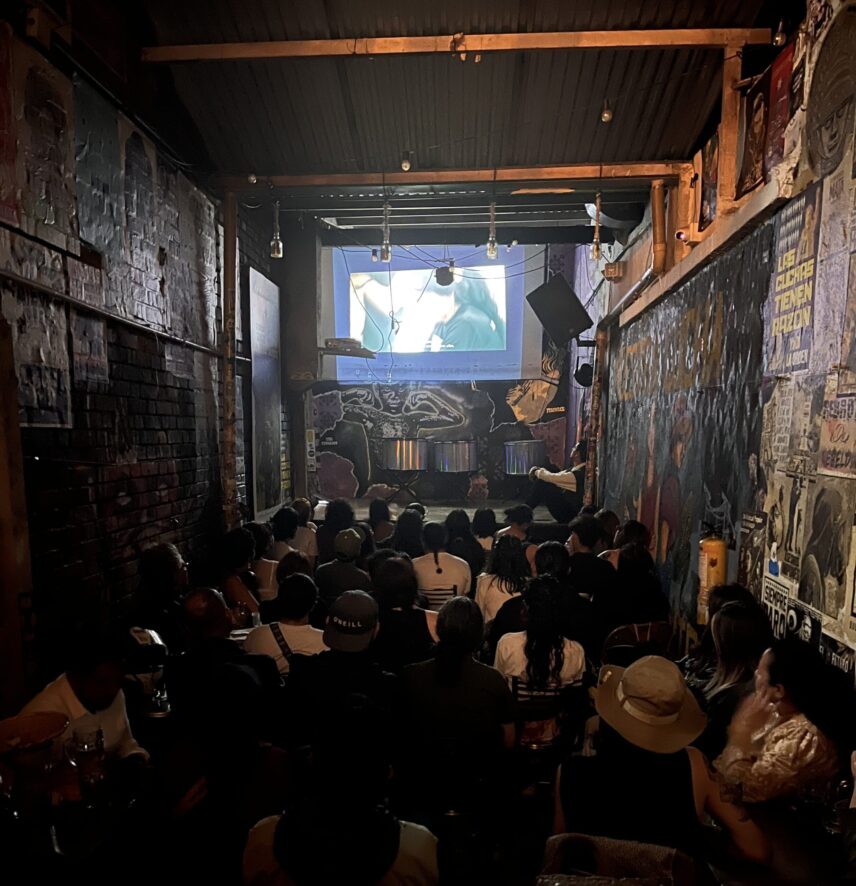
That morning, I had smiled when Mama Luna, leader of the community kitchens in Cali, texted me: “mami, ya estoy en camino,” (“honey, I’m on my way”). Streams of WhatsApp messages had gone out to everyone with a stake in the film: victims of ocular mutilation, supporters of the national strike, and members of the groups who participated in the film, such as MOCAO, Teatro Morfosis, Teatro Popular Quira, and Teatro la Candelaria. From those messages grew a full event. Batucada drumming. Testimonial rap. The co-director and sound designer were in town, along with two members of MOCAO from Pasto.
Cuban film director and screenwriter Julio García Espinosa’s call for an imperfect cinema insists that aesthetic flaws can be a sign of ethical rigor. A cinema that leaves the spectator unchanged is complicit with the structures it claims to critique. In our film and screening, the space was filled with creation outside our control: the raps, the speeches, the drumming, none of it was ours. That also made it speak to the Latin American feminist tradition of testimonio, or testimony, in which authorship is shared, situated, and relational, and in which personal narrative becomes a vessel for collective memory.
Entre Luz
The opening to the film, Entre Luz, weaves through the lush green mountains of el Valle del Cauca, set over testimonies and slow-motion video portraits of actors from Teatro Morfosis—a company made up of members of MOCAO, Teatro la Candelaria, and Teatro Popular Quira. This theater troupe was headed to perform Cuerpos en Resistencia, a testimonial theater performance about ocular mutilation by police shooting during protests in Colombia. News audio describing the national strike intruded like stray thoughts. We hear reporters recount the 2021 protests against neoliberal policies and police brutality before portraits of actors give way to archival footage of police confrontations in black and white.
The film turns to Cali, to the streets where the theater troupe held a performance denouncing the 2021 violence. Activists set up tables and printmaking stations. Women from several neighborhoods who had fed protestors during the national strike, dubbed “Madres comunitarias” (community mothers), chop vegetables for the communal stew.
Cristian, a police shooting survivor from Pasto, says, “They took my eye but not my strength to fight for my people.” As she ladles broth, Mama Luna exclaims, “We want justice! This was not just an uprising. It was a war where they killed our boys.” The screen darkens into a disorienting montage of the street performance: bodies crouching, miming throwing a stone, bracing for return fire, then a shot, then a slow pantomimed fall, then clawing back up to a furious, collective “¡Resistencia!”
The film ends with a reflection by Salome, a survivor from Bogotá, over murals of protestors shot in Cali: “Lucho por quienes ya no están.” (I fight for those who are no longer here.) The final scene features a dedication to Cristian Bastidas, Yury Camargo, and Esteban Mosquera, victims of ocular mutilation who lost their lives after the attack, and to all fallen comrades, from Colombia to Palestine.
Making the Film
I came to my research haunted by my own ghosts. Raised in the United States by a Colombian family with its own experience of police violence, I had come to the national strike and its aftermath through mourning. As part of my dissertation research on state violence and collective memory, I sat down with Juan Pablo, a MOCAO leader, for coffee. I proposed embroidery workshops as a way to tend to the dead, to make something with the hands that grief makes restless.
He listened, then shook his head. MOCAO had been wanting a film, he said. That was that. I called Gabriel, my co-director, to coordinate travel to Cali for the group’s upcoming performance. What began as a research visit became a documentary.
Haunting suffuses Colombian social movements. The movements have a chant for it, scratched on countless walls and recited at events, in which a crowd collectively evokes a fallen comrade: “¡Solo muero si ustedes van aflojando! ¡Porque el que murió peleando vive en cada compañero!” I only die if you all weaken your resolve, because whoever dies fighting lives on in each compañero. To hear dozens of people shout it together is to feel something shift. The dead are present not merely as memory but as a political force, guiding collective projects and keeping hope alive. To create a film within these movements meant attuning to that force, letting it shape decisions about what to linger on and what to carry forward.
Since it was both Gabriel’s and my first time directing a film, we brought an amateurness that turned out to be an opening. It made us genuinely dependent on the people the film aimed to serve.
Back to the Screening
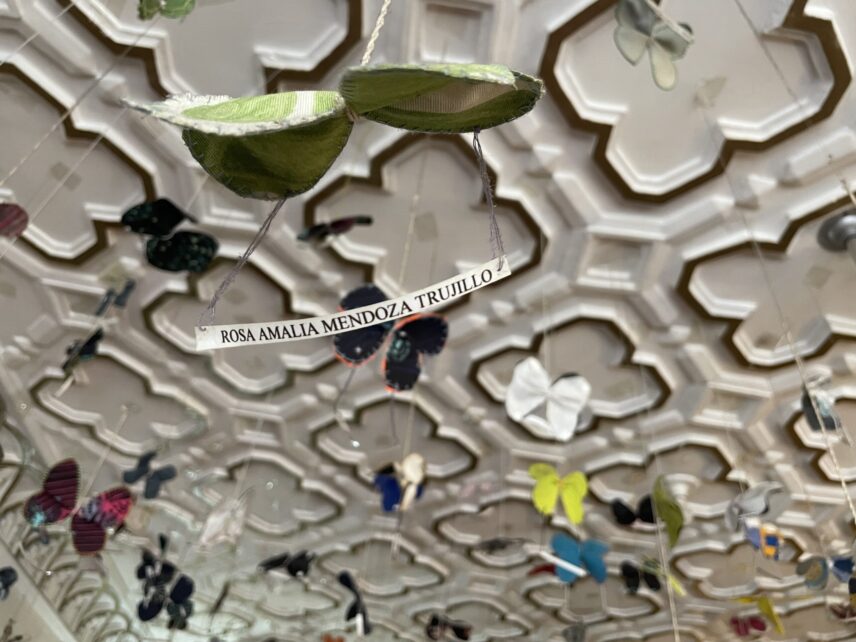
The screening took place at La Casa de la Paz, a space adorned with memorials to people killed resisting the state. Thousands of embroidered butterflies hung from the ornate ceiling, each carrying a typed name of social leaders killed since Colombia signed the 2016 peace accord with the FARC. The bar runs on homemade beer, viche, and chapil. The walls are layered floor to ceiling with block-print posters, rich reds and yellows with dark outlines. They read: “Lucha como abuela.” Fight like a grandmother. “Teo Aldana Vive.” Teo Aldana Lives. “No olvidamos a Cristian Hurtado.” We remember Cristian Hurtado.
Cristian and Teo, two young men killed by police bullets, were names I had come to know through their mothers. Their ghosts were there that day, as were others. These included victims of the so-called “false positive” killings, civilians murdered by soldiers for cash rewards, and guerrilla combatants who had signed the peace treaty and were killed anyway. The dead were not only written or occasionally spoken about: they also inhabited the space alongside us, guiding what happened there.
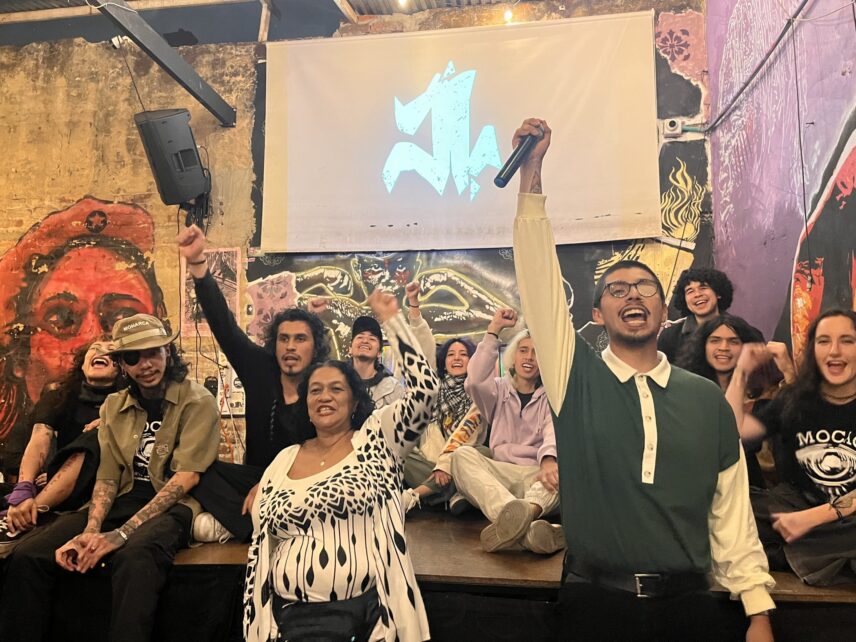
Sergio Romero, who was shot in the eye during a protest on May 1, 2014, and now leads the Quira Popular theater group, served as our MC that evening. He invited the guests to shake their bodies before the film started, to prepare themselves to receive the testimonies. When it ended, the women from the theater troupe performed the same women’s rap that had closed the film. Their bodies were painted with the words “Las Cuchas Tienen Razon” (“the mothers of the disappeared were right”), “ACAB,” and women’s names—Yuly, Magali, Gloria—honoring victims of feminicide. Their rap declared: “Mujeres sentipensantes; Venimos a hacer parte; De la protesta social; Con el cuerpo y desde el arte” and closes exclaiming “no contaran con nuestro silencio.” (“Feeling-thinking women; We come to be part; Of social protest; With our bodies and through art…do not count on our silence”). Sentipensantes is a term used by sociologist Orlando Fals Borda, to describe a way of knowing that connects thinking and feeling which resonate in the local realm of political performance.
I watched the agua aromática, herbal tea brewed from fresh herbs my friend Ariel had brought, get ladled from Mama Luna’s pot by another friend, Juliana, who passed cups to the people at the front. Cup by cup, hand by hand, it moved through the entire patio until it reached me at the back steps. People used their neighbors’ backs as platforms to fill out feedback forms. Heads bobbed with the drums. Tears fell quietly. When Sergio solicited audience reflections at the end, there were too many raised hands to count.
After the screening, one victim featured in the film hugged us and said he had cried far more than expected, then joked that his mom thought he should have had more screen time. Juan Pablo, the producer from MOCAO, was warm but critical: the film was beautiful, but it was missing context. It didn’t explain why they had gone out to protest in the first place.
The feedback forms were similarly specific and considered:
“I liked the scene from the car that gives a 3D sensation, which you lose when you’ve lost an eye.”
“The soundtrack volume should be lowered during the testimonies.”
“I like that digna rabia (dignified rage) was transmitted through sensations… thank you for not letting our memory be erased.”
“The film needs a message that clarifies the reasons why we went out to march during the national strike.”
One final reflection read: “We cannot lose the spaces we’ve gained with the sacrifice of eyes or by others who have been braver than me. I am still scared.”
Gabriel and I spent months integrating this feedback into the film. We added photos to the memorial slide at the end, so the dedication to the dead could hold their faces. We responded to Laura’s and others’ calls for context by adding a sequence of news audio at the film’s opening that explained the motivations for the national strike. And we made sure the shots that had moved people most—the mountain range filmed from the road, the communal stew, the close-up portraits—stayed central to the cut.
What defined this screening—worth the chaos of WhatsApp threads, missed flights, a tilted projector, and chairs that ran out—were the commitments that we, the filmmakers and community, had made from the beginning. The filmmaking process was ghost-guided, shaped by the dead who haunt Colombian social movements and the causes they fought for. It was imperfect by design, refusing the smoothed-over aesthetics of finished cinema in favor of an openness to collective authorship. And it allowed for refusal, for collaborators to opt out of certain modes of participation without losing their stake in the work. Together, these commitments produced a particular style of testimonio, one that belongs to the people who lived it, rather than the filmmakers who recorded it.
Joshua Babcock is the section contributing editor for the General Anthropology Division.