

Article begins
A year and a half into the COVID-19 pandemic, and a year into my fieldwork in Sheet’ká (Sitka, Alaska), I spoke with Lorena about COVID-19, vaccination, and public health policy. Lorena, a pseudonym for a Tlingit elder, was worried about the virus. But perhaps she was more worried about how the longer histories of settler infectious disease management shaped and might continue to shape Indigenous life. Wondering aloud about the pandemic and its governance, Lorena mused, “Is this a way to limit Indigenous communities around the world, to end their lives and their families’ lives?” Elsewhere in our conversation, she framed COVID-19 policy as challenging bodily autonomy, stating, “[COVID-19] policy… is challenging our civil rights. Because we should have the right to our own body and our own thought process.” Her critique of COVID-19 policy, couched in the language of civil rights and bodily autonomy, caught me off-guard, as it had an odd resonance with the rhetoric of another community I encountered during my fieldwork.
In Sitka City Assembly meetings, certain settler residents spoke out against COVID-19 mitigation measures, drawing on anti-government, libertarian, and health freedom discourses that framed public health measures as coercion. Warning that public health efforts were part of a scheme to instill “communism,” one woman declared, “Last time I checked, this is the United States of America, not the United States of Soviet America.” Comparing COVID-19 public health measures to Soviet governance, she drew on US-based tropes to frame the measures as coercive. For residents like her, public health mitigation efforts represented state intrusion into bodily sovereignty, not communal care. In this view, refusing mitigation and pursuing “natural” immunity through infection became a legitimate expression of freedom. But that freedom requires a body that can afford to take on risks associated with infection—that is, a white settler body historically insulated from the harm and coercion that have marked Indigenous encounters with biomedicine and the state, a body physically resilient enough to withstand illness and emerge unscathed.
A major difference, however, was that settler residents feared future coercion, while my Tlingit interlocutors feared past and ongoing coercion. Though both groups framed their concerns in terms of autonomy and civil rights, the history underlying those claims was starkly different. At City Assembly meetings, settler residents warned that masking violated their autonomy, with one asserting that “you don’t have the authority to restrict our breath.” For many Tlingit interlocutors, concerns about public health were grounded in lived experiences of medical violence, rather than speculative warnings about lost autonomy. They cited a history of medical abuses, including nonconsensual medical procedures and experimentation on Indigenous bodies. They treated these histories as assumed background, alluding to them rather than narrating them in detail; I did not press for more. Occasionally, they shared specific events—like when a doctor from the federal Indian Health Service non-consensually sterilized a Tlingit man’s mother after his birth and when a boarding school doctor removed a Tlingit girl’s teeth with no medical justification. They recounted these incidents to me matter-of-factly, as reminders of history that many in the community already understood. These were not isolated incidents, but part of racialized public health regimes whose institutions, such as boarding schools and federally funded tubercular sanatoria, left lasting trauma and illness. This history colored Lorena’s approach to COVID-19 vaccines.
Lorena, who was often in and out of hospitals because of chronic immunological conditions, felt caught between a rock and a hard place. She knew that a COVID-19 infection could mean hospitalization, long-term health effects, or possibly death. But vaccines did not provide Lorena with a neat escape from that risk. As she told me, the medical institutions urging her to get vaccinated were part of a history of settler experimentation and abuse directed at Tlingit and other Indigenous people.“Public health policies during pandemics in the past has created an internal distrust of policies, procedures, and people telling me what to do with my own body and other people’s bodies,” Lorena told me. “And it is something so strongly rooted, this mistrust, not because I’ve read it in a book, but because my ancestors had shortened lives or didn’t even exist—potential ancestors—because of pandemics that have went through.” Deciding to get vaccinated was not a simple medical choice for Lorena and many of my other Tlingit interlocutors, but a reckoning with settler politics and history. Compliance, she worried, could reproduce colonialism’s historic harms and perpetuate its ongoing ones, exposing her body to risk from settler medical violence rather than infection.
Despite her misgivings, Lorena felt guilty not vaccinating. Some of this was external. An organization she belonged to planned to mandate COVID-19 vaccination, intensifying her sense that her decision would affect others, not just herself. This external prompting deepened a feeling of shame that by not vaccinating, she was failing to protect others and “not helping [her] fellow man.” Lorena elaborated, “That’s something we don’t take lightly as a people because we are a communal society… We want to do what is right for our own communities.” Her gesture toward the relationship between communal obligation and vaccination diverged from the individualistic tone that I heard from vaccine-hesitant settler residents of Sheet’ká, who framed refusal as a matter of freedom.
Once vaccines became available, Lorena decided to get vaccinated, but a personal history of strong allergic reactions made her concerned about what the vaccine might trigger. “I had went to the hospital for 3 and a half months and I had told them because I have a compromised immune system, I cannot just take this vaccine. You know, it could have life threatening effects.” Her anxiety about the vaccine was eclipsed by concerns about getting infected with COVID-19 during a severe wave of the delta variant, when Sheet’ká briefly led the nation in case growth, experiencing a 1400% increase in cases in mid-July 2021. Lorena pursued vaccination but requested an ICU bed with staff on standby in case she had a concerning reaction to the vaccine. Citing its limited capacity during the pandemic, the hospital denied her these accommodations for several months.
Only once that wave subsided would the hospital reserve an ICU bed for Lorena’s vaccination. Lorena felt “terrified, just terrified,” getting the first dose of the vaccine. Her terror shows that vaccination was not an embrace of settler public health but a careful reckoning between medical risk and infrastructures whose abuses had eroded community trust. Speaking of her choice, Lorena explained, “I did decide to do at least one because they met me. They finally did. They wrangled with me and they set everything up.” Her describing this negotiation as “wrangling” suggests that her medically and historically situated concerns may have been treated not simply as reasonable accommodations, but as demands to be managed before she could be brought into compliance. Vaccination only became possible through this accommodation, but it did not erase the imbalance in power.
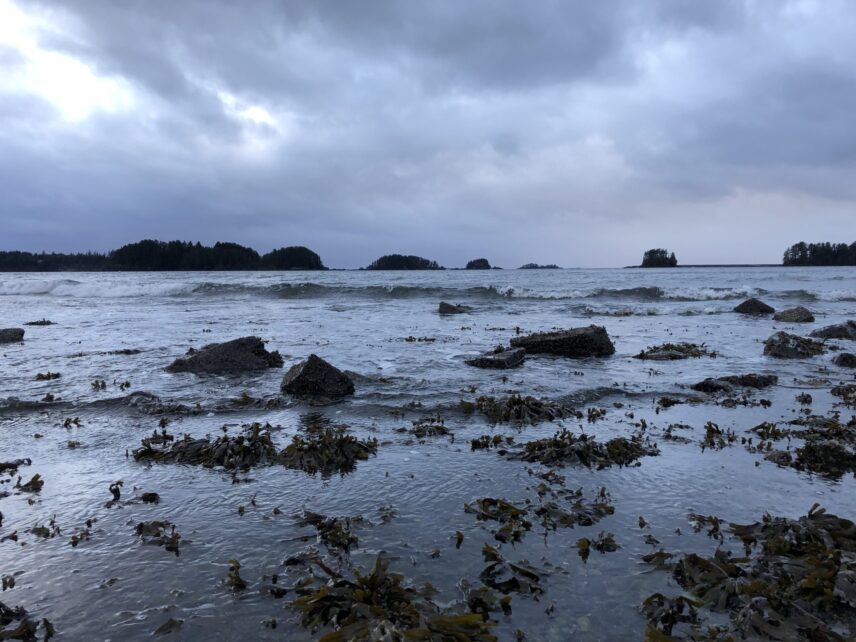
While she did not have the adverse reaction that she feared, Lorena’s experience getting vaccinated did not resolve her concerns. On the way home, from the backseat of her friend’s car, she looked up at the low, grey sky over Sheet’káand gasped. She described seeing a projected image with an arrangement of numbers and letters that represented her DNA, her personality, and her essence—perhaps settler forms of biomedical legibility—all being separated from her body. Echoing histories of settler surveillance and exploitation of Indigenous communities, she interpreted this as an attempt by powerful institutions to extract something from her to fortify their own power.
“I’m a fighter, I’m a warrior woman, and I said, ‘Oh no,’ and I literally took my spiritual weapons out, threw what is called a grapple hook… We use it when we’re grappling for kelp and herring eggs and stuff like that in the ocean. Well, I took my spiritual weapon… and I pulled back down my DNA, my personality bar, my essence. I said, ‘You will not!’ … So I pulled it back down and back into me.”
The “spiritual weapon” Lorena used, the grapple hook, is a key tool in seasonal subsistence harvesting in Sheet’ká. Harvesting and sharing foods like kelp and herring eggs sustains human communities, relations with ancestors, seasonal cycles, other-than-human relatives, and fulfills ancestral obligations. Lorena did not explain the grapple hook as a fixed symbol. But it became a tool through which she pulled herself back together, asserting her integrity amidst extractive biomedical pressures.
For the next three days, Lorena lay in bed and barely ate. Her energy was completely gone but over time, she regained her strength. Reflecting on her experience receiving a second mRNA shot weeks later, Lorena mused, “Do I feel more protected now? Do I feel as this whole thing is a lie? I don’t know. But I’m in between a lie and the truth.” Lorena’s “whole thing” spans the virus, the vaccines, the governance surrounding them, and the longer history they sit within. The lie might be the promise that vaccination offers straightforward protection; the truth is the history that makes this promise untrustworthy. She was living in both at once and vaccination left her there.
According to mainstream public health, Lorena’s vaccination might be understood as a linear resolution of risk. For Lorena and many other Tlingit people I spoke with in Sheet’ká, vaccination was, instead, another encounter within the hazardous terrain of settler health infrastructures. Her hesitancy did not stem from a failure of understanding, but from a careful, historically grounded assessment of medical risk weighed against the dangers posed by COVID-19.
Biomedical and public health discourses often misrecognize experiences like Lorena’s. Clinicians and public health workers frequently frame vaccine hesitancy as evidence of poor health literacy or irrational fear, a perspective that flattens historically distinct forms of mistrust. In both public health and public discourse, professionals often interpret hesitancy through frameworks that reflect white settler concerns about personal bodily autonomy, obscuring the longer histories of coercion, experimentation, and uneven care that shape Indigenous engagements with biomedicine. As a result, vaccine hesitancy is reduced to misinformation rather than understood as a historically situated analysis of power and exposure.
Lorena’s careful decision-making highlights the bind that medically vulnerable Indigenous peoples and people of color face when navigating public health interventions. Settler colonialism has produced enduring social vulnerabilities and uneven biological exposures to disease and medical harm. Public health often misunderstands Indigenous vaccine hesitancy because it sees vaccination as exiting a field of risk rather than entering one in which medical institutions have required Indigenous bodies to disproportionately absorb harm. Lorena’s story shows vaccination can be a site of communal care and a site where histories of coercion remain unresolved.
Sanghamitra Das and Taylor Bell are the section contributing editors for the Society for Medical Anthropology.