

Article begins
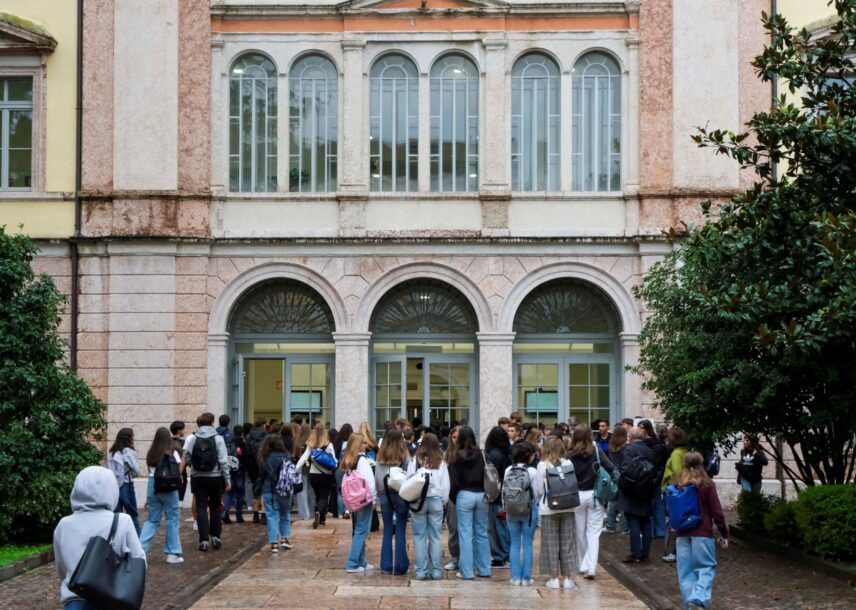
In 2025, a high school in Trentino, Northern Italy, posted a public display in its main hall featuring a short video on a wall-mounted screen. The video was built around a series of parole intraducibili, or “untranslatable words.” Students collected examples from their peers in multiple languages, emphasizing speakers of heritage languages whose families had migrated to Italy since the 1990s. These included not only languages with a standard codified by institutions and written texts—such as Serbian, Mandarin Chinese, or Albanian—but also non-standardized varieties, such as Moroccan Arabic.
Yet to my surprise, the video also featured the local vernacular, commonly known as dialetto trentino, the “Trentino Dialect”—a variety that, as a dialetto rather than lingua, has long been positioned in subordination to the national standard. Like other regional vernaculars, the variety is often described as backward in contrast to the modernity of the Italian language.
The video was created for UNESCO’s International Mother Language Day, which, as described on the official website, is commemorated every February 21st to celebrate “efforts to preserve linguistic diversity” in a globalized world. The project was initiated by my brother, who was then serving as both a teacher and head of inclusion. One afternoon, over coffee, he casually mentioned the initiative, noting that the screening had had a significant impact on teachers and that including dialetto trentino in the video had been his idea. Curious, I asked whether I could record our conversation, sensing it might be generative for me as a researcher of speakerhood and identity in contemporary Italy.
I found myself listening eagerly, not only as a sibling, but also as a teacher, as someone often praised as a “cosmopolitan polyglot,” as an aspiring linguistic anthropologist, and as a stubborn dialetto speaker. And yet, as my brother spoke about the students’ linguistic experiences, his hesitations, choice of words, and the subtle affect carried in his voice activated uncomfortable reactions in me. I felt unsettled by the sense that, while the project was designed to challenge linguistic marginalization, it wasn’t quite pushing boundaries in the ways my brother intended.
This isn’t just a story of linguistic marginalization. The bigger picture is about economies of recognition: how value and legitimacy are unevenly distributed across contexts and social groups. As anthropologists have long argued, rather than challenging power, recognition often reproduces binary divisions and inequalities. Just as dialetto trentino appeared briefly as one among many legitimate mother tongues, so too could a group of second-generation students be reimagined as exceptionally gifted, temporarily occupying a privileged position in a space that otherwise marginalizes them.
A Window onto Invisible Multilingual Experiences
The conversation between me and my brother, M, largely comprised stretches of monologue, with occasional interjections from me. I began:
Andrea: Why do you think the video made such an impression on people?
M: The video was quite nice… because you could get about fifteen portraits of students who were often seen in a certain way… I wouldn’t say stigmatized, but not exactly in the most positive light. And it turned out that there were so many boci [kids] who spoke two, three, even four languages. And you could see a gap between school-based competence, which is almost the only lens of observation at school…
My brother hesitated for a moment, as if trying to find the right words, while I listened.
M: And then you could see the life stories… the experiences… of people with migrant backgrounds—but not only migrant, also cultural. What came out of it was an entirely unknown background. It was as if a window opened onto their lives. That was my impression, and I think many others felt the same: “Porca vacca! [Damn!] Look who we have here!”
I sensed the genuine appreciation behind my brother’s words, which I found unsurprising given his deep commitment to social equity. The video created more than a fleeting moment of recognition: by embracing UNESCO’s rhetoric of linguistic roots and allowing students and teachers at the school to see their peers in a new light, it also unsettled the established conditions under which multilingualism becomes visible and valuable in educational spaces. It worked against the invisibility and suspicion that often mark the linguistic repertoires of students from diasporic communities.
In contemporary regimes of mobility and competition, multilingualism is often celebrated as a form of capital to be cultivated, especially for upper-middle-class students. But when tied to a racialized migrant and low-income background, it is far more likely for it to be reframed as a problem to be corrected. In schools, second-generation students who may not speak Italian at home and who speak another language without having learned to read or write it are often cast as failing to master any language, and therefore as struggling to become functional learners, or even individuals.
This video’s gesture of recognition widened the boundaries of legitimate multilingualism in multiple directions. It extended not only to students racialized through their migrant identities, but also to linguistic forms outside canonized categories. Moroccan Arabic—an unstandardized and institutionally unrecognized variety increasingly visible in Morocco’s public life—was acknowledged for its cultural significance, without being required to conform to dominant standards of linguistic completeness.
Still, my brother’s word choice caught my attention. While he described the students as plurilingual wonders who spoke “two, three, even four languages,” he did not refer to them as studenti, but as boci—a Trentino term meaning “kids,” one that often carries a distinctly patronizing tone. Even as their multilingualism elevated them, the speakers remained in a markedly lower social position.
Superlinguistic Kids, “Mono-dimensional” Teachers
As the conversation continued, it became clear that my brother wasn’t only celebrating the students’ linguistic abilities. Continuing to speak hesitantly, he also seemed concerned about how the students’ multilingualism affected others at the school.
M: So you have all these young people, and we [the teachers] feel that it’s our role to educate them… They come here to learn, we’re the possessors of education, of the officially recognized qualifications, and all that… and yet, then… in light of a comparison with them I was also perceiving this thing here… of us also being, a little bit, as if the discourse were being reversed, as if it were us, so to speak, who now were at the margins.
Andrea: That’s quite ironic—but what made you feel like you were “at the margins”?
M: It was the contrast between the monodimensione [mono-dimensionality] of the teaching staff—which is largely all… Italian for sure, but also specifically Trentino—and seeing students who carry… perspectives… that are more up to date, more contemporary.
What initially appeared as a celebratory acknowledgement of students’ backgrounds began to shift into something else. Against teachers’ role as the official “possessors of education,” multilingualism was no longer simply one valuable aspect of biography among others; it became a source of stigma. Echoing an economy of recognition shaped by narratives of globalization and increasing cultural complexity, my brother described these students as “more up to date,” better prepared to navigate the world. In this global economy, discourses of rootedness and minoritized identity are readily captured and reframed as valued competencies, allowing otherwise marginalized groups to access a position of authority.
In the end, a preexisting hierarchy did not disappear. It was just reversed. The young students were prepared for the multilingual and intercultural present, while the Italian—and especially Trentino—teaching staff, including my brother, were stuck in the monolingual and monocultural past.
Dialect, Deficit, and the Paradox of Linguistic Roots
If the video was meant to celebrate non-dominant languages and heritage, why did this logic not extend to the teachers? Many of them routinely use both Italian and dialetto trentino, a variety included among the other mother tongues in the video. In that sense, they too could technically be described as multilingual. Yet, dialetto did not seem to qualify as a mother tongue—and therefore a legitimate, “authentic” language—in the same way. The distinction resurfaced clearly later, when my brother described the students’ contributions.
Andrea: Which words did they come up with?
M: They were sometimes playful, sometimes more profound: some were connected to food, others to concepts from the Qur’an, others to traditional Balkan dance…
The enthusiasm in my brother’s voice as he spoke about second-generation students—something that became even more apparent later when he showed me the video—shifted noticeably when he described the contribution of a young man representing dialetto trentino:
M: There were a couple… of Italians—because I had actually suggested allowing dialetto as a language as well—so there were also a couple of Trentino kids who brought out, I don’t remember, but like the word… descantabaùchi. Honestly, they made an impression… It was striking to also see a Trentino speaker say their word… like that… kind of, I wouldn’t say superficial, but…
As my brother described what he saw as the contrast between the chosen words, his speech slowed, and his intonation slipped into irony, caricaturing the voice of a dialetto speaker. He rolled his eyes while repeating the Trentino word featured in the video—descantabaùchi, a term used to admonish someone to “wake up,” pay attention, and avoid a preventable embarrassment. Aware of how highly I value our local dialetto, he quickly inserted a caveat: perhaps this wasn’t a problem with the variety itself, but with the speaker’s word choice.
Despite the caveat, my brother’s gestures and shifts in tone still signaled that dialetto could never attain the symbolic weight as the other heritage languages in the video. It continued to operate within a different economy of recognition: not the global, UNESCO-sanctioned one valuing linguistic and cultural roots, but a national framework structured around the troubling binary of (modern) language and (backward) dialect. Still tethered to the shame historically assigned to it within Italy’s sociolinguistic order, dialetto could not be revalued as something “up to date” and claimed with pride, ironically even by the very person who had proposed including it alongside other mother tongues.
Recognition and the Reproduction of Difference
A single video or conversation is hardly an indicator of large-scale social change, whether as evidence of growing appreciation for migrant communities or the supposed marginalization of whiteness amid the excesses of identity politics. Yet, as anthropologists know, even a single utterance requires an entire world of meaning to be understood. From this perspective, my conversation with my brother reveals what the anthropologist Elizabeth Povinelli has analyzed as the gaps between the rhetoric of multiculturalism and the actual practices of recognition through which difference gets evaluated across scales.
The temporary reversal of a hierarchy becomes possible—and can just as easily be undone—because groups are asked to perform identities shaped by distinct regimes of recognition: the first international, where multilingualism and cosmopolitanism are valued; the second national, where loyalty to Italian monolingualism and distance from disruptive dialects are still expected. Accordingly, even when students from migrant communities are celebrated, their exceptional status ultimately confirms their distance from the national society.
Meanwhile, speakers reclaiming the legitimacy of local vernaculars in Italy find themselves caught in an unresolved tension between competing national and global frameworks—a double bind I have often experienced firsthand as a young dialetto speaker. Too backward and non-standard to be recognized as languages in their own right, and too old-fashioned to appeal to younger speakers, dialetti are also objects of suspicion because of their connection to far-right movements since the 1990s. Political parties such as the Lega Nord have mobilized dialetti as symbols of a threatened autochthonous, fixed tradition in the face of migration from North and Sub-Saharan Africa and Southeastern Europe.
Yet the solution is not to make dialetto trentino fit within a global economy of linguistic recognition, adding it to an expanded list of up-to-date, supposedly real languages. Expanding access to a flawed category—“language,” historically defined through the stigmatization of practices positioned against it—does not transform it into a good one. It merely shifts the line, temporarily redistributing recognition while old forms of exclusion always find a way to reemerge.
Joshua Babcock is the section contributing editor for the General Anthropology Division.