

Article begins
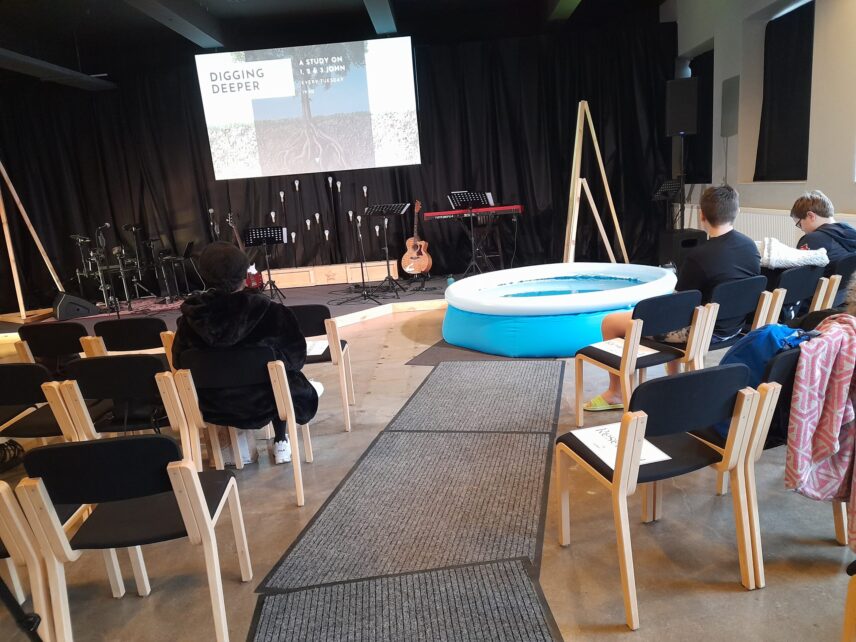
My first visit to Unity Church in Vilnius seemed routine—another fieldwork site in my study of religious communities. As I entered the hall and found a seat along the left wall, nothing suggested this would be different from dozens of other services I’d observed. Then the worship band began to play. The first chord progression hit me with unexpected force, and I suddenly felt transported—not just by church music, but by the immersive quality of live rock sound. As the worship service progressed, I began to recognize familiar musical elements—one song’s structure reminiscent of Van Morrison, another echoing The Kinks. This American missionary-founded congregation had brought music that gradually awakened memories of my teenage years in Soviet Lithuania, when Western rock represented a different kind of freedom. This unexpected collision of worlds—Pentecostal worship and Soviet-era rock memories—sparked a profound realization about cultural fluidity. How had rock music, once denounced as Western ideological corruption, become a vehicle for spiritual transcendence in post-Soviet religious space?
Music has always played a crucial role in Christianity, revealing much about a community’s identity and theological orientation. During years of researching Baptist communities in Lithuania and Ukraine, I discovered how musical choices served as markers of a congregation’s position on the conservative-progressive spectrum. Some communities restricted themselves to piano and stringed instruments with formal choirs, strictly avoiding applause. Others embraced guitars and even drums, tolerating and even encouraging clapping. These musical boundaries were important indicators of a community’s identity—its belonging to or distancing from the conservative, closed Soviet style.
When I decided to change the focus of my research to Pentecostalism and entered Unity Church, I wasn’t unprepared for Pentecostalism’s emphasis on emotional expression. I had lectured my students on contemporary Christian music’s emergence and evolution into a significant sector of the American music industry. Yet nothing prepared me for my emotional response to experiencing familiar rock sounds in this sacred context—a gradual recognition that connected me to my past in unexpected ways.
Traversing Political Boundaries: Rock’s Fluid Resistance to Soviet Control
I was born and raised in Soviet-occupied Lithuania, where national independence symbols were carefully hidden or destroyed by the regime, replaced by mass-produced Soviet propaganda. The dominant colors of my childhood were gray and red—the pervasive grayness of everyday life splashed with red flags and posters. Large Leninist quotes on red fabric hung in prominent city locations for years. One typical example near the children’s library I frequented proclaimed, “‘Art belongs to the people’ – V. I. Lenin.” Like public spaces, art forms had to be ideologically “correct”—aligned with strict ideological formulations. Soviet citizens needed protection from “incorrect” art, just as they needed shielding from “harmful nationalist reminiscences.”
While visual propaganda dominated public spaces, sound became another battleground for ideological control. The local radio station broadcast repetitive daily programs with minor variations in morning news and popular “hits” for the masses. But in the evenings, our home filled with different sounds—the scratchy interference of jamming signals as my father listened to Voice of America and Vatican Radio broadcasting in Lithuanian. These “voices,” carried by fluid radio waves that disregarded the Iron Curtain, brought information that contradicted official narratives and was therefore treated as a threat. The Soviet response was technological—numerous closed military bases throughout the USSR jammed foreign radio transmissions, protecting territory from Western ideological invasion. One such base stood in Išlaužas, near my hometown of Kaunas.
Between the state-controlled local radio in the mornings and the evenings spent with my father trying to catch foreign broadcasts through jamming signals, I found my own path. I established a daily ritual of listening to rock music that would become an integral part of my identity. Unlike the passive consumption of official culture, this music made me an active seeker and consumer. I hunted for cassettes, copied rare recordings, and tried to find out what the lyrics of the songs are about. Rock became my space of protest and authenticity, a realm where I could explore feelings and ideas absent from the gray-red official world. Even without much reflection, the very act of seeking out this music—navigating black markets for recordings, learning to decode lyrics—became a formative part of my teenage years.
The regime’s response included not just censorship but also an aggressive propaganda campaign against all things Western. Rock music was a prime target, denounced as decadent, primitive, and harmful to youth development. Ironically, this anti-Western propaganda often produced the opposite effect—young people like me gravitated toward rock’s energetic protest music precisely because it offered an alternative to the tedious, worn-out propaganda channels.
Unable to simply ban this cultural flow, Soviet authorities attempted to domesticate it by creating state-sponsored “vocal-instrumental ensembles” (VIAs). These groups, composed of well-dressed young men with formal musical education, performed with approved lyrics and tamed musical arrangements designed to serve as an acceptable alternative to rock. Lithuanian rock bands like Hiperbolė tried navigating this system by adopting conformist appearances—wearing suits and bow ties and performing texts by state-approved poets—while still maintaining authentic rock energy. Despite these attempts to comply with Soviet norms, their growing popularity eventually prompted authorities to disband the group at the height of their success—a clear recognition that even in this “tamed” form, rock music contained energies that the regime could not fully control. This fluidity manifested in rock’s remarkable ability to adapt while maintaining its core rebellious energy. Despite systematic efforts to contain it, rock music flowed through Soviet society like water finding cracks in a dam—unstoppable once it had begun to seep through.
Moving Between Secular and Sacred Spaces: Rock’s Contested Religious Journey
In my experience growing up in Soviet Lithuania, religious institutions had limited public voice regarding cultural matters. The official Soviet atheism positioned the state itself as the primary cultural and ethical arbiter, while religious bodies operated under surveillance and constraint. This created a unique situation where direct religious critique of rock music was largely absent from public discourse—not necessarily because religious leaders approved of it, but because they lacked platforms to voice such concerns.
This Soviet reality created an unusual circumstance where the Iron Curtain, while failing to block rock music itself, effectively blocked the wave of religious criticism that accompanied rock in Western countries. While American and Western European Christians were publishing books warning about rock’s spiritual dangers, debating backward-masked satanic messages, and organizing record burnings, Soviet believers had limited access to these theological debates. The primary framework for evaluating rock in the USSR remained political rather than spiritual.
Despite this absence of explicit criticism, rock was not welcomed as a worship music in the following decades in post-Soviet religious communities. This resistance presumably stemmed from multiple sources: the emotionally engaging rhythmic music was perceived as difficult to control and potentially disruptive to orderly worship. Again, religious communities, focused on survival during Soviet times, had become cautious about changes and innovation. Aditionally, the general cultural association of rock with rebellion and secular values created implicit barriers to its sacred adoption.
So, what makes this religious journey of rock on the back of the Unity Church particularly significant is how it demonstrates music’s remarkable capacity to eventually cross the huge geographical teritory and boundaries between domains often viewed as fundamentally separate. The same sonic elements that once prompted wariness in religious communities gradually became vehicles for worship in places like Unity Church, creating new pathways to transcendent experience while maintaining their distinctive emotional power.
This transformation represents the second dimension of cultural fluidity—rock’s movement between secular and sacred spaces, between being perceived as potentially disruptive and becoming a deliberate tool for spiritual breakthrough. This boundary-crossing quality challenges simplistic divisions between sacred and secular, showing how cultural forms can maintain their essential character while serving radically different purposes.
The Persistence of Form: Emotion Beyond Content
During my fieldwork years, I had visited various religious communities throughout Lithuania and Ukraine, including several different denominations. In some American-founded communities, I had observed worship services with full rock band setups—electric guitars, drums, and professional sound systems. In one community in Lviv, I had observed worship music accompanied by electric guitars, whose meditative cycles of simple, repeated lyrics resembled mantras more than rock. In all these cases, music was an important part of my data collection—interesting and significant, but never deeply personal.
At Unity Church, something unexpected happened. The emotion I had prepared to observe and document as characteristic of Pentecostal worship—as important research data—suddenly became my own profound personal experience. The familiar rock structures created an unanticipated connection between me and this community, linking me to a past I rarely remembered or reflected upon in my daily life. The researcher became unexpectedly entangled with the research subject.
This experience led me to seek out Mark, an American missionary responsible for the musical aspects of worship at Unity. For him, this was simply “his” music—a comfortable part of his cultural environment where he was an expert. When I mentioned my fascination with the sounds that reminded me of The Kinks, the reference didn’t seem to register with him. However, our conversation about music became a connection point of partially shared experience. We both appreciated the rock form, though from different cultural and personal backgrounds.
Mark enthusiastically recommended I listen to John Mark McMillan, his favorite artist. Over the following weeks, McMillan’s music became a recurring topic in our conversations. Mark would direct my attention to the singer’s vocal timbre, nuanced lyrics (challenging for me as a non-native English speaker), and musical choices. As a listener with my own rock background, I noted the contrast between McMillan’s first album—with its sharp, hard, garage-like sound—and his softer second album, admitting I preferred the musical edge of the first. Mark wasn’t convinced by my observation.
Eventually, Mark returned to the United States, and I completed my research at Unity Church. Yet something unexpected persisted. John Mark McMillan remains my most-listened-to artist across all music genres. This continuation of musical preference represents another dimension of fluidity: how elements of identity, supported by emotional engagement, can endure far beyond the circumstances that created them.
This experience at Unity Church revealed something profound about musical form and its emotive power independent of content. In two vastly different contexts separated by decades, rock music maintained its distinctive sonic identity and emotional impact. In Soviet Lithuania, Hiperbolė adopted conformist appearances—yet authorities still recognized and feared rock’s inherent energy, eventually disbanding the group at the height of their popularity. Decades later, in a post-Soviet religious context, rock music serves entirely different purposes as part of American Pentecostal worship traditions represented by Unity Church. This tradition has successfully harnessed rock’s emotional power for spiritual purposes, yet the form itself—the sonic structures, rhythms, and timbres—remains distinctly recognizable, triggering emotional responses that connect directly to Soviet-era experiences.
Conclusion: Fluid Forms in Transforming Contexts
Rock music’s journey from Soviet-era threat to vehicle for spiritual transcendence demonstrates the multidimensional nature of cultural fluidity. Its ability to traverse political boundaries despite censorship, to move between secular and sacred spaces, and to maintain its emotive power through transformations of meaning is remarkable. This journey reveals how cultural forms flow in complex, non-linear patterns across seemingly impermeable boundaries.
The relationship between form and content emerges as particularly significant in this analysis. While content (lyrics, stated purposes, explicit messages) may radically transform, certain formal elements (sonic structures, rhythmic patterns, timbral qualities) maintain consistent emotional effects across contexts. This observation challenges simplistic models of cultural change that fail to distinguish between a cultural form’s various components and their differential persistence.
In post-Soviet Pentecostalism, rock music exemplifies this complex fluidity—neither wholly imported nor entirely indigenous, neither completely secularized nor fully sacralized. It occupies a liminal space where memories of resistance meet contemporary spiritual aspirations, where global forms meet local sensibilities, and where the secular and sacred intermingle in ways that challenge conventional boundaries.
Building on this case study, future research might examine other examples of cultural forms that maintain their emotive power while crossing boundaries between seemingly opposed contexts, further developing our understanding of cultural fluidity in post-Soviet spaces.