

Article begins
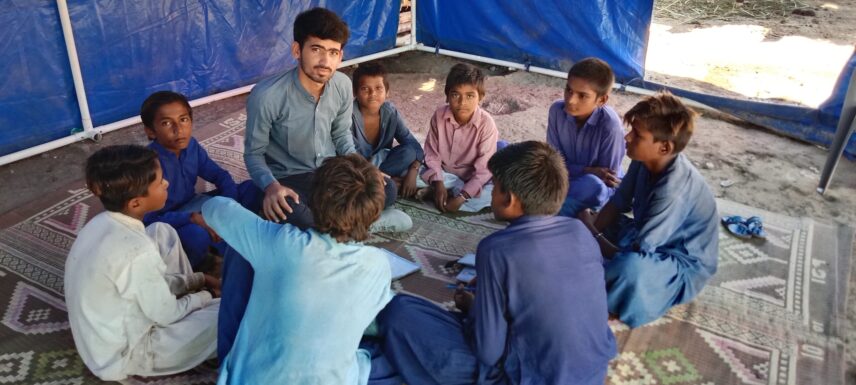
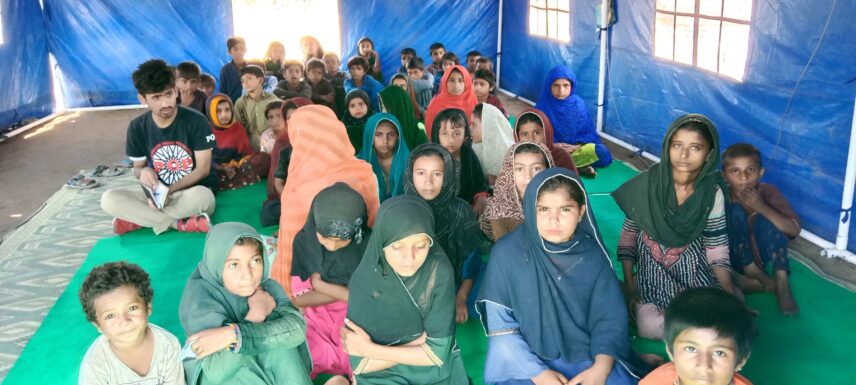
In 2022, Pakistan was facing one of the worst floods in its history. At the same time, I was in my seventh semester of a bachelor’s degree in anthropology at the University of Sindh, the semester in which students are required to conduct fieldwork. I chose a topic shaped directly by the unfolding catastrophe: “Schooling in the Time of Disaster: An Ethnographic Study of the 2022 Floods.” I planned a multi-sited ethnography across three districts, without any institutional funding or formal logistical support. At the time, it was unclear how such fieldwork would be possible.
Through a few personal contacts of my supervisor, I was introduced to a local NGO working in flood-affected areas. They agreed to take me on as a volunteer. The next day, I moved into their office, where I stayed for several weeks. This period of fieldwork, like all that followed, was entirely self-funded. When I returned, both my supervisor and I felt that the data was insufficient. I decided to extend the research to the Badin district in Lower Sindh, one of the areas most severely affected by the floods. I spent more than a month there. This was the most intense and generative phase of my research, and again, it was financed entirely through my own resources.
What still lingers for me is the sense that this research needed more time in the field, time that was simply unavailable because of limited resources. At no point did I apply for research funding, not because I chose not to, but because there was no clear channel to do so at the bachelor’s or master’s level in Pakistan. Student thesis research is widely treated as a personal responsibility, a burden to be carried individually in exchange for a degree. The institution sets the requirement for fieldwork but offers no material support to make it possible. Among my peers, topic selection often began not with intellectual urgency but with logistical calculation. How far is the fieldsite? Can I stay with relatives? Does my supervisor have contacts there? In this environment, research capacity becomes quietly tied to socioeconomic background. Students with family support or urban networks are better positioned to undertake ambitious projects. Others adjust their intellectual horizons to their financial realities.
This whole experience repeated when I was going for the fieldwork for my master’s, during which I had selected a topic that didn’t cost me much financially, and the field of my choice, which was also a very tough task for me. This time I was in a top-ranking university. Moving to a higher-ranked university, I assumed that institutional prestige might translate into research infrastructure. The campus appeared modern, the rhetoric ambitious. Yet when it came to fieldwork support, the pattern remained unchanged. There were no structured small grants, no transparent funding channels, no routine reimbursement mechanisms, even for doctoral research in the social sciences.
My experience was not unique. A classmate who researched transgender communities engaged in street begging told me that even conducting interviews required negotiation. Some participants expected compensation for their time, which she felt was ethically appropriate but financially difficult. She paid for each interview herself. Beyond that, she covered all travel and accommodation expenses while moving between cities. Like many of us, she financed her research quietly, absorbing costs that were never formally acknowledged by the institution.
Beyond these individual efforts, there was no formal mechanism in my university for even small research grants at the undergraduate or master’s level. When I once asked a senior colleague about funding, he laughed and said, “Be thankful they’re not asking you to pay the university for your research.” The comment was meant as humor, but it revealed something deeper. The absence of funding was so normalized that the idea of institutional support felt almost absurd. Students were expected to finance their own fieldwork as part of the cost of earning a degree.
Over time, this absence of support shapes the kind of anthropology that becomes possible. Research questions are adjusted to fit available resources. Students often choose topics that are manageable rather than ambitious, nearby rather than multi-sited, and affordable rather than exploratory. Theoretical discussions of long-term immersion or multi-sited ethnography remain in the classroom, rarely translating into practice. When research must be self-financed, intellectual risk becomes a luxury. The result is not the absence of anthropology, but its narrowing, an anthropology constrained less by imagination than by material limits.
These patterns do not begin or end at the departmental level. They are embedded within a broader higher education system that prioritizes certain sectors over others. Funding streams more readily support technical, industrial, and commercially viable research, while the social sciences often operate with minimal material backing. The consequence is subtle but significant: disciplines that do not promise immediate economic return must rely on individual sacrifice rather than institutional investment. In public discourse, higher education reform is often framed in terms of competitiveness, innovation, and technological advancement. These priorities are not insignificant. Yet they rarely translate into sustained investment in social inquiry at the undergraduate or master’s level.
Anthropology departments in Pakistan continue to function. Classes are held, theses are submitted, degrees are awarded. On paper, research requirements are fulfilled. But beneath this appearance of continuity lies a quieter erosion. When fieldwork depends on personal savings, family support, or informal networks, research becomes unevenly accessible. Questions are adjusted to affordability. Ambition is tempered by material limits. The result is not the disappearance of anthropology, but its quiet narrowing. Multi-sited projects remain aspirations discussed in theory courses. Long-term immersion becomes a privilege. Intellectual risk feels costly. Over time, this shapes not only individual theses, but the contours of knowledge itself.
What is lost is difficult to measure: the studies never undertaken, the questions never pursued, the deeper engagements that required time and sustained presence. This is the anthropology that could have been, constrained not by lack of curiosity or commitment, but by the steady normalization of doing research without support.