

Article begins
In 2026, members of the Society for the Anthropology of Food and Nutrition are writing for Anthropology News on the theme of temporality in food anthropology. This contribution from Janita Van Dyk kicks off our four-part series.
Geert walked over to the whiteboard. After marking an X and Y axis, he explained each set of lines, curves, and bumps drawn on his impromptu graph to the class of food studies and culinary master’s students in attendance. His graph abstracted four variables measured over four seasons and the amount of time and work expended. This was a year in his life. After completing a graduate food studies degree in Italy as a Dutch international student, Geert had rented a plot of land with a group of friends outside of a major city to start a small, commercial farm, or “market garden.” Geert and his friends had come back to their alma mater to share their farming insights to current students in a lecture series about the realities and challenges of market gardening. I was there, auditing the class as part of my ethnographic fieldwork among young students and professionals pursuing food-related work in Northern Italy.
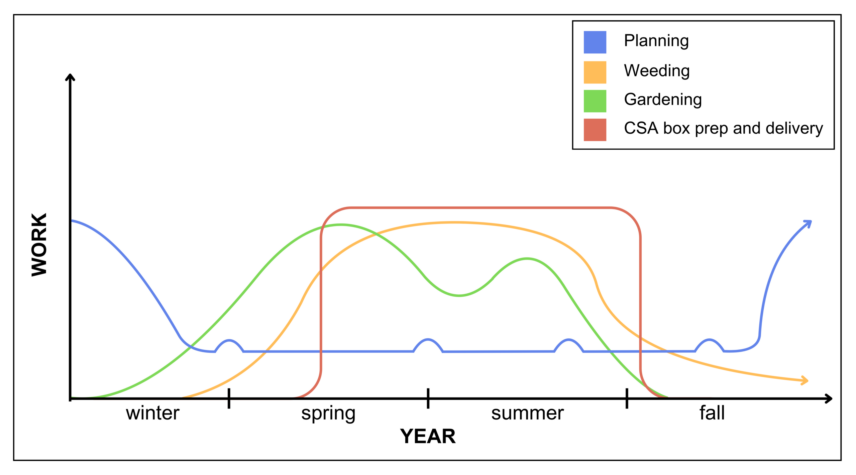
The first line, depicted in blue, was “Planning.” It included meetings, mulch and compost purchases, plant nursery orders, diagrams of soil beds and crop rotation plans. It might also include work spent deciding and implementing a new experimental project, like inoculating areas between seed beds with mushroom spores.
The next line, depicted in orange, was the one Geert disliked the most: “Weeding.” While their team wanted to design a system that introduced companion species and crop rotations that would “ecologically” mitigate pests, weed growth, and pathogen spread, the weeds still grew and needed to be pulled up.
The other two lines were gardening (green) and CSA box preparation and delivery (red). These were consistent weekly tasks that involved everything from repairing equipment to moving seedlings to the hoophouse or open field, from problem-solving how to fill subscription boxes despite an earlier- or later-than-anticipated harvest to loading up their electric delivery bike and transporting boxes across the city. In addition to all this, Geert and his team worked secondary jobs in catering companies or office positions.
The graph, focused solely on schedules and labor, departed from what had preceded this discussion—the temporality and seasonality of “natural” or “closed loop” cycles of plant growth, seasonal weather, carbon sequestration, compost breakdown, and harvesting periods. Yet, despite assuming generally predictable circular loops of horticultural rhythms, their market garden never appeared like this ideal of a closed system that they could manage with minimal inputs. The garden allowed them to coordinate multiple jobs and priorities. It also demanded quick attention and problem solving with unseasonal weather changes or unanticipated effects of what they had initially thought of as “minor” interventions into their farm. Sometimes they needed shortcuts, like sprinkling sugar beet pellets to plant beds, which wasn’t, according to Geert, “in the philosophy where plants are communicating with the soil food web and doing it themselves, but this is our way of saying, grow fast, and we do see a difference.”
Unpredictability and flexibility—listening to Geert’s lectures provided an opportunity to think about how anthropological approaches to capitalist, agricultural, and food temporalities were neither predetermined nor decontextualized.
Food studies and multispecies scholars have increasingly approached the rhythms and tempos of other agri-food or elemental phenomena—like soil microbes, crop growth, food decomposition, or weather patterns—as at odds with capitalist or “abstract” temporalities of financial markets or shift schedules. Food and agricultural temporalities “limit” or misalign with capitalist ones; their rhythms are both ephemeral and material. Yet Geert’s depiction of farm work also demonstrated the complementarity between the hustle and grind of multiple jobs and the rewarding yet unpredictable demands of small-scale commercial food production. Or rather, his experiences indicated how time and temporality were results of, rather than precursors to, “coordinating” with the material and social realities of their market garden.
In my broader work, I call these forms of coordination—the active, social, and material emergence of time and temporality—“time work.” Anthropological scholarship on time’s relationship to food has taken a back seat in recent years to the more pervasive attention to the role of place and placemaking. These include critical analyses of terroir and the taste of place; the relationship between craft, landscape, and embodied labor; or food nationalisms, regionalisms, and localisms. Time might be depicted as an ingredient in these critical mixtures—a “packaging skill” to reference artisanship or an investment in accruing value in ferments like cheese and wine. But beyond its more discursive appearance, attention to the labor of time, rather than place, is sparse.
In other subfields, however, anthropological analyses of time and temporality have grown substantially, such as engaging with temporalities of infrastructure, climate activism and sciences, speculation, and others. Ethnographic fieldwork at this international food studies university and its surrounding milieu in Northern Italy became a key site for me to think about how young people, seeking professional opportunities in agri-food sectors, parsed an economic and social field laden with values tied to tasting and buying place-based products coded, at least on the surface, with loaded terms like “artisan,” “tradition,” and “heritage.”
Ultimately, time is indissoluble from place and place-making, within and outside of agri-food projects. Many arrived to this site with the hope that working with and learning about food would provide them more autonomy over their time and labor. Young people like Geert imagined food production as more rewarding than previous experiences in office jobs or corporate placements, because it fulfilled a basic necessity of human life. Food offered opportunities for “meaningful work,” an ethnographically salient term that had multiple temporal connotations: Freedom over one’s time. Opportunities for devoting energy to experimentation and innovation. Respite from burnout. Playing with new food trends. Keeping many future doors open rather than going “all in.” These were unexpected temporalities in a context where tradition, artisan continuity, and “slowness” are far more common slogans attached to the region’s wine and cheese industry. Geert’s own alma mater likewise had strong financial and ideological ties to the Slow Food movement, an international food organization that markets and elevates Italian local and artisan products for domestic and global consumers alike.
What unfolded throughout my fieldwork was a marked ambivalence about the centrality of place as adding value to interlocutors’ products, and most especially, to their experiences and depictions of work. Pursuing food-related professions wasn’t an escape or solution to capitalist rhythms, just a more “liveable” option.
As Geert and his team’s garden project unfolded, many of the same neoliberal buzzwords—flexibility, passion, innovation—could be easily glossed as repackaging precarity as potential and uncertainty as autonomy. But perhaps substitutions weren’t made; rather, these experiences could operate alongside and in tension with one another. Moments of coordinating with the plasticity and unpredictability of their farm brought this to the fore.
At the beginning of the team’s project, accidental interventions drastically affected the garden tempos. The plastic sides of their hoophouse, which they had forgotten to open one weekend, meant that a sudden unseasonal heat spell had tricked their tomatoes into flowering a month earlier than anticipated. Anticipating that their initially poor, clay-rich soils would take years to accumulate organic matter, a winter of applying mulching and compost left them shocked the next season by a significant difference in soil quality.
Their lease also played an incongruous role in how Geert and his team referred to the meaning and temporalities of their work. Rather than offering stability and permanence, land ownership was restrictive and a lease offered a future “out.” In their present and near future, the indeterminacy of plant growth and harvests, the random yet stimulating periods of intense and light garden work, and the experimental learning environment was never meant to be profitable—and that made it preferable. Farming was their work, yet not their livelihood; no one in the team paid their rent with the money made from the CSA subscription boxes.
Growing and selling food in this small market garden yielded contradictions into the relationships between time, value, and work. Farming was work, yet part of its value was that it did not always feel like work. The indeterminacy, rather than fixity, of the ecological rhythms coordinated with flexible work schedules. Their work was entrepreneurial, yet throughout their lectures, Geert and his team members pointed to the non-commercial tasks or projects for which their farm offered opportunities. Their non-familial unit—a team of friends—reframed lack of generational knowledge as being able to learn “new” insights and apply “fresh” approaches. Their relationship to land—that inalienable entity—was considered better leased than owned when assessed against an uncertain future. If this is capitalist “time discipline” at work, then it’s certainly of a different kind.
In his essay, “Time, Work Discipline, and Industrial Capitalism,” E. P. Thompson marked the gradual yet significant incursion of “clock” time into the most intimate social fields. Whereas nature once demanded work rhythms according to its heartbeat, industrial time transformed peasants into laborers and divided work from life. His essay frequently drew on “pre-industrial” agricultural labor and natural rhythms as historical barriers to integrating industrial time and labor organization. My sense is that, alongside the pervasive “post-industrial” landscape of Northern Italy and its only ever “partially” industrialized and small-scale agri-food sectors, time is coordinated in ways that highlight its production out of the frictions and, notably, its complementarities within market, climatological, and social uncertainties.
These frictions and complementarities hold manifest paradoxes that, in the case of the market garden, refuse to be flattened into one-size-fits-all ascriptions of alienation or confusing passion with exploitation. For people like Geert, a lease could be both limiting and freeing. Unpredictability could be exciting and exhausting. Seasonal changes could be generally anticipated and specifically unforeseen. Plans changed, but the hustle would continue.
“Time work” foregrounds how people actively negotiate and produce temporality through ongoing coordination with lease payments, weather shifts, harvest cycles, and changing labor schedules. Rather than asking which temporalities dominate or discipline, I focus on how time is made liveable under precarious and unstable conditions. Neither fully governed by “nature” nor by “capital,” the hustle works through indeterminacy, making time an emergent outcome of these coordinated practices.
Ariana Gunderson is the section contributing editor for the Society for the Anthropology of Food and Nutrition.