

Article begins
Dr. Elizabeth Lapovsky Kennedy, a cultural anthropologist, social activist, and scholar of women’s and queer studies, died on May 23, 2026, at the age of 86 after struggles with Parkinson’s. Bobbi Prebis, labor activist and her partner of 50 years, pre-deceased her by several months. Liz was a brilliant, generous, and lively thinker who enjoyed the generative spaces of working with others. She was gifted at bringing people together and fostering curiosity and growth; she was the beloved mentor to generations of students and collaborator in multiple transformational communities.
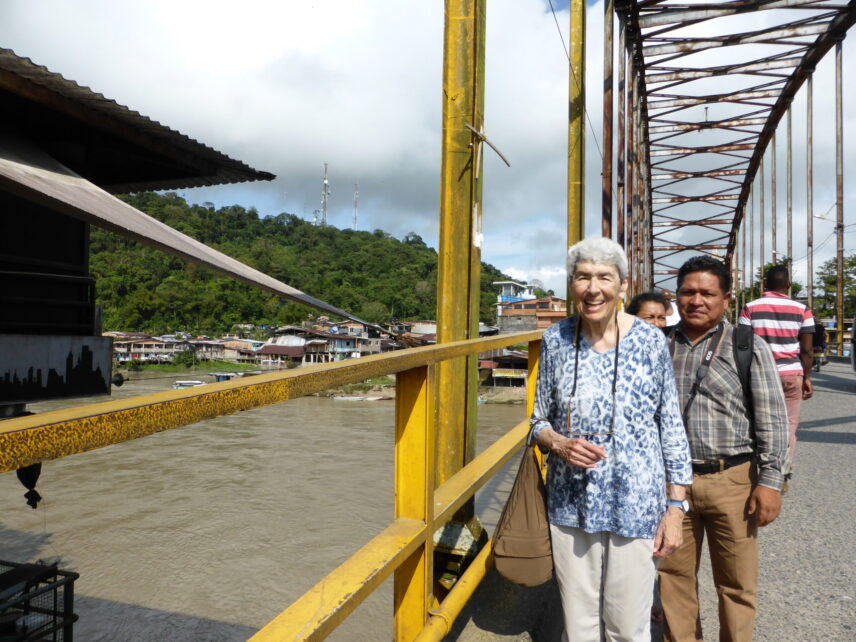
Originally from Brooklyn, New York, Liz was awarded a philosophy degree from Smith College, a master’s in anthropology from the University of New Mexico, and a PhD in social anthropology from Cambridge University. With a foundational commitment to social activism, for her doctoral degree Liz sought to understand how Indigenous Wounaan, in Colombia’s Chocó Department, governed given the absence of police. A National Institutes of Health (NIH) grant funded the research, making possible twenty-seven months of rural study and a spousal stipend to Liz’s then-husband, Perry (the first man to receive one). However, Liz’s doctoral committee erroneously insisted that she must be mistaken about Wounaan equality, particularly gender equality, and required her to substantially revise and resubmit the dissertation on autonomy and social responsibility (Lapovsky Kennedy and Velásquez Runk 2026 in Interwoven Rosewood). The revised dissertation was accepted in 1972. The dissertation, together with the three films that Liz and Perry made, were embargoed given their concern that Texaco, which was oil prospecting in the region, would use the information to take advantage of Wounaan.
Before she finished her PhD, Liz was hired at the State University of New York (SUNY) Buffalo in 1969 and transitioned her area of scholarship to women’s and queer studies. Initially hired in American studies, Liz helped found SUNY Buffalo’s Department of Women’s Studies in 1971, one of the earliest in the US. In addition to her institution-building, over seven years, Liz worked together with Ellen Carol DuBois, Gail Paradise Kelly, Carolyn W. Korsmeyer, and Lillian S. Robinson to author the foundational book Feminist Scholarship: Kindling in the Groves of Academe, published in 1985. Remarking in 2012 on her career building women’s studies, Liz wrote, “I found intriguing and intellectually satisfying such challenges as how to create a nonhierarchical program within a hierarchical institution, how to encourage teachers to develop curriculum that includes all women, how to recognize the oppressed not only for their weaknesses but also for their strengths, how to get feminist courses approved by a traditional curriculum committee, and how to encourage full participation while still leaving time for scholarship” (Lapovsky Kennedy 2012, 123). In 1993, and after thirteen years of community oral history research, she and Madeleine Davis co-authored the book Boots of Leather, Slippers of Gold about the lesbian community of Buffalo from the 1930s to 1960s. The acclaimed volume won the Ruth Benedict Prize of the AAA, the Lambda Literary Award in Lesbian Studies, and the Jessie Bernard Award of the American Sociological Association. In 1998, Liz and Bobbi moved to Tucson, where Liz became head of the Women’s Studies Department of the University of Arizona. Among her many accomplishments there, Liz supported the department’s concentration in Chicana and Latina studies, developed the doctoral program, and initiated the Women’s Plaza of Honor on the campus. In 2018, Liz was the Association for Queer Anthropology’s Distinguished Achievement Award Winner. Her papers are archived at Smith College’s Special Collections and State University of New York at Buffalo’s Archives. Her feminist posters and activist graphics are at the San Francisco Museum of Modern Art.
Over the last twenty-one years, Liz returned to work with Wounaan through collaborations with the Wounaan National Congress and the Foundation for the Development of Wounaan People in Panama, and Julie Velásquez Runk. Under a documenting endangered languages grant of the National Science Foundation and the National Endowment for the Humanities they used Liz’s recorded stories (with those of three other scholars) as source material for linguistic analysis and training of Wounaan linguists. They also digitized, translated, and distributed for free to Wounaan the three films she and Perry made as The Wounaan Trilogy, and digitized Liz’s corpus of over two hundred recordings of Wounaan music and ancestral stories; both sets of recordings are archived under Wounaan control. At the time of her death, Liz was collaborating on the continued rematriation (sensu Gray 2022) of the 1964–1966 research materials to Wounaan in Colombia through the organization Woundeko. These included a thousand color slides, thousands of black-and-white photos, nearly 100 objects, and 38 notebooks. Her final submitted manuscript was co-authored on the practical challenges of rematriation given continued structural violence, restricted archival space, and the absence of climate-controlled facilities with Wounaan data sovereignty.
(Julie Velásquez Runk)