

Article begins
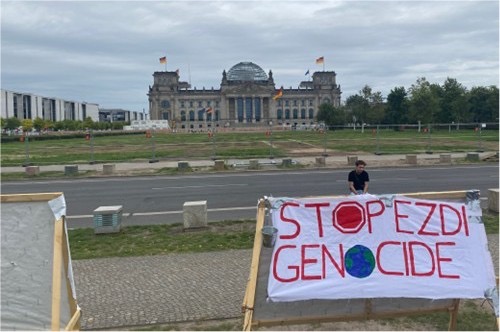
ISIS’s attacks on the Shingal mountains in 2014, which resulted in the death of an estimated 10,000 Yezidis and the enslavement and trafficking of over 6,000 were not, Hatem and Faroukh told me, an isolated episode of violence. The “full truth of our genocide,” Faroukh explained, the German state does not see. Hatem and Faroukh are two young Iraqi Yezidi (variously Yazidi, Ezidi, Ezdi) men originally from Shingal, the region attacked by ISIS in 2014. In August and September 2024, the two men were involved in a 50-day-long protest encampment outside of the German Parliament in Berlin organized by Voice of Ezidis for the Truth of Genocide (Veto-G). The group estimates that about 15,000 people engaged with the displays at the camp or attended one of the associated events. Their campaign sought to show German politicians and the public the extent of Yezidi oppression over the past century and the ongoing conflict with the Kurdish Democratic Party, which leads the Kurdish Regional Government. Events at the camp revealed that threats to Yezidi continuity today and inherited cultural memory of past violence shape not only the possibilities for a Yezidi future in Iraq but also the way young Iraqi Yezidi refugees live in Germany.
Hatem and Faroukh situate the relatively recent Yezidi displacement into Germany within a longer history of persecution. The Yezidi struggle, as Hatem says, is against “forced displacement, political marginalization, and the denial of [Yezidi] identity.” For many Iraqi Yezidi refugees I know in Germany, the history of violence against Yezidis and the ongoing violence in Iraq casts Germany’s engagement with Yezidis in a new light. In my work on Germany’s strategies of refugee management, I have argued that some Yezidis experience programs and policies designed to facilitate integration as unsettling repetitions of previous episodes of forced assimilation—particularly given the feeling of my interlocutors that Yezidi culture is at risk.
Through their activism, Hatem and Faroukh seek to expose the cruelty of Germany’s recent deportations of Yezidis to Iraq, and to challenge Germany’s support of Kurdish political groups who played a role in facilitating ISIS’s attacks on Yezidis. They seek to make visible the unacknowledged dimensions of the 2014 genocide and Yezidi oppression today. In both Germany’s domestic management of refugees and its foreign relations, my Iraqi Yezidi contacts have the same demand: that German policymakers see how the state’s treatment of Yezidi refugees fits into larger, transnational processes. They demand attention to the actions of Germany and other countries that created instability in Iraq, fueled violence against its ethnic minorities, and continue to support certain groups at the expense of others.
The experiences of my Iraqi Yezidi refugee contacts suggest the disciplinary function of the German government’s techniques of refugee management—by which I mean refugee camps, language courses, identity documents, precarious legal statuses, deportation processes, and the like—works through an engagement with an asylum seeker’s personal history and received cultural memory. Yet states, as James Scott famously pointed out, tend to simplify. They are unable or unwilling to see nuance, and what the state does make legible obscures other realities. Scholarship itself on migration to Europe has also struggled to simultaneously capture the dimensions of power in specific tactics of refugee management and how these tactics fit into the longue durée of European involvement in exploitation in the Middle East.
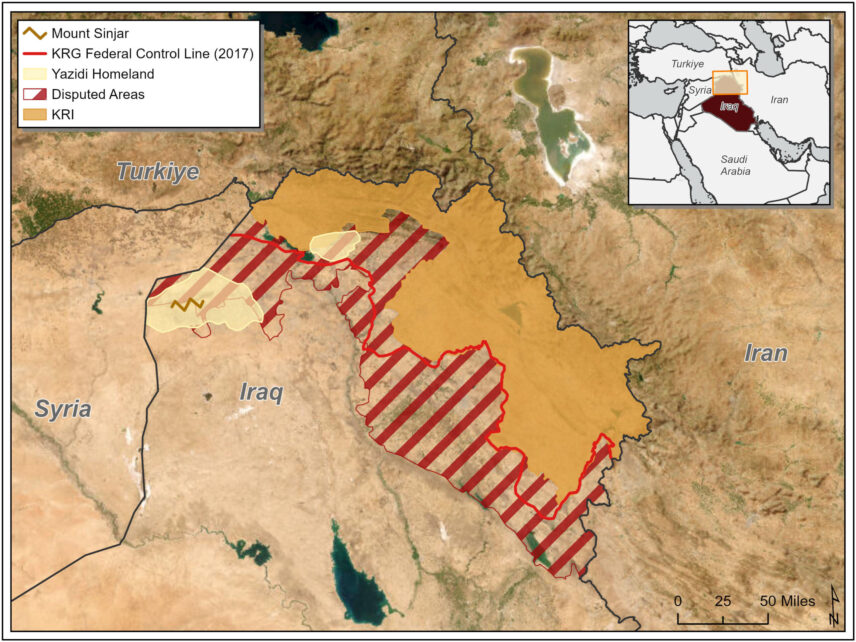
The participants in the protest camp asked passersby to see a broader Yezidi history and understand the precarity of Yezidi life today. Iraqi Yezidis, who are mostly Kurdish-speaking, lived in relatively isolated communities prior to the US invasion on geopolitically significant land situated along the disputed border between Iraqi central government territory and the Kurdish autonomous region. Numbering between 500,000 and a million worldwide, Yezidis are strictly endogamous and practice an ancient monotheistic religion. Yezidis have long experienced oppression, violence, displacement, and forced assimilation, especially during the Ottoman Empire, as a part of the Ba’ath Party’s Arabization projects, and the post-US invasion “Kurdification.”Following the 2014 genocide, hundreds of thousands of Yezidis fled to refugee camps in northern Iraq and Türkiye where many remain. Roughly 100,000 Yezidis fled to Germany, which now shelters the largest Yezidi community outside of Iraq (about 250,000).
Germany has been considered a desirable destination for many Yezidis fleeing Iraq despite the difficulties of life in diaspora. Even as some of my Iraqi Yezidi contacts fear life for Yezidis in Germany might result in a slow-moving cultural annihilation, Iraqi Yezidis have continued to seek asylum in Germany because it has generally provided people with safety and security. In the years immediately following the 2014 genocide, most Yezidis from Iraq were given international protection. Even in recent years when fewer Iraqi Yezidis received protected status, people could still generally expect to move from a temporary “tolerated” status to a more permanent status in Germany if they learned the language and found a job. In late 2023, this changed when Germany began deporting Iraqis, including Yezidis, after an alleged German-Iraqi agreement to facilitate deportations. Amid a rise of anti-refugee sentiment, the German governing coalition formed in 2025 is calling for a significant crackdown on immigration and asylum, though some German states have enacted limits on the deportation of Iraqi Yezidis.
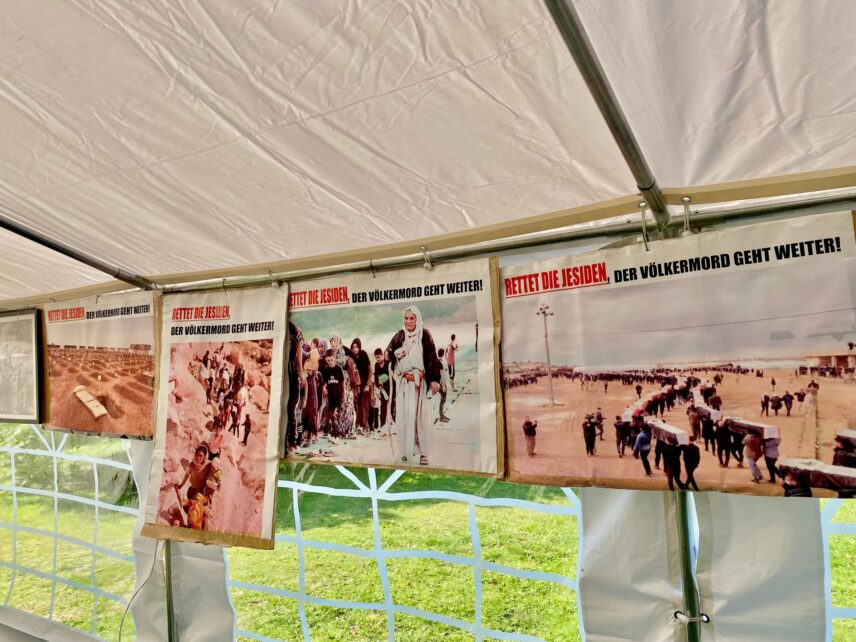
The Veto-G camp was organized partly in response to the deportations of Yezidis since 2023. Their group was not alone in demanding action on this issue; numerous protests, including hunger strikes, have been organized by Yezidis since 2023 calling for an end to deportations and for international protection for Yezidis in Iraq. But on a deeper level, in the content presented to witnesses of the demonstrations and the structure of the encampment itself, the protest camp was a demand for Yezidi visibility. As Hatem told me, Yezidis are “entering a new phase of injustice—one happening in silence.” More than 10 years after the 2014 genocide and a year after the German government formally recognized the ISIS attacks on the Yezidis of Shingal as a genocide, Hatem and Faroukh argued that Germany has refused to see the ongoing persecution of Yezidis or understand how the experience of a long history of genocide and persecution renders Yezidis vulnerable.
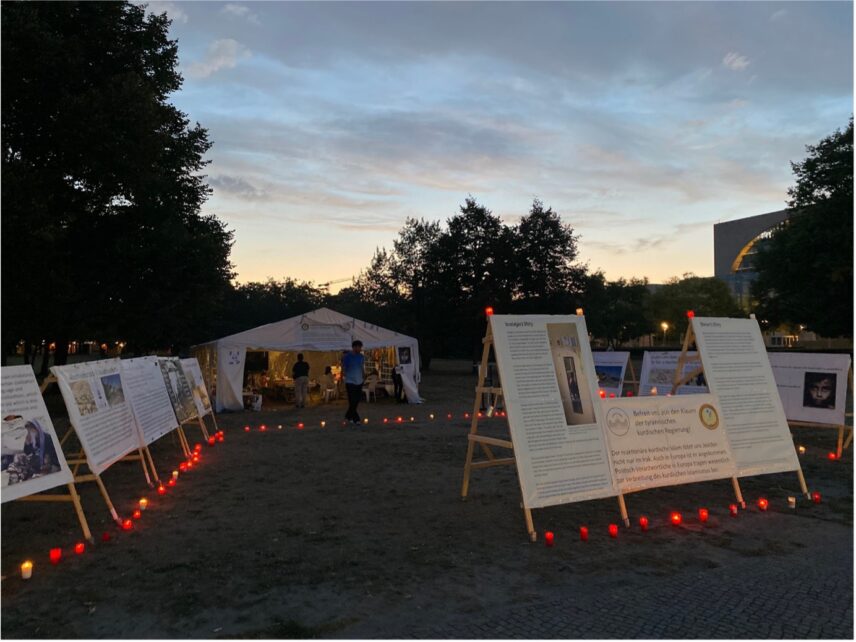
An enduring presence on the doorstep of parliament was a provocative means of demanding visibility, demanding recognition. Encampment and occupation are not new activist tactics. Indeed, in recent years, they have been the mode of choice for social movements over the last few decades, including the Arab Spring occupation of Tahrir Square in Egypt, the Occupy Movement, the Standing Rock protests against the Dakota Access Pipeline, and Palestine solidarity protests. Often these protests work to make injustice visible through ritual and community-building. The Veto-G camp was no different. Hatem described the rough routine of each day: putting out the posters every morning, engaging passersby, taking turns giving speeches or speaking with the media, holding a daily moment of silence to remember the victims of attacks on Yezidis, lighting candles when the sun set, and playing traditional Yezidi music and poetry in the evening. Faroukh spoke of older Yezidi men and women kissing the doorframe of the tent when they visited and bringing food—ritual actions that one would see at a Yezidi temple in Iraq. These small acts lent a spiritual quality to the political work of making injustice visible. For him, this behavior spoke not only to the significance of the activists’ work but also to something that has been lost in Germany. He argued that many Yezidi older people need this kind of spiritual practice but do not have the opportunity in Germany. Of course, he pointed out, they could build a temple in Germany—it would not be hard, he said. But it would not be the same because “Yezidi identity is linked with the homeland,” he emphasized.
Demanding that the full scale of oppression be made visible and that rights are acknowledged is important work that many minorities have engaged in, but scholars in the field of Indigenous Studies have noted that recognition has its limits. As Audra Simpson and Glen Sean Coulthard have demonstrated, the narrow form of recognition that has been the paradigm of liberal politics depends on the very actors who perpetrated acts of violence against indigenous communities acknowledging their actions. Neither see this as the solution for Indigenous futures. Germany’s recognition of the Yezidi genocide and ongoing Yezidi precarity—while still pursuing deportations—is perhaps further evidence of the troubling insufficiencies of recognition.
Hatem, Faroukh, and the others in their group have plans for additional efforts to make the world see the Yezidi struggle. Again and again, Faroukh told me, Germans would ask him at the camp about their government’s role in Iraqi instability or support for the Kurdish control of Yezidi land. These questions are perhaps one hopeful sign that people, if not so easily their governments, are capable of seeing ongoing and systemic transnational violence.
Lauren Crossland-Marr is the section contributing editor for the Society for the Anthropology of Europe.