

Article begins
Even in May, it was still dreary with rain in New England. Beatriz, a former fellow at the Hood Museum in Dartmouth, drove us to a farm in the Upper Valley, a segment of land between New Hampshire and Vermont composed of small towns. Karla Rosas, a Mexican-born artist raised in Louisiana, and Yehimi Cambrón Álvarez, a Mexican-born artist raised in Georgia, hopped out of the car, greeted by the scent of manure and the sight of lazing cattle huddled under a barn. My collaborators at Dartmouth and I organized a multi-day workshop with the artists for our migration courses to center creative practices by migrants. As artists, both Karla and Yehimi contend with the experience of undocumented life in the United States and visualize migrant life through the struggle of everyday life.
Migrant storytelling has “affective economies.” Stories are exchanged, circulated, and performed for specific means. In US publics, the prevalent story of illegalized migrants is one of victimhood or economic productivity. The complexities of everyday life and the way migrants must carry on in raising their families, going to school, and struggling to live safety is often invisible. Perceiving migrant life within this matrix where only suffering or exploitable labor is visible legitimizes limitations placed on migrant life. This essay examines how artists perceive, communicate, and feel for undocumented life, and the ways they make the invisible dramas of everyday life at the center of discussion. This means evaluating the tensions in how artists contend with the often invisible experience of illegalized life, violence, and how they enact possible futures through artworks that call on memories across borders.
Karla and Yehimi’s artistic approach and abstraction deliver a way of making the usually invisible parts of migrant life—the everyday struggles that aren’t sensational, but rather so ordinary—visible. You don’t have to see the faces of the arrested, or the dreamers in rallies protesting in front of the White House, or the scarred hands of campesinos to make migrant lives visible. Migrant life is already in the everyday: in the fabric stitched from warehouses in Los Angeles and the fruits packaged at the grocer, from the students in your classroom to dolls that hold memories of a specific person. Karla and Yehimi’s art conveys the complexities of everyday life and how it is littered with a spectrum of emotions from disembodiment to empowerment. With guidance from the artists, students curated migrant life through a “praxis of care.” Both Karla and Yehimi feature their families in their artworks and contend with the question of in/visibility and must curate what is “on view” for the public. But there’s also the invisible gendered labor they call attention to as they credit their matriarchal lines for passing on the techniques of sewing, knitting, and creating across borders. “Women’s work” of sewing and creation is preserved through the crossing. Their art practices render what is usually invisible about migrant lives—history of gendered labor and emotional care work—visible.
The Textures of Re-membering
At the farm, we arranged tables and chairs for our students and the dairy workers while La Jaula De Oro by Los Tigres del Norte played on a tinny phone speaker. Students piled in one by one as we organized rolls of yarn and trinkets, then Karla demonstrated how to knot and cut the threads. Students picked out their fabrics and wrapped it around a cardboard cutout. “Dolls do things,” Karla explained to the students. She told them of la muñeca de maiz, where dolls were made by taking scraps from the environment such as abandoned corn husks, to enjoy, to transform, to make a desire for something as simple as a doll not only visible, but tangible. We twisted and braided and twisted the fabric to create the dolls. The plan was for the farm workers to join us in this workshop, but they were unable to sit in through the session until lunch. In the following weeks, the students from our course, Migrant Lives and Labor in the Upper Valley, met the farm workers for their English as Second Language sessions and demonstrated the doll-making process. We attempted to unbury childhood desires and make them visible through the dolls.
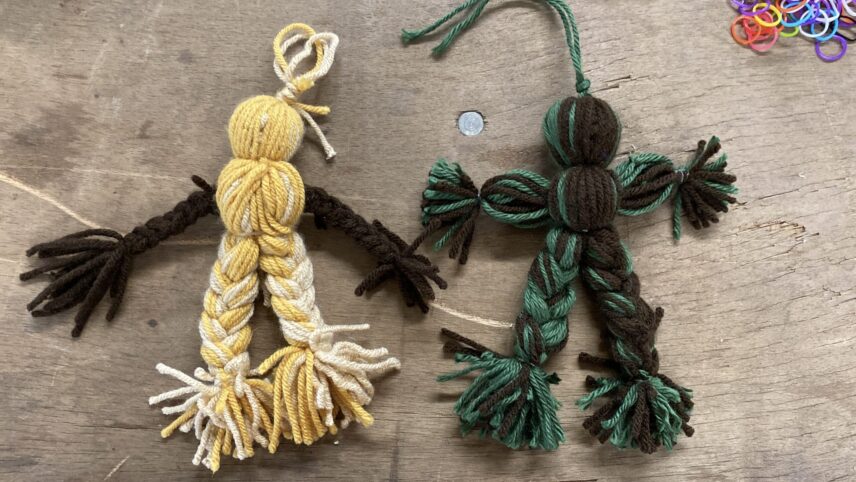
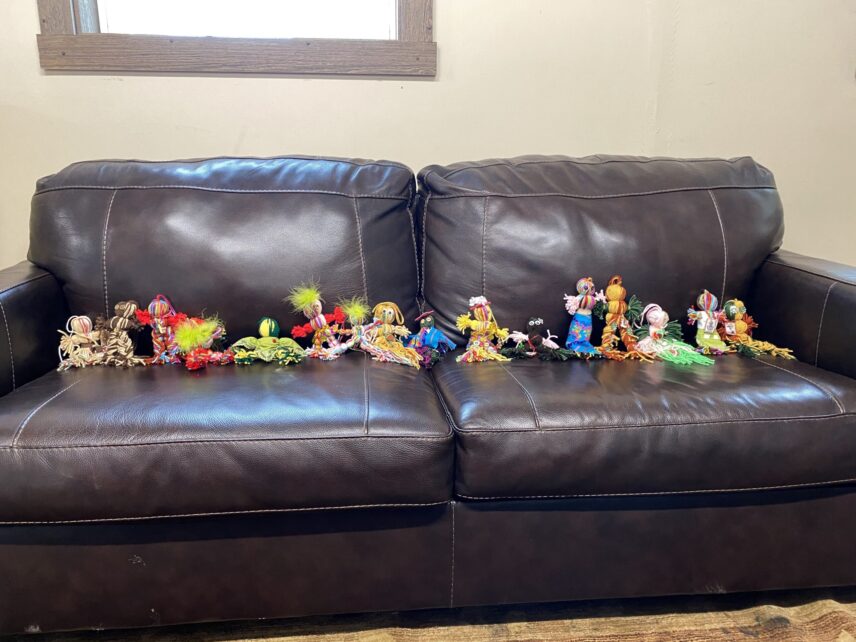
Karla Rosas’ artwork centers migrant narratives beyond (il)legalities. The mundane is a key character in her work across various mediums: painting, sculpture, fabrics. Migrant life, as Karla visualizes, isn’t solely about the sovereign borders that prevent a good life, but how borders exist within one’s emotional states that persist through time. Dolls, childhood objects, are given meaning by their players. Karla staged two dolls sitting on a swing set in Lo que te pasa a ti también me pasa a mí (What happens to you happens to me, too). The two brown dolls, with their bangs made of yarn and eyes made of beads like tears, contain center pieces “corazones de sandia,” which is the alternative title of the piece. “I think of the heart connections i have across borders,” Karla states, “en Mexico, en Palestina, y en otros lugares tambíen. finding power and even freedom in the threads i weave into the fabric of other places, even when i cannot physically be there.” The Instagram post with this installation included a photo of her family playing on a swing set made of fabric and rope. Karla crafted a piece that renders migrant life visible through the everyday without reifying the imagery of violence and suffering. Rather, solidarity and empathy are core themes of the installation’s title, revealing the ways in which migrant life is about forms of care as such as it can be about pain.
In her work with dolls and the workshop with students, play is a key part on portraying the many facets possible in migrant life. Transforming a childhood memory into doll form protects a certain vulnerability: the face of the undocumented living through the ordinary. Dolls make her family visible without showcasing their identities and endangering them, and it also speaks to the invisible labor of love and care in mediums traditionally perceived as women’s work. As Karla states, her work is about “re-membering — putting things back together after colonization, migration, disaster, and loss have broken them apart.” During the time where Kilmar Abrego Garcia was stuck in CECOT and families were picked up by ICE in sanctuary cities, our workshop created in an ongoing era of loss, not only imagining a different world, but trying to actualize it.
From Despair to Repair
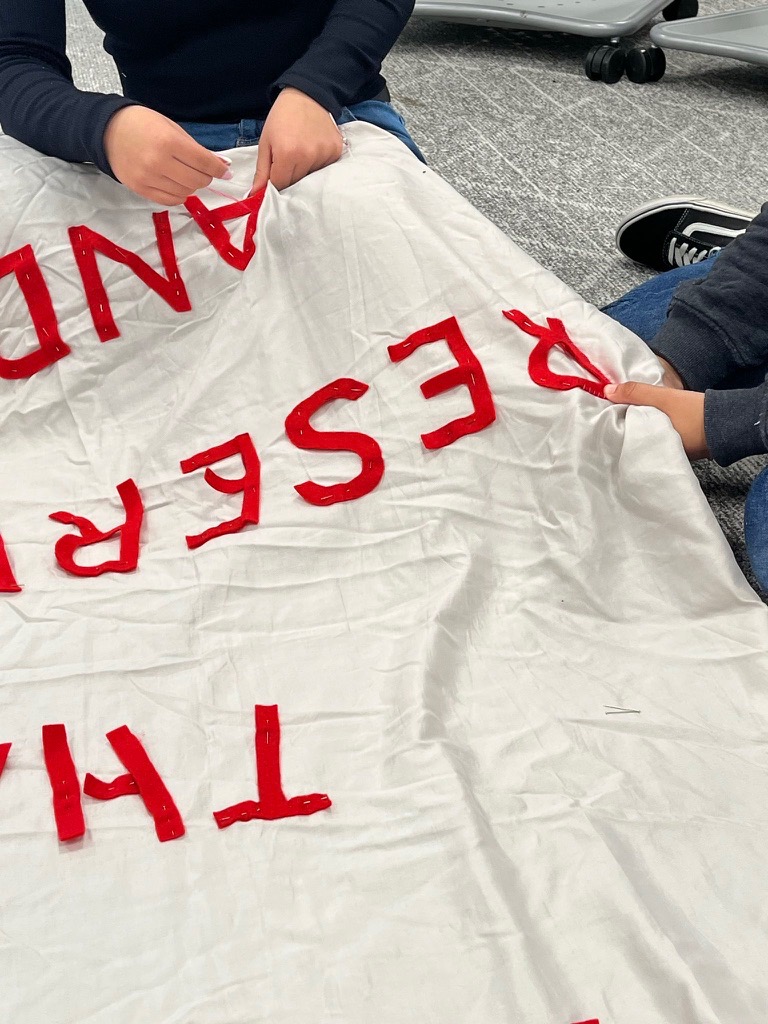
Just the day before, Yehimi led a banner-making workshop with my class, Crossing Over: Latino Roots and Transitions. I wasn’t satisfied with the title I inherited, so I often to refer to the course as Migration Ethnography. I witnessed my students stitching together a banner while they narrated stories of their own migration, that of their families, or their friends as they threaded needles across red fabric that bore the words, “It is in collectivities that we find reservoirs of hope and optimism.” Yehimi and Karla came in with something pragmatic: students were able to craft works that embodied a feeling about migrant life. The banner itself migrated from the hands of another group of students Yehimi worked with to my own students; they are, after all, stitching Angela Y. Davis’ very words into the fabric. The banner will be passed onto other students until it is eventually donated to a group in Chicago—once again, traveling to other hands.
On the same week of her MFA Exhibition at School of the Art Institute of Chicago, Yehimi flew to New England for our workshop. At this time, the news cycle reported even green card holders getting stopped and barred from entry at airports. I was struck with her commitment to join us. Yehimi’s MFA exhibit, A Loving Way to Hold Our Precarity, is a textile installation that draws on matriarchal techniques passed onto her by her mother and grandmother using discarded materials from her family’s furniture projects. Leather and netting are woven together to represent the “various pathways to maneuver in and out of visibility,” as migrants must strategically decide when and how they must be visible or invisible to the public eye. At the initial glance, a viewer may not understand how the textile displays, made of scrapped leather and vinyl, speak to migrant life. You must look closer and draw the curtains to “confront the violence undocumented people face in a country that criminalizes and animalizes our existence to disappear us through exploitation, detention, and deportation.” Whereas the animal is skinned, tanned, and fundamentally transfigured, the migrant accrues a similar procedure living illegalized. Creating leather enforces a transformation through the disfigurement. The process “parallels the systems that intend to break us, coercing us to form our own thick, durable skin.” It asks the viewer to hold onto the experience of the viewing, just as the piece itself serves as a safety net, a place that peaks directly to violence migrants endure, revealing the tensions that exist in unveiling the invisible.
La Muñeca: A Gift for Those who Come After
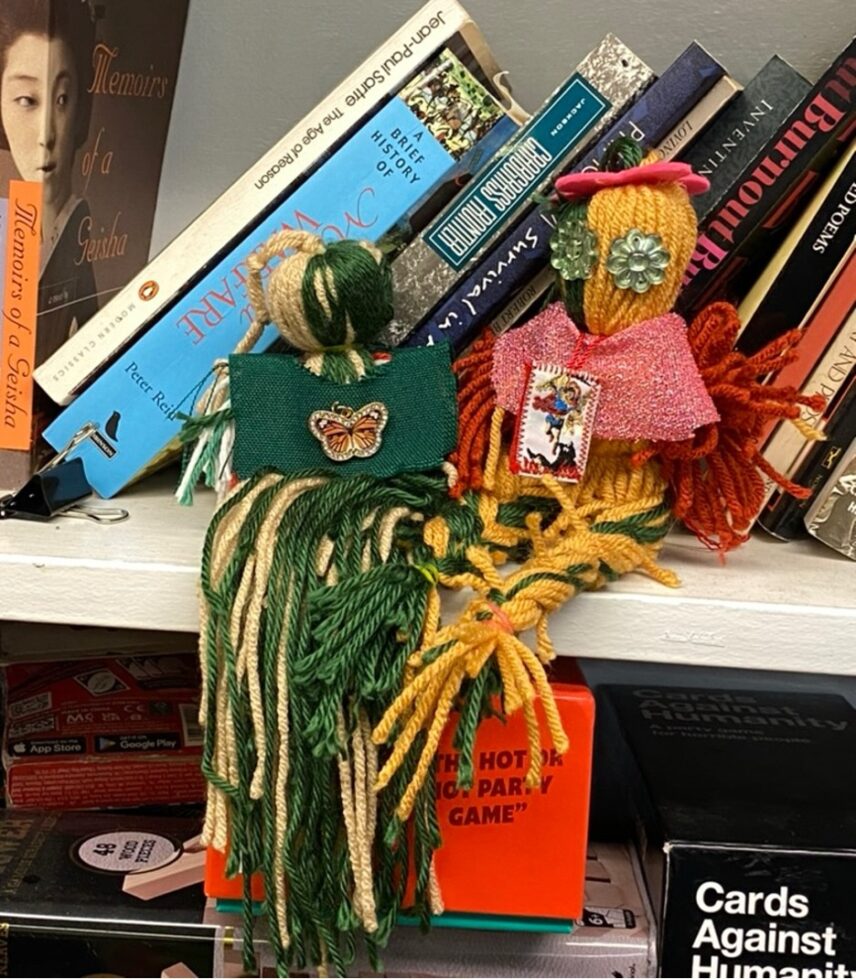
Karla left the once-unfinished doll on the bookshelf in La Casa, a Living Learning Community, for keepsakes, a visible reminder of our brief stint at Dartmouth. A doll for someone to play with, write a narrative for and into. Evidence that migrant lives will exist despite the threat of racial violence in detainment and deportation. Evidence that migrant desires exist, no matter how ephemeral or unfulfilled. These dolls retain the spirit of a migrant imaginary rendered invisible, erased under the mission of illegalization. I can only hope that the doll is cared for too, nurtured, stared at in wonderment, and a curiosity that forces the viewer to weave their own story. Maybe the doll will no longer represent a migrant, but something else. It sits in La Casa, visible, an icon for when migrants must remain invisible to the government and its deportation machine.
Liliana Ramirez and Tannya Islas are the section contributing editors for the Society for the Anthropology of North America.