

Article begins
Months following Algerian independence from French colonial rule in 1962, Shaykh Mohamed Bachir El Ibrahimi, one of the founders of the Jem`iyyat al-`Ulamā’ al-Muslimīn al-Jazā’iriyyin (Association of Algerian Muslim Scholars) was invited to address the first Friday congregation at Ketchaoua Mosque in central Algiers. In a celebratory tenor, he began his address to the crowds that had gathered at the mosque and overflowed onto its steps, congratulating them on their newfound political independence. With a shift in register, addressing the new leaders of the nascent Algerian state, he turned attention to a different kind of liberation, and the question that had driven his work with the Association throughout the three decades prior to formal decolonization.
“I pray for a determination that eradicates colonialism from the souls, as it has been eradicated from the land… O people of Algeria, colonialism is like the devil. Our Prophet, peace be upon him, said: ‘The devil has lost hope of being worshipped in your land, but he is satisfied to be obeyed in lesser matters.’ Colonialism has left your land, but it has not left its interests in your land, nor has it left your tongues or some of your hearts.”
Sitting on the steps of the Casbah and overlooking the Mediterranean, Ketchaoua Mosque had been, since its establishment in 1612, the cynosure of the city and among its most prestigious mosques. Over a hundred years before El Ibrahimi gave this speech, just two years after the beginning of the French occupation in 1830, colonial troops raided Ketchaoua Mosque at bayonet point under orders to convert it into a cathedral, as part of the broader colonial “civilizing mission”. Copies of the Qur’an found inside were set on fire in a nearby public square. When roughly four thousand city residents barricaded inside in protest to defend the mosque, French troops were ordered to attack. The carnage would continue throughout the day of December 18, 1832; it was said that the process of clearing the bodies of the slain and cleaning the mosque and its surroundings would take several consecutive days. The massacre would come to foreshadow a pattern of genocidal violence across successive French governments over the 132 years of colonial occupation, even as their techniques evolved and shifted.
In speaking from the very grounds of the Ketchaoua massacre over a hundred years later, El Ibrahimi indexed the link between “the two colonialisms”: the brutal, carnal, and violent modes of material domination, and the colonialism of the “tongues, hearts, and souls” to which such forms of domination were inextricably bound. He explained that colonialism was not just territorial domination or the “torture of bodies”, but more profoundly, a force that “rips away volition” and “wages war upon moral interiority” of those subject to its effect. “Were [colonialism’s] afflictions confined to material matters alone,” he wrote:
“…the affair would be light. But it goes beyond them to the convictions of the self, to the movements of the secrets of the heart, to the crucible of affect, and to the binds of the soul.”
Taken together, this account of the layered effects of colonialism gestured to a distinct theory of power, in which colonial domination, through operations that reordered the material conditions by which souls could be formed, came to constitute the soul’s deformation.
It was this deformation that the Association sought to counter through its schools. Over twenty-five years, it established hundreds of such schools, known as “free schools” (al-madāris al-ahrār), across colonial Algeria, where Arabic and Qur’anic study—otherwise banned or placed under colonial control—could be taught. Perhaps more importantly, these schools served to inculcate an ethico-political sensibility among their students, through what one of the former students of the schools, Kheira Merzouk, described as “subtle allusions”.
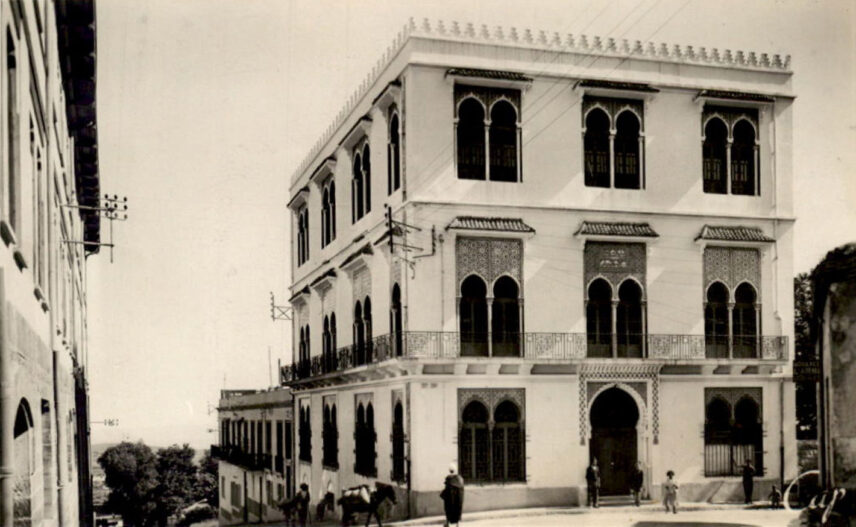
Two years into the Revolution in 1956, Kheira Merzouk, then only seventeen years old, would describe the dismantling of these schools as a fracturing of the self. She recalled her memory of the day colonial forces raided her school at gunpoint, forcing its closure:
“We were studying Qur’an… I even remember the verse we were reciting. In the hallway we found our teachers… lined up along the wall, soldiers shouting at them… There was talk later that one had been killed… When we came back the next day, everything was gone.”
Asked how she felt that day, she gestured to what she had previously described as a rupture within the self (nafs):
“I was split apart (bnādem yanqasim)… That was our refuge. [Placing her hand to her heart] … It was a major heartbreak. It was from there that I went up to the mountains [to join the resistance].”
What was this self (nafs) so affected by colonialism, and for El Ibrahimi and Merzouk so inextricable from the material domination and structural disarticulations of colonialism?
Most often translated as “self” or “soul” in English, nafs, my interlocutors explained to me, carries instead a polyphony of valences, continuously formed and changing through practices of self-cultivation in relation to the divine: the nafs proper as the ambivalent site of moral potential, its rūh as an aspiring spirit, its `aql as discerning mind, its heart as disclosing “hidden depths” (sarā’ib al-qalb), and its hawās as extensions and mediators of the sensorial. The nafs also pertains to a host of external figures and forces: the divine from which derive (and to which are subsumed) all manner of power (malaka), from the powers of political governance to the powers of self-cultivation; the fitra, the inner dispositional and primordial godward pull, and the devil, the malevolent and cunning seducer, to which El Ibrahimi likened colonialism.
It was precisely in this multivalence that the soul was understood to exceed material injury and extraction and to manifest in realms unseen. This irreducibility did not render the soul unaffected by colonial power. Rather, what colonialism could not seize directly, it did so indirectly, through the infrastructures, socialities, and conditions through which the soul’s ethical formation unfolded. It was in this sense that El Ibrahimi would warn of the devil’s cunning.
The colonial disarticulation (tafkīk) of the sustaining conditions (muqawwimāt) of the soul’s traverse—such as Ketchaoua Mosque, Merzouk’s school, and the infrastructures of spirituo-ethical life—constituted a reordering of the cosmology of forces mentioned above. As my interlocutors would remind me, the destruction, cooptation, and fragmentation of mosques, shrines, schools, intellectual lineages, scholars, and their endowments (awqāf) curtailed the conditions of possibility for the cultivation, orientation, and sustenance of the soul and its communities of belonging.
Yet colonial domination remained necessarily partial and non-totalizing. Consistently, my interlocutors would return to the divine in their accounts of colonialism’s effects. As another of the Association’s graduates, and later volunteer in the armed struggle, Zhour Doumaz, would quip about her role in the revolutionary struggle: “This was never, after all, France’s land. It is God’s earth.”
For her, colonial effect, though devastating as it passes through materiality and approaches the interiorities of the soul, is marked nonetheless by an outer limit. In other words, while colonial power can reach deeply into material life and shape the formation of the soul, it cannot claim ultimate authority over it, because the soul’s relation to the divine exceeds worldly rule. And through this radical ungovernability of the soul, Doumaz finds the outer limit to worldly power, and perhaps most profoundly, a limit to the hubristic, decidedly colonial, imagined “Sovereignty” of the human.
After the closing of her school in 1956, Merzouk answered El Ibrahimi’s call for the Association’s graduates to join the National Liberation Army of the FLN (National Liberation Front), in which she served as a teacher and guard. She recalled the disorienting euphoria when she and her fellow volunteers heard that independence had finally been declared in 1962:
“An [FLN] general came to us and said, ‘You have been liberated; you have been liberated!’ And so we walked for many kilometers [back to camp], but… [laughing] … everything still looked the same. I was thinking, ‘Where is this independence?!’”
Though marked with a kind of gallows humor, her question was consistent with her narration of the multivalent sitedness of power. She had earlier described, for example, in stark contrast, a deeply embodied and affective experience during the Revolution when the FLN’s forces appeared to be on the verge of defeat. In almost inconceivable conditions, she gave birth in a snowy alley between two barracks. The sound of the crying baby was received as an indication of liberation, prompting one of her comrades to declare, “We are free! We are free!” (taḥarrarnā! taḥarrarnā!).
Narrated decades after independence, amid the disillusionments of a postcolonial, late-liberal present, Merzouk’s question—“Where is this independence?”—was stated with the ambivalence of hindsight. Hardly signaling a retreat from material politics in invoking the elusiveness of independence—the colonialism El Ibrahimi warned remained in hearts—Merzouk pointed instead to both the necessity, and necessary limitations, of both material decolonization and the spirituo-ethical work of self-formation. In recalling the refuge she found in her school as a teenager, she gestured towards the necessity for this work to reside in the “free” institutions and community infrastructures of ethical life. It was in this entanglement and tension, between the pragmatic need for political decolonization and the imperatives of the soul, that independence could be sustained as more than a formal administrative achievement, and that it could be reimagined as an enduring practice of ethico-political possibility.
Naomi Haynes is the section contributing editor for the Society for the Anthropology of Religion.