

Article begins
Honoring the lives lost and renewing calls for justice, St. Anthony’s Shrine in Colombo held special services on April 21, 2025 commemorating the sixth anniversary of the deadly Easter Sunday suicide bombings. The church was one of three targeted in a series of coordinated suicide attacks by several Muslim extremists, which killed more than 250 people and injured 500 others. As I walked through the church procession, I found myself reflecting on the aftermath of those attacks.
I remembered June 3, 2019, when organized masses across Sri Lanka took to the streets in support of Athuraliye Rathana Thero, then a parliamentarian and a prominent monk undertaking a fast unto death. Rathana Thero, a pioneer of the militant Buddhist movement in the mid-1990s, warned of a Buddhist demographic decline amid perceived Muslim and Christian expansion and advanced anti-pluralistic religious politics. Sitting on the steps of the Sri Dalada Maigava, the sacred tooth relic of Buddha, the symbol of Sinhala Buddhist sovereignty, he demanded the resignation of a Muslim cabinet minister and two Muslim governors accused of aiding the suicide bombers in the Easter Attack that had targeted Christian churches, along with several secular sites earlier that year.
Despite the widespread criticism that the attacks were the work of an invisible state or the secretive illuminati of the deep state, the government traced the bombings to Jihadist Sri Lankan militants linked to the Islamic State. These militants had been largely invisible prior to the attacks. In the aftermath, Rathana Thero’s fast unto death became a spectacle of deep-rooted rumors, suspicions, and vengeance against Muslims—pernicious habits that reveal the structural violence of the Sri Lankan state.
As the monk’s health declined on the fourth day, his demands gained traction in the media via an affective circulation of grief, anger, and despair which seemed to inspire people. Rumors spread that Sinhalese, both Buddhist and Christian, were planning to exact vengeance on the bodies, spaces, and commodities of Muslims of all classes in several districts in the Northwestern and Western Provinces. In some localities, these attacks amounted to a mini-pogrom. That evening, all Muslim elected representatives—nine cabinet ministers and two provincial governors—resigned. Many Sinhalese Buddhists lamented that the resignation symbolized the “brotherhood” among Muslims that they themselves lack and will never have. The forced resignation was an insurrectionary act, not in the Marxian sense of a violent takeover, but in the sense of an interruption in state power. Such a breakdown of the contingent social equilibrium reveals the chain of equivalence necessary to sustain this force—a common front that typically goes unnoticed or invisible until, as sociologist Bruno Latour suggests, things fall apart.
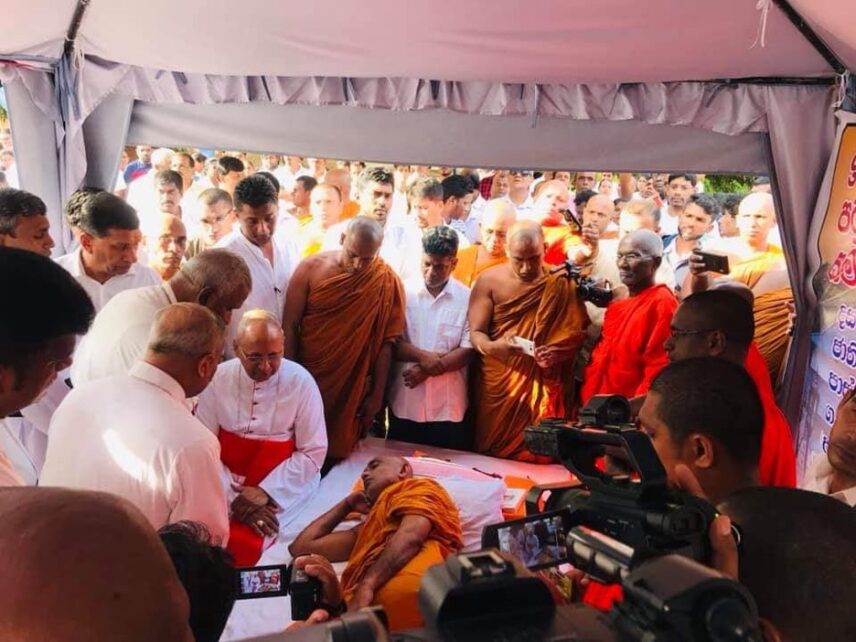
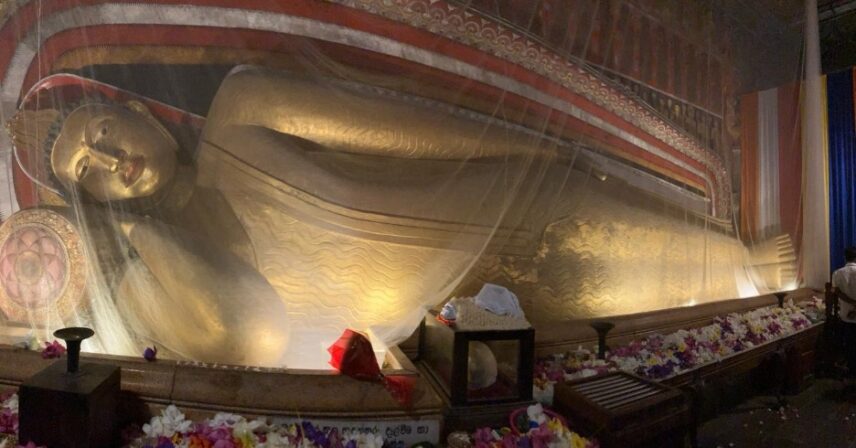
By drawing continuous media attention, Rathana Thera gathered support across ethnic and religious lines, transcending the immediate context of the Easter attack. Public and private TV channels broadcast the hunger strike from dawn to midnight, portraying him as a hero willing to sacrifice himself for the “country, nation and religion.” Cameras often zoomed in on him lying on his right side, head resting on his elbow, evoking the Buddha’s Parinibbāna posture. It was a spectacle designed to imbue the act with an added dimension of religious piety by engaging in the visual semiotics of the Buddha’s own death. Rathana Thera, with his peaceful and non-violent pose, assumed the posture as “a son of the Buddha,” not only an epithet for monks, but as a tool to deploy Buddhist piety in anti-pluralist politics. While his fasting responded to the perception of growing danger and the ambivalence of Sinhalese ethno-nationalism in the context of a pluralistic society, his posture conveyed the opposite of vengeance, as if reminding the public that neglecting his body—a symbol of Buddhism—was a severe profanation. These images and the sentiments animating them were highly effective.
I recalled it was the fourth day of Rathana Thera’s death fast. The midafternoon heat was unbearable as I walked along the Maradana-Colombo Fort Road. Several hundred white-clad lay Buddhist men, with a few women, marched down the street, ordering shopkeepers to close and join them. As they passed, their refrain rang out: “This is our country; this is the Sinhalese country!” Despite heavy police and army presence, it was unclear whether the protesters or the police had more authority. The state’s prerogative for imposing order—its ability to control the mass mobilization—seemed suspended, perhaps in anticipation of violence.
This suspension of state power, the spectacle, and the heightened emotions surrounding Rathana Thera’s hunger strike, were paving the way for another “crucial punctuation point” in Sri Lanka’s modern history, echoing what anthropologist Pradeep Jeganathan identified with the 1983 Sinhalese violence against Tamils. Then, riots began in response to the killing of 13 Sinhalese soldiers killed by the Liberation Tigers of Tamil Eelam, leading to “Black July”—a massive wave of violence against Tamils—killing, burning, and harassment, largely carried out by Sinhala men from urban and suburban working- and lower-middle-class backgrounds. Thousands were killed, and billions of rupees worth of property was destroyed. It was a moment of terror on an unprecedented scale in Sri Lanka, making visible whose lives mattered. Though I did not witness those events, Rathana’s fast hovered on the edge of another “Black July,” feeding the same discursive potential for episodic, anti-pluralistic violence.
Disturbed, I kept refreshing social media, tracking the unfolding drama. Unedited videos flooded chat groups, capturing chants: “This is our country; we shouldn’t give it to the Muslims; deport them to Arabia.” Some of my Facebook friends shared calls to gather and travel to Kandy. Buses carried banners: “Honorable Thera, you are not alone. We, Christians, attacked in Kahatapitiya, support you.” A Tamil parliamentarian and two Tamil priests fasted in front of their Hindu temples in support of Rathana Thera. These consolidated sentiments reveal, amongst other dynamics, the popular anti-Muslim lore that united Sinhala Buddhists, Sinhala Christians and Tamils against Muslims despite their religious and ethnic differences.
Meanwhile, a media campaign aspiring to criminalize the veiling of Muslim women became prominent almost simultaneously, as if prohibiting veils would obviate future attacks. It became clear that anti-Muslim sentiments were not merely the purview of a militant Buddhist arena of politics, but had spread widely across the island. Sinhala Buddhist militancy against Muslims, with its history of episodic violence, re-emerged in the aftermath of the tragedy. In this moment of suspended “normal” political discourse, new and often hidden currents of Islamophobic solidarity—forged across previously divided ethno-religious lines—became visible.
At one point during the fast, cardinal Malcolm Ranjith, Colombo’s Catholic Archbishop, visited Rathana Thera. Social media buzzed with criticism, saying his visit legitimized Rathana’s demands. At the same time, Galabodaatte Gnanasara, another prominent monk who had earlier gained notoriety as the figurehead of contemporary Sri Lanka’s most vociferous anti-Muslim activist, visited his fasting colleague. Previously jailed for contempt of court, Gnanasara received a presidential pardon just one week after the Easter Sunday attack, perhaps a tacit acknowledgement of his warning against the rise of Salafist Jihadists in Sri Lanka. In a rousing speech, Gnanasara blamed the government: “for those who have gone to jail, death is not a surprise,” he said, reminding followers of their ability to rally against the state, and their readiness to die causing island-wide pandemonium unafraid of state power. The powerful Asgiriya and Malvatta monasteries, which hold the exclusive right to joint custodianship of the Tooth Relic, released a statement asking the president to respect Rathana’s demands.
Ultimately, Rathana Thera’s fast had the effect of consolidating previously covert Islamophobic commitments—not just among Sinhala Buddhists, but also within some of the island’s Christian and Hindu constituencies. It galvanized seemingly disparate anti-Muslim sentiments and made visible the state’s antagonistic politics, with monks as de facto sovereigns. Rathana Thera was able to suspend the normal order, a power that is normally wielded only by a sovereign. And, inasmuch as Rathana Thera’s goal was the removal of duly elected Muslim MPs from their posts, those Muslim ministers who did in fact resign were made to do so solely on the basis of anti-pluralistic pressure, and without a democratic procedure in the parliament. In this respect, Rathana’s hunger strike operationalizes the power and structural possibility of interrupting normality, law, and due process on the part of activist monks by foregrounding the position of the victors—those whose terror is often normalized and thus only made visible at exceptional times.
Angie Heo is the section contributing editor for the Society for the Anthropology of Religion.