

Article begins
From ancient DNA to baby bonuses, the persistent myth of the nuclear family conceals diverse kinmaking practices.
Even without context, many people will recognize the object depicted in Figure 1. The multiple rows of circles and squares connected here and there by horizontal and vertical lines of varying lengths represent a genealogy—a visual depiction of family relationships. Without consulting the key, some may even intuit what the different shapes represent: circles indicate biological females and squares biological males. The different colors represent different family lineages, many of which are interconnected in a single pedigree (Pedigree A) that spans seven generations and includes 64 individuals.
License: CC BY 4.0 [https://creativecommons.org/licenses/by/4.0/]
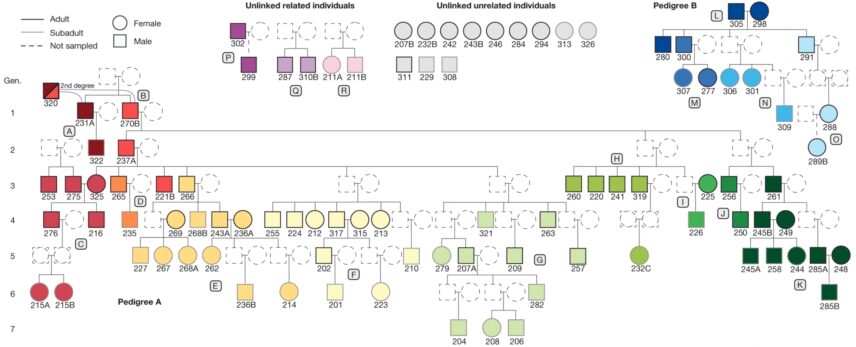
That this genealogy is based on genetic data extracted from human skeletal remains of individuals who lived roughly 6,500 years ago in France would have seemed remarkable ten years ago, but such studies are rapidly becoming commonplace. Technological developments in sampling, sequencing, and analyzing archaeogenetic data from individuals who lived hundreds or thousands of years ago produce high quality genetic data that could revolutionize our ability to study kinship in ancient societies. Unfortunately, these studies seem to be having the opposite effect; instead of providing new insights into kinship in the past, they are simply projecting contemporary Western ideas about relatedness—the characteristics that make people kin—and ideal family forms onto cultural contexts where they may not belong.
Closer to home, two recent articles by Caroline Kitchener in The New York Times describe how the second Trump administration is workshopping strategies to strengthen the American family. Proposals include incentivizing married couples to have more kids by paying out $5000 baby bonuses and rewriting the tax code to make it more affordable for one parent—*cough* the mother *cough*—to stay home with the children instead of using outside child care.
Although they may seem unrelated, archaeogenetic studies of kinship and conservative efforts to promote “traditional” family values share much in common. They reflect the beliefs that “real” families are connected through genetic (née blood) ties and that the nuclear family is the fundamental human family. Intentional or otherwise, our ongoing cultural idealization of genetic relatedness as “real” and social relatedness as “fictive” and our belief in the myth of the traditional nuclear family function to conceal other kinmaking practices and real family groups.
Anthropologists have understood for decades that folk ideas about relatedness influence the way we study kinship, but for those of us who do not study living people, this is a hard lesson to learn. Across Western societies, kinship is thought to be based on shared biological essence. These beliefs about what makes people kin continue to shape archaeogenetic methods we use to investigate kinship, especially in ancient societies, and simultaneously restrict the types of relatives, kinship practices, and family groupings we can detect in archaeological contexts. If shared biological ancestry creates kinship, then to study kinship in the past we need methods that yield evidence of shared biological ancestry. However, this contributes to what the psychologist Daniel Kahneman referred to as theory-induced blindness. Because we assume kinship is a relationship based on shared biological ancestry, we are ill-prepared to recognize kinship based on social relatedness, what social scientists tend to call “kinning” or “kinmaking.”
Archaeogenetic approaches to kinship are designed to identify genetic relatives within cemetery samples; they are not intended to find or identify social or “fictive” kin, those based on adoption or other cultural practices for making kin. The rise of ancient DNA methods to study kinship in archaeological contexts is reinforcing the idea that nuclear families and biological kinship are not only traditional American values but are the universal and natural family unit and method of kinmaking, respectively, for our species.
The identification of biological relatives in cemetery contexts can only tell us so much about kinship because kinship is an intergenerational web of social relationships. In many societies, social kin relationships align with biological relatedness, making biological data potentially informative of kinship in those contexts. However, not all kin are biological relatives. Many of us have kin who play important roles in our lives who are not biological relatives. These include spouses; in-laws; aunts and uncles by marriage; stepchildren, -siblings, and -grandchildren; adopted or fostered children, siblings, and grandchildren; and other social or so-called fictive kin. Genetic data are unable to detect these types of kin relationships, yielding at best a partial understanding of ancient kinship. In societies where discourses of relatedness are less reliant on shared biological essences such as blood and genes, this biocentric approach to kinship represents a form of scientific colonialism that conceals the diverse ways in which ancient peoples forged kin relationships and established familial networks.
Genetic genealogies, like all variations of family trees, are not neutral depictions of naturally occurring phenomena. They are better thought of as graphic designs invented to convey socially significant and culturally biased types of information about ancestry and family. Genealogical models of relatedness based on inheritance of shared biogenetic substance have served as the standard way to represent—and therefore think about—kin relationships in Western society since the Middle Ages. Drawing from traditions dating to classic antiquity, eleventh-century Christian scholars formalized the genealogy depicted as a family tree to represent Jesus Christ’s ancestry. Although Euro-Americans tend to take the language and symbols of genealogies as natural aspects of kinship, genealogies were produced through experiments with different visual tools and organizing metaphors.
Genetic pedigrees may reveal certain types of kin relationships, and in doing so, they conceal other types of kin relationships that they are incapable of detecting. Returning to the pedigree chart from Gurgy, consider the grey circles and squares at the top center of Figure 1, those labeled “Unlinked unrelated individuals.” Genetic investigations of kinship create two categories of persons: genetic relatives and nonrelatives. Virtually all archaeogenetic studies focus their interpretive lens on the genetic relatives and largely ignore the nonrelatives. Perhaps viewing them as nonrelatives is the issue. While acknowledging these individuals may not share a close genetic relationship with other analyzed individuals from the cemetery at Gurgy, it may be more productive to consider them differently related rather than nonrelatives. Perhaps these were social kin, relatives created through social practice and cultural customs instead of created via the circumstance of birth.
This problem becomes compounded when findings from these studies are picked up by mass media, often with nuance and interpretive qualifications lost in translation between academic and general audiences. Roughly 4,600 years ago, four bodies were carefully arranged in an oval-shaped pit identified as grave 99 at the Neolithic burial site of Eula near the town of Naumburg, Germany. Following their excavation in 2005, the remains were determined to be those of an adult female, an adult male, and two children. Ancient DNA analysis indicated genetic relationships between the woman and the children and between the man and the children.
The site’s excavators referred to grave 99 as evidence of a “classic nuclear family,” and mass media headlines eagerly played up this trope. The other mass burials at the site received little to no mention in press releases, even though they may reflect common contemporary American families: a potential stepmother buried with three children (grave 98) and a potential single father of two (grave 93). It is difficult to overlook the fact that reportage of this remarkable site focused on the one burial that conforms to the ideal Western family form and obscures alternative family compositions. The former was made highly visible whereas the latter remained invisible except to those who read the original journal article—scholars and other specialists.
It would be reductive and inaccurate to suggest that media coverage is solely responsible for perpetuating the nuclear family fallacy; archaeological research is also complicit. In 2008, archaeogenetic approaches to kinship were novel; now they predominate archaeological kinship research. This is problematic because archaeogenetic studies operationalize Western ideas of kinship rooted in biological relatedness. So folk beliefs about kinship and family shape academic approaches to kinship and family, which end up finding evidence that supports their baked-in assumptions and biases. This scholarly evidence is used to further promulgate the myth of the nuclear family and the primacy of genetic relatedness as the foundation of kinship and justify government initiatives to strengthen the traditional American family, which has never really existed in the way or to the extent we believe it has.
When those views shape policy, they effectively punish the substantial percentage of American families that do not conform with the nuclear family cultural ideal. Incentivizing marriage and birth rates among heterosexual couples penalizes and discourages “nontraditional” families. As Kitchener writes, these initiatives are “part of a broader social agenda being pursued by the Trump administration and its allies to promote a very specific idea of what constitutes a family—with a married mother and father who have as many children as possible, a concept that leaves out many families that do not conform to traditional structures or gender roles.”
With the increase in ancient DNA studies of kinship, genetic relatedness continues to overshadow social relatedness and conceals the flexible ways members of our species have used creative kinmaking practices to forge family networks. To counter this, archaeologists need to collaborate with geneticists and sociocultural anthropologists. We need to implement diverse theoretical and methodological approaches to kinship in the past, and we need to support scholars who can draw from diverse backgrounds, experiences, and worldviews to develop those frameworks. Instead of assuming that shared biology automatically makes people kin, we need to investigate how people used discourses of relatedness to create kin relationships and residential family groups beyond nuclear families. What made people kin in different cultural contexts? How did people use kinship to build communities? How were kin relationships affected by larger social, political, and environmental conditions? These are much more interesting questions compared to which individuals in a cemetery shared the same genes.