

Article begins
Coming into the Shift
It was a hot July Saturday in Seattle, well into the 90s (over 33°C). Our shift ran from 2:30 p.m. to 11 p.m.: another wedding. I arrived tired. Several coworkers said the same when we traded greetings.
The night before, I’d worked a long fundraiser with more than a hundred staff. I picked up the shift through one in-house employer to support another that was short-staffed. Most workers were that company’s regular employees. Temps filled the gaps, arriving in two ways: some, like me, through personal contacts; others via staffing apps such as Instawork. That night, I saw three in-house coworkers and a few I had overlapped with only once or twice, mostly when Instawork sent them to a company where I worked, and occasionally when I was temping elsewhere.
Among people who had worked together briefly, routine small talk about which company and which event showed how crews move across Seattle’s catering scene. Fluid affiliation holds the industry together as reputations, stories, and networks travel with us. While the scene does not fully meet the criteria of an unbound community I discussed elsewhere, its porous, mobile ties echo aspects of it.
Construction complicated the walk from the light rail station; I cut through a blocked zone and was assured I was at the right venue when I saw the bride in her white dress posing for photos. As I walked up, I introduced myself as one of the caterers to a man in a suit who turned out to be the bride’s uncle. We exchanged a few friendly words. A small moment of mutual invitation: his family’s world merging with ours, the hired help, for the day.
Catering places us at life’s markers—weddings, funerals, mitzvahs—rituals that exceed logistics. Food frames these transitions, shaping guests’ experiences and ours as workers.
Research Among Peers
I try to be open about when I’m doing research, though in practice the lines can blur. We’re people being people together, and it is not always clear when or how to pause and announce that something is “fieldwork.” I aim for openness, even if the execution is sometimes imperfect.
I had decided in advance I wanted to write about this shift. I checked in with coworkers one by one when we had a moment alone, explaining that I wouldn’t use names or the company’s name. Reactions ranged from casual, “Oh yeah, that’s fine, I don’t care,” to curious: “Do you have any particular publications in mind?” A few responses were enthusiastic: one coworker said someone should make a reality show or sitcom about catering, and another, just finished with undergrad and taking time before graduate school in a field not far from anthropology, was especially engaged. Despite it being our first night working together, an intellectual kinship was created.
Getting Ready
Several coworkers were already onsite when I arrived, and we began setup while waiting for the two leads to arrive in their white vans with food, drink, and supplies from the shop. Delays are routine: traffic, last-minute holdups, slow departures.
We would have eight staff for a little over a hundred guests: event manager, lead, chef, bartender, and four servers (one floated behind the bar to cover a gap). It was a mixed-gender crew; the majority were women. Ages ranged from early twenties to early sixties, with most somewhere in between. The front-of-house staff appeared to be Euro-American, while the chef—who was Mexican—worked in the back-of-house. The crew’s age, gender, and ethnic distribution reflected broader patterns in Seattle catering, though these vary across companies, staffing rosters, and individual events, and are by no means universal.
While we waited, we set tables through individual piecework that quickly formed a greater whole. The setup was simple, buffet style: plates at the buffet, a single knife and fork at each place, napkins already folded. I suggested my coworker do forks while I did knives.
Duk, duk, duk, duk. Done.
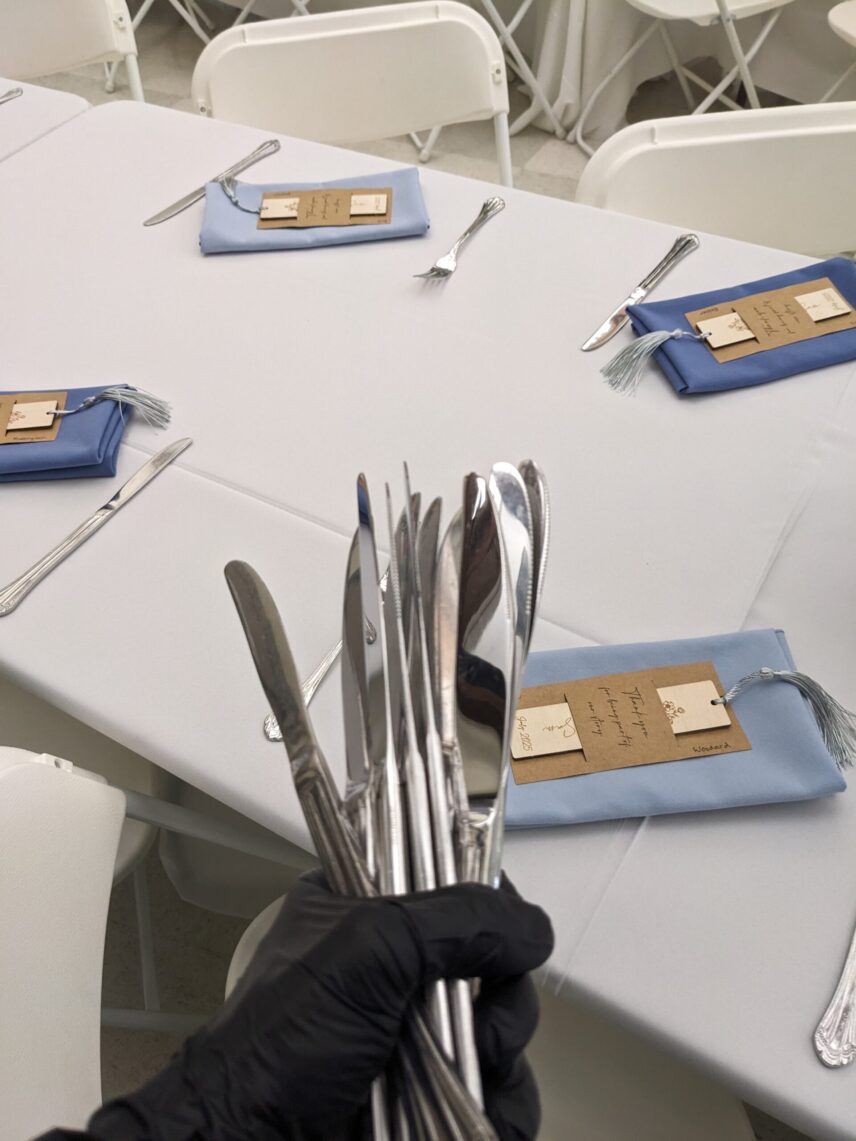
Next came water glasses, another collective task. It was hot and ice was limited, so we filled glasses in racks and slid them into the fridge until dinner. Improvised adjustments like this are second nature; we figure things out on the fly.
When the vans arrived, we helped with the load-in, lifting, balancing, stacking carts, rolling them up ramps and through hallways. Load-in carries us into the heart of event time, the same exertion that will close it.
We spotted each other as we pushed carts, guarding against toppling piles. In catering we learn to move as extensions of one another, becoming larger bodies made of many bodies, ideally in concert. Marcel Mauss called these choreographies “techniques du corps”: habits of the body learned until they live in muscle and stance. I’ve felt this in my ethnographic work as well, learning Tenrikyō ritual movements and, more recently, participating in Butoh trainings as fieldwork, both from Japan, kinesthetically distinct yet grounded in the same truth. The mind may grasp the form, but the body learns by doing. The “we” is made in doing, not declared in advance. Teamwork makes the dream work. That making has a mechanism: embodied consistency—shared forms that settle in bodies over time.
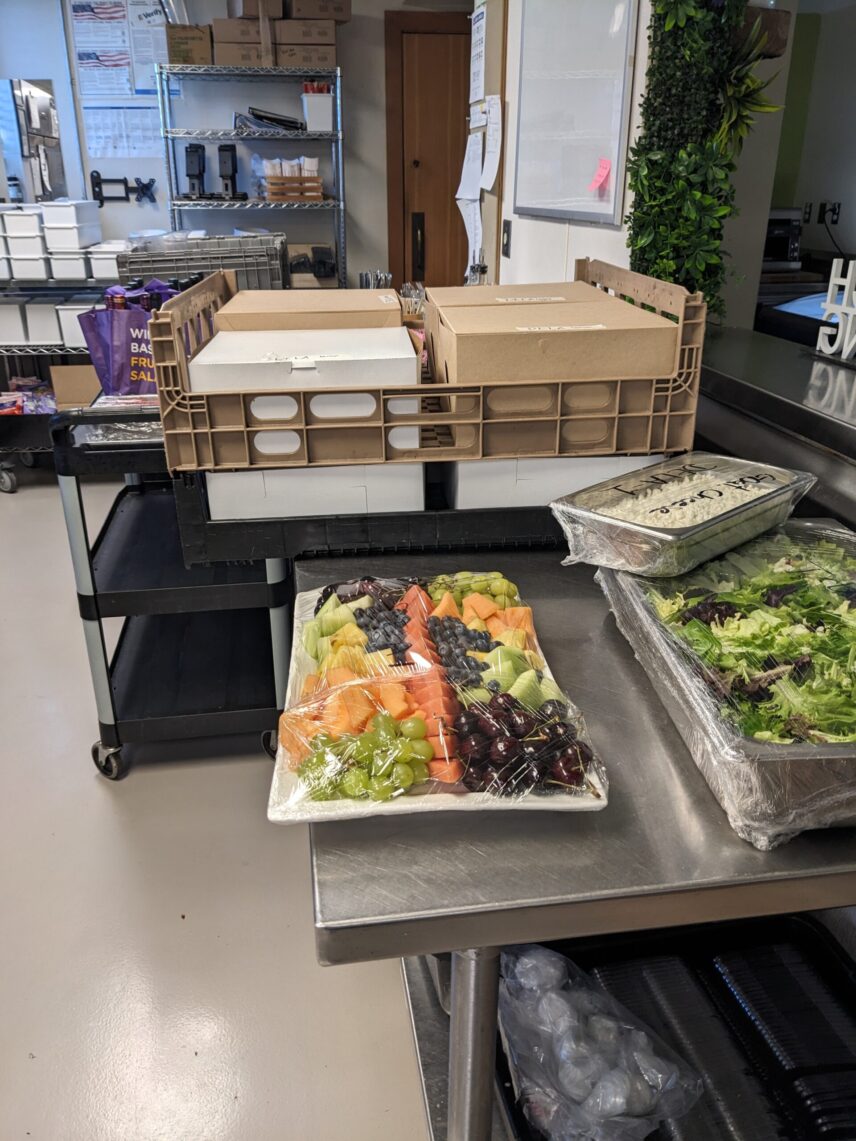
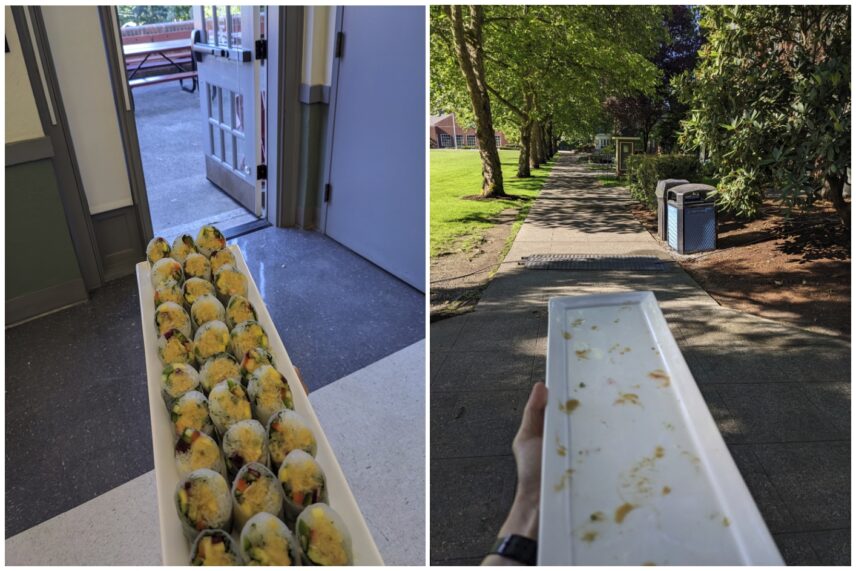
Once inside, we faced the usual puzzle of fitting our food and equipment into an unfamiliar kitchen already full of venue supplies. The chef raised a question about the miso-ginger sauce for the spring roll tray-passed appetizers. Through a mix of English and Spanish, we worked it out: not a big bowl—which would be awkward and precarious while passing—but small dollops on each piece. A little later, another server carefully topped each roll. Whether typical or not, pitching in so the show goes on is standard.
Cocktail Hour
Word came that the ceremony had ended and guests were spilling into the courtyard for cocktail hour. Roles had been assigned. I volunteered to pass appetizers, as I often do. Passing apps gives me the right rhythm: brief exchanges, small windows into groups’ ways of being. Carrying a tray allows entry into conversations, justified by the offering. Without it, the same movements would be odd; with it, expected.
Two of us were assigned to passing and one to bussing. In practice, we flowed between roles, trading trays, bussing glasses, matching appetite and supply. The courtyard was a three-to-four-minute walk from the kitchen and dining hall, so the work became a constant back-and-forth.
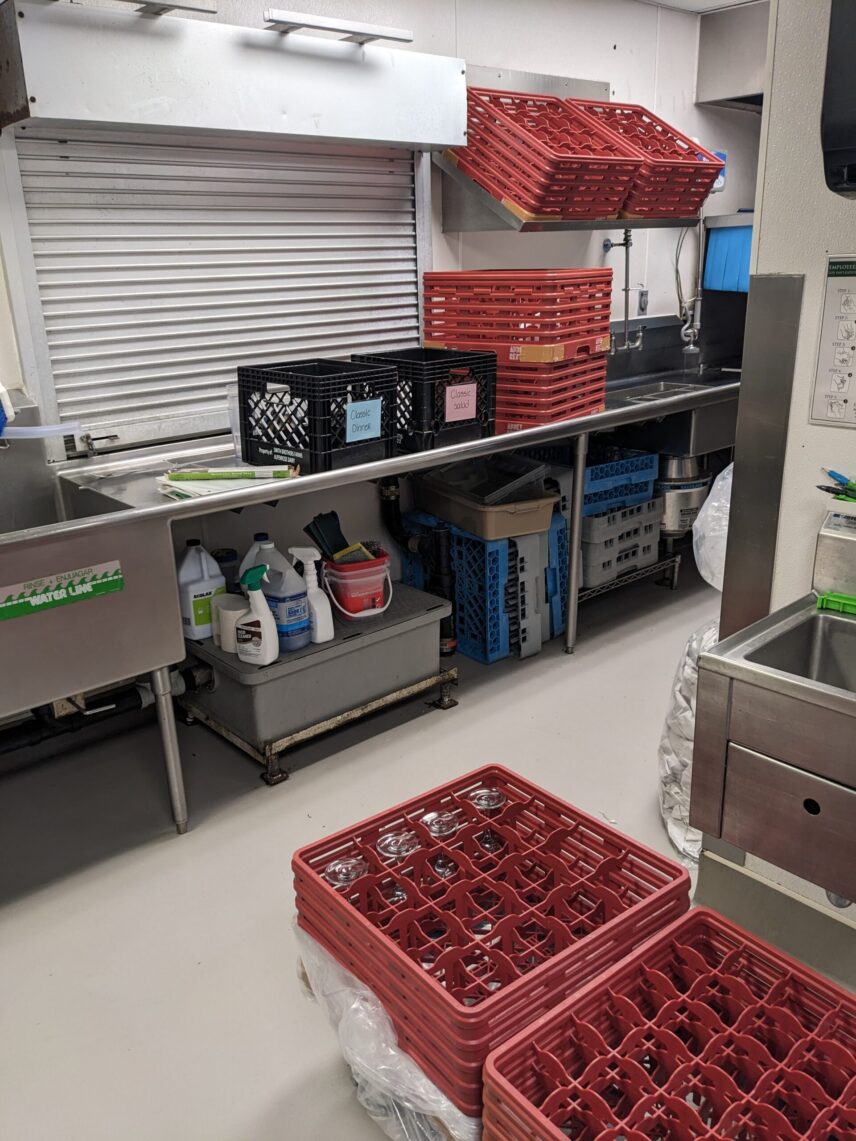
At first there was no bussing station set up in the kitchen. A server new to catering asked what to do with the glasses. I knew the general shape of what we needed, but in an unfamiliar venue it’s faster to do than explain. I told the server to leave the glasses with me and I set it up. Later, recounting this to another coworker, we both named the why. In catering we don’t learn primarily through words. We do, and then we remember. Knowledge settles in the body; action leads; language follows.
Dinner
We had largely prepared the buffet lines before cocktail hour, holding back only the last-minute hot foods. I was the buffet captain—an impressive-sounding title for keeping an eye on what needed replenishing while the runners helped replace trays.
Guests came up table by table. There were two buffet lines—one nut-free and one not—but no signage. I projected my voice to explain to each group. Was it elegant? Debatable. Was it important? Yes, especially for those avoiding nuts due to allergies that we had been alerted about in advance. Signage would have been better, but as with so much in catering, we made it work.
I like being buffet captain: I see guest reactions, what they take and what they leave. My anthropologist self, especially my interest in the anthropology of food, surfaces here. I sometimes share bits about dishes; sometimes guests share back. Compliments flow—small exchanges of recognition.
After the line slowed, two servers shifted to bussing. It’s an awkward phase: some still eating, some done, some wanting seconds, and not many spare plates. You read the room, make judgment calls, accept small misses. Given the heat and low water levels, they first refilled glasses, appreciated and a good way to circulate, then began removing plates and flatware. This is much of catering: you play it by ear.
Break
Toast time is our cue to be off the floor. We sit on flipped-over crates or wherever there’s space in the kitchen: a small eye of the storm. The scene looks chaotic, and in that mess we eat and talk. Conversations range: the shift itself, life news, word from other companies. Seattle’s scene is small and porous. Over time, these kitchen-break conversations accumulate and weave steady threads of familiarity.
Dessert
During the toasts we set dessert on the same buffet and cleaned the white linens as best we could. Instead of cake, the couple chose tarts: one gluten and dairy free with nuts; the other nut-free but with dairy and gluten. No signage again, so I called out the options as guests approached while others bussed lingering dinnerware and then dessert plates. The flow continued.
Party Time
As dessert wound down, the room shifted. Some conversations stretched on at tables while others drifted into the dance room. With guests up, we could bus more assertively, interrupting less and reading tables more easily. Younger guests took to the floor; parents and grandparents lingered and reconnected. Pop music spilled over, aprons carried small marks from earlier chaos, children’s clothes stained from food and play.
For a brief time the boundary between “the help” and guests softened. For them, a once-in-a-lifetime event; for us, one of many, yet for that moment, shared.
The Case of the Missing Bag
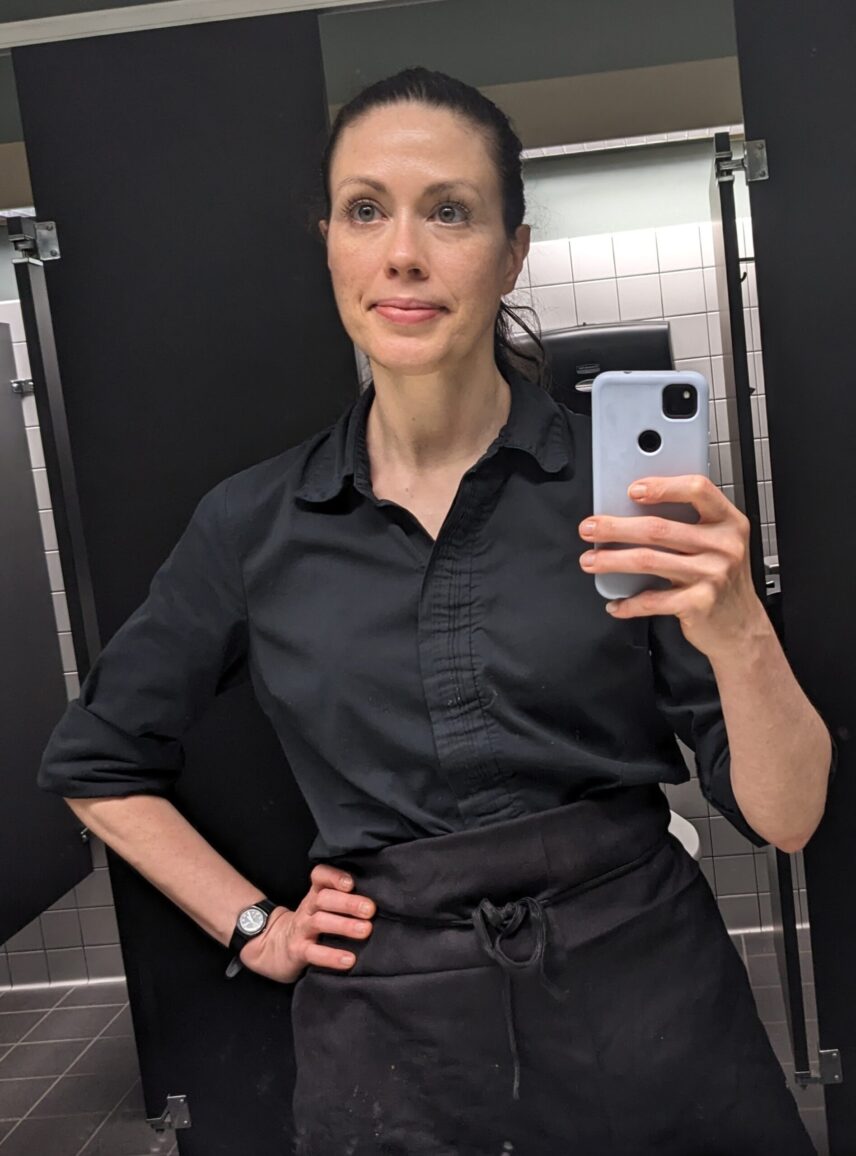
Toward the end of bussing the dinner tables, the lead told me a guest was missing “a brown shoulder bag” and that we should keep an eye out. The description didn’t narrow much, but information circulated with a little joking about how vague it was. I asked the bartender, a friend, which guest it was; her clothing description made the woman easy to spot. Another server noticed a brown bag by the guest book. I asked the woman if it was hers. It was. Relief and laughter followed, a tiny shared triumph. Small crises punctuate events and remind us the larger flow is collective.
Closing the Night
DJed dance music shifted to karaoke: individual customizations have become their own standard. Meanwhile, we were bussing and staging load-out while guests kept celebrating. Family and friends had flown in from far away and assumed an 11 p.m. end; our contract required a 10 p.m. wrap to be out by 11. An agreement let the party run longer while we broke down more than usual with guests present: bussing glasses, stripping linens, clearing tables even as people sat and talked. Guests seemed unbothered, happy to keep celebrating while beauty was unbuilt, piece by piece.
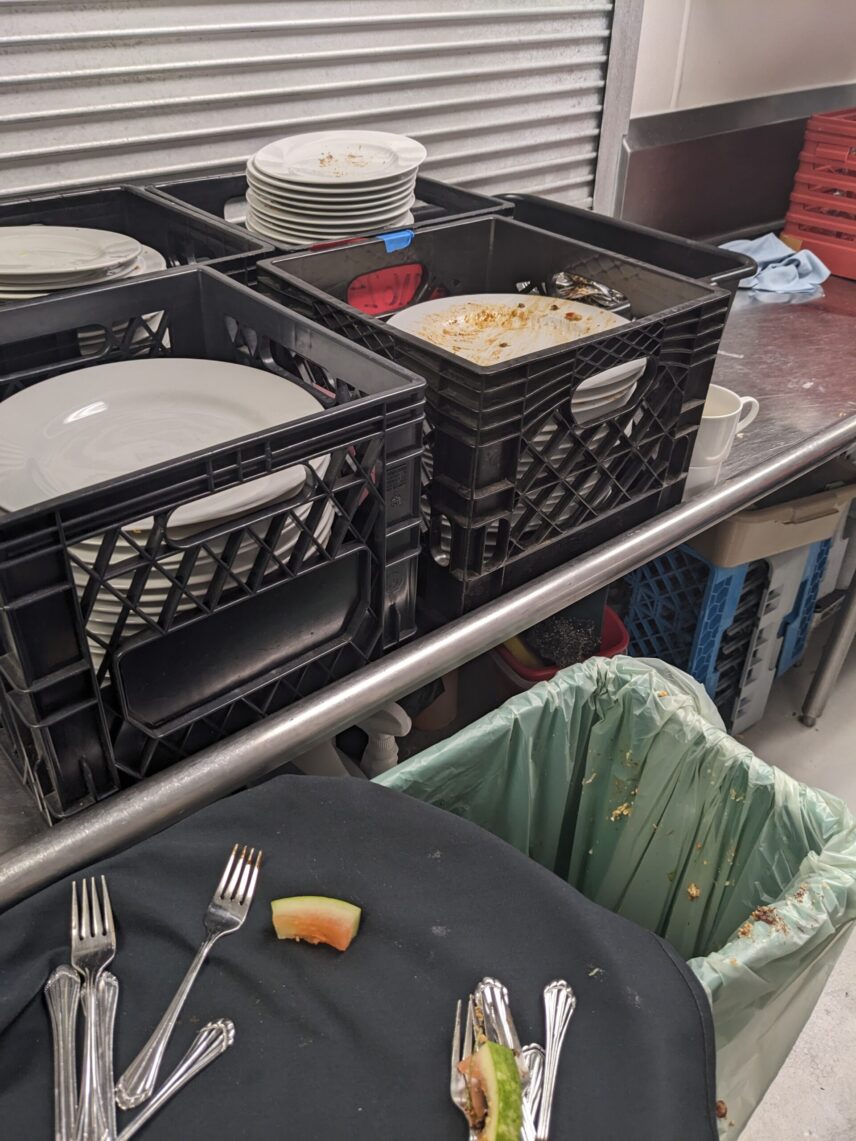
Near the end I asked the event manager about the chairs. “I’ll stay and rack them,” she said, sleeves rolled despite her supervisory role. I offered to stay and help rack chairs in exchange for a ride to the light rail station. She smiled and agreed: deal. Another coworker who helped hopped in as well.
The event went well. We navigated some tough moments and kept the flow intact. This wedding folds into the history we carry in our bodies and talk. Each shift, we assemble a temporary world and then disassemble it. What remains is largely embodied: muscle memory, seasoned know-how, and a habit of working in sync. The night before flowed into this one; this one will flow into the next. The way we handle a tray, the quick scan that tells you what needs doing, and the shared vocabulary become part of us.
Affiliation moves the same way, through what we know about companies, events, and people, the moments we share, and the ties that form. It moves with us across crews and venues, and it stays with us elsewhere, shaping how we read a scene and how we carry ourselves, the knowledge that lives in muscle, bone, and habit. All of it travels.