

Article begins
After two decades of expansion, China’s real estate economy slumped into a prolonged recession. Beginning from 2020, small and big developers, trapped in debt accumulated over the previous aggressive cycles of profit accumulation, abandoned works on ongoing housing projects, leaving hundreds of apartment buildings unfinished. Most apartments in the abandoned projects were already sold through home presales, and a significant number had been sold to migrant families buying their first homes in cities. Facing the prospect of losing their life savings by purchasing future homes, some families moved to live in their unfinished apartments. Making a home out of the bare concrete, they creatively repurposed the limited resources they had on hand to improve the infrastructure, ensuring access to utilities such as electricity and water. Many also turned to social media to share vlogs of everyday life in the infrastructural ruins, to garner the attention of the local government, who could step in to bail out the developments. Hence, they not only live within, but live to salvage their homes from the ruins.
One short TikTok video, first posted in fall 2024, shows a collage of the different chores people take while living in an abandoned housing development. The vlog opens with a woman cooking stewed vegetable on a coal stove who casually says to the camera that she has been living in the abandoned construction for two months. Then, another woman, facing the camera, introduces herself as the homeowner in the housing development called The Ark in Kunming. With a noticeable southwest accent, she calmly states that her family had bought a home here with all the savings they had frugally accrued over years of working as migrant laborers in Kunming. As she recounts the abandoned state of the housing development, we see two men, each carrying three stacks of bottled water, walking upstairs along handrails made with ropes and steel bars. “We have to do this every day,” the man in the front said. Next, a woman leaning on a panel of rusty steel with laundry hanging on it, murmured, “Meibanfa.” The Chinese expression meibanfa, or “there is no other way,” means that one has to take certain action forced by the circumstance. It was repeated several more times by different actors in the minute-long vlog. One man, moving shredded potato and rice into paper bowls, said, “Meibanfa, we have no electricity nor water here.” Later, the same man said, “We want them to quickly resume the construction.”
Vlogs like the above are not mere displays of the hardship endured by those living in urban China’s real estate ruins; they are a kind of quiet indictment grounded in the ordinary works sustaining life in an impossible condition. In the dozen vlogs I archived through digital ethnography, few made grand statements about their situation. Very few, when showing their own life in the abandoned buildings, used words like the crash or crisis that would signal something dramatic or disastrous, as often seen in news coverage of China’s real estate recession. The focus is almost always on the mundane details of life and concrete demands, such as the resumption of construction or the installation of water and electricity, etc.
Even the colloquial name of the abandoned housing development communicates the logic of care and repair. In everyday language, people call the abandoned construction lanwei lou, a phrase that literally means “rotten-tail housing” or “rotten-tail buildings.” Rotten-tail means a project going awry, an undertaking not properly completed, and a plan in suspension. It points to a state of being that demands reclamation but can also become irretrievable as time goes by. Living in the rotten-tail housing hence is a proactive step taken to move things in the direction of reclamation.
These homeowner’s hopes for reclamation are not unfounded. “The Happy City” is perhaps one of the first “rotten-tail” developments that went viral on the Chinese internet, after The Paper—one of China’s most popular news media outlets—reported stories of its buyers moving into the abandoned housing project. The development of “Happy City” was sold out in 2014, and construction was scheduled to finish in 2015 but halted due to the developer’s debt issues. The project had been stuck in limbo since then, while homebuyers were still paying mortgages. In May 2020, one of the homebuyers, Chun, a single mom from rural Sichuan, moved to live in the ruined development. It was a choice borne of necessity. The onset of the COVID-19 pandemic had forced her to close her restaurant, and she couldn’t afford rent while also taking care of her young daughter and her ill father (and paying a mortgage). Gradually, more buyers moved in. Yong moved in with his son and wife, who told the reporter, “Rich people can just live in one of their other properties, if they bought a rotten-tail property; we are from the countryside, we can only afford one home; and no matter what happens, this will be our home.” The family insisted on climbing 18 floors every day so they could live in the apartment they bought, unlike others who mostly set tents in more accessible blocks. Stories about the people living in “The Happy City” rotten-tail housing garnered public sympathy and the attention of the Kunming government, who bailed out the project and resumed its construction in 2021.
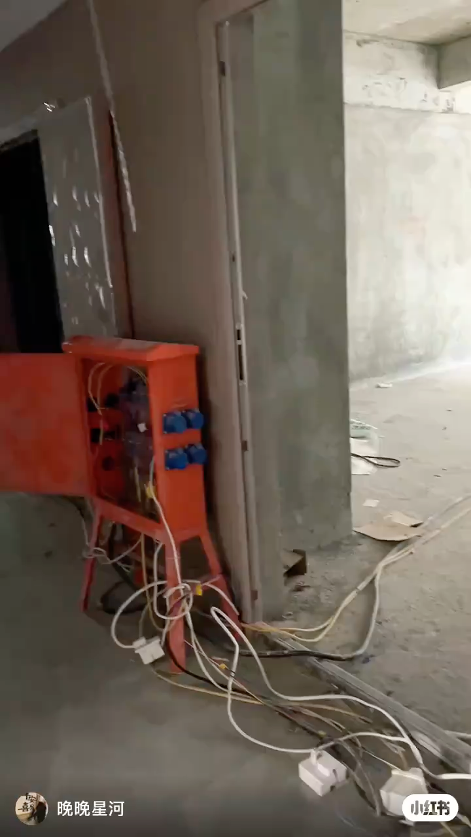
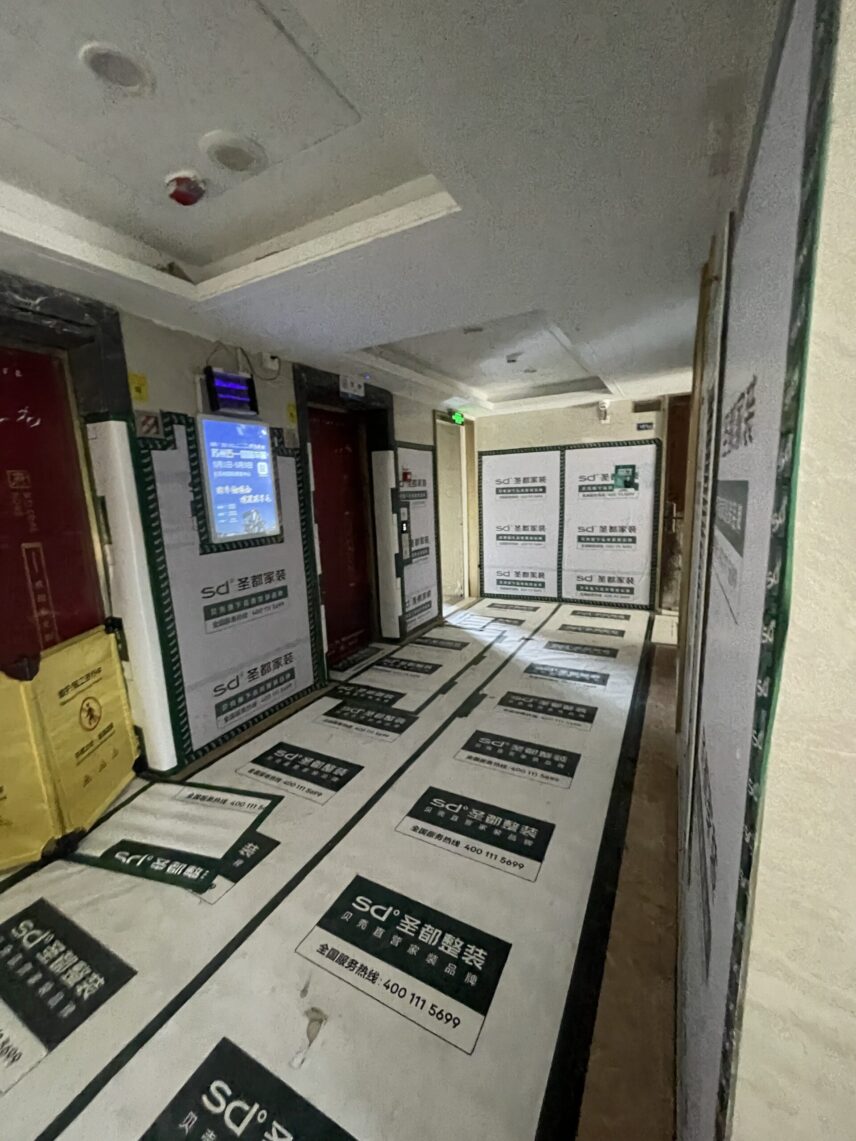
Posts and vlogs on social media show that people make varied efforts to make rotten-tail-buildings habitable, and their living arrangements oftentimes depend on the stages at which construction was abandoned. For buildings in crude conditions, people set up tents on the exposed concrete floor and slept on old mattresses or in sleeping bags. They hung used bed sheets, as curtains on the window frames, and wallpapered the exposed bricks. Some apartment buildings appear to be more complete; some even have working elevators covered with half-peeled plastic wrap. This is the case with Wanwan Xinghe, a vlogger sharing her life living in her home in a rotten-tail building on the social media platform Rednote. At first glance, her home looks no different from an almost-finished apartment building. The most notable issue seems to be the unlit, dusty corridor, with several thick tangled electric wires running through it. Those wires are a necessity, as the building has no electricity and Wanwan Xinghe has been using the industrial electricity left open by the contractor who abandoned the project. In making videos documenting her life, Wanwan Xinghe, along with other homebuyers, pressed the developer to install electricity to the building.
By living in rotten-tail-housing and creating vlogs to share their experience, residents blend everyday life with protests and negotiations with local authorities, hoping to repair the only home they have in the cities. But the material construction is not the only thing that needs to be fixed. In one project I followed in 2015, homebuyers organized among themselves and tracked every step the developers were supposed to follow to complete the housing. They walked through the process with the developer, making sure the buildings passed quality control and the fire prevention features were up to standard. They checked all the paperwork and urged the developers to finish the procedures so the housing bureau could issue the property deeds. In another “rotten-tail” project that I followed from 2022 to 2024, residents formed an online chat group. In the group, they updated each other on progress made by developers, shared contact information for lawyers, and exchanged their experiences dealing with banks over home loans. In doing so, homebuyers repair the property relations by working on the techno-bureaucratic processes through which a residential property, along with the urban rights it entails, comes into existence.
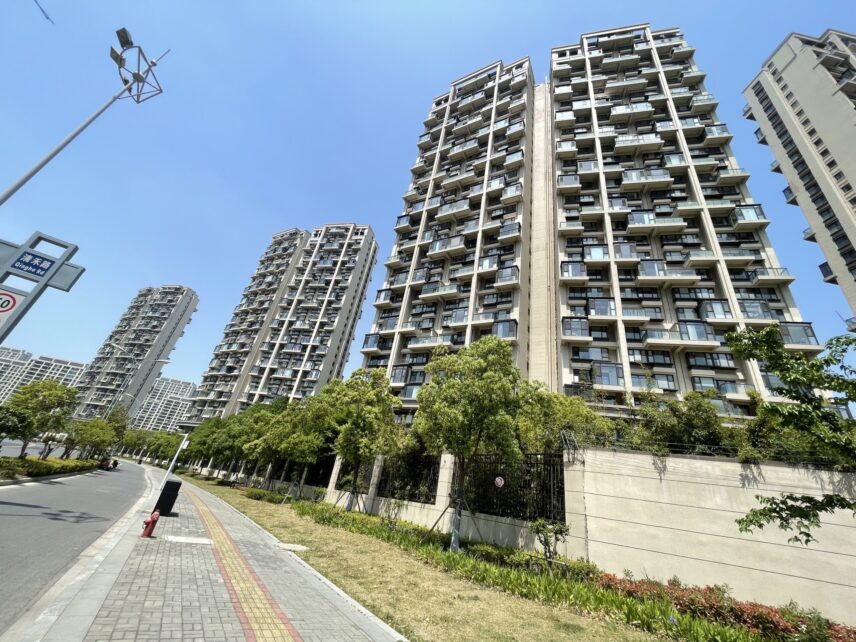
The logic of care and repair resonates with my study of the moral economy of home-buying in contemporary urban China. From 2013 to 2015, I started conducting fieldwork in a low-end housing market at the urban periphery of east Nanjing. Homes there were valued at one-third of properties in central Nanjing and attracted many first-time migrant homebuyers. Still, the overall high price of residential properties made home-buying an uphill battle for most. What stands out from my observations were people’s conviction that they had to have a home of their own, even if it meant they would have to use up all savings and borrow from their families and friends. The pursuit of home ownership is a life-affirming and morally justified endeavor for many aspirational urban citizens. What young people and migrants had, as buyers, brokers, and developers told me, was an inflexible demand (gangxu) for a home in the city where they wish to live.
The gangxu, or inflexible demand, is a vernacular concept that became popular in China in the past few decades. Referring to a family’s need for a first home, the concept of inflexible demand, like other popular but elusive concepts such as the people or democracy, is ambiguously defined. Those who fit, and came to embrace, the label, have been mostly young buyers who migrated to the city from smaller cities, towns, and rural areas. But a lot of urban young people also self-identify with the label, invoking the need for a home as they move out of their parents’ house. Developers and brokers capitalized on this aspiration and marketed “inflexible demand” properties to them. The state, when adjusting housing policies, claimed that it did so to protect ordinary citizens’ “inflexible demand” for homes. Hence, the term travels across diverse contexts as an empty signifier, framing home-buying as a life project that supersedes a market logic. Those who bought homes out of an inflexible demand, and among them, the unfortunate ones who moved to live in the abandoned homes they bought, tell stories of China’s real estate economy with a different focus than those viewing the market as a formal system extracted from individual actions. Common metaphors used in narratives of a financial crisis—such as boom, bust, and crash—are conspicuously absent. Also absent is any mention of a cyclical collapse of value as an inescapable fate of capitalist overaccumulation; instead a linear pursuit of positive value is manifested in the prosaic tasks sustaining the everyday. The housing that is abandoned but inhabited is not a ruined capitalist venture, but an open-ended condition of life demanding to be redressed.
Alex Wolff and Yanping Ni are the section contributing editors for the Society for East Asian Anthropology.