

Article begins
We are on the pier, the Molo Favaloro, a section of the port in the small Italian island of Lampedusa, reserved for disembarking boats of migrants brought most often by Coast Guard patrol units. Among the people disembarking, one man is held up by two other people who were onboard with him. He is semi-conscious. He lost consciousness during the journey. The doctor on the dock briefly examines him. His fellow passengers say he has diabetes and had not taken his diabetes medication for days. Their boat’s engine was failing, and no one was rescuing them, so their sea voyage took much longer than expected, and he had run out of medication. If he had stayed at sea any longer, that fainting spell would most likely have turned into a coma.
A few days later, in another boat, a migrant woman arrives in Lampedusa unconscious from a terrible burn all over her legs, arms, and back. This is the effect of the mixing of gasoline—which leaked from the precarious engine, accumulating at the bottom of the boat—with seawater, making a skin-burning mixture. The effect is also often lethal. When the woman gets off the boat at the dock in Lampedusa, the medical unit does not have the equipment to treat such a complicated case. The only chance of treatment is to transfer her immediately by helicopter to a hospital in Sicily. That is what happened, at least in this case.
That same day, yet another boat disembarks. Migrants who have just arrived at the pier line up for the quick medical inspection by local medical personnel. They are briefly checked, a quick general look, especially over the hands and eyes. After the medical inspection, one man in line stops, and although the doctor signals to him that he wants to move on to the person behind him, the man stands still. He wants to show the doctor something else. He lifts his shirt and shows him some large scars, marks, and bruises on his body. As he does so, he stares at the doctor, as if asking him for attention, or even as if he was accusing him of those signs of torture, challenging him. The doctor looks quickly, assessing that these scars are no longer a symptom. He expresses that those marks on the body do not signal a clinical anomaly for which he could or would want to do anything. The doctor asks no further questions. He tells the man to lower his shirt and leave and let him inspect the others behind him. He has no time or interest in the migrant and his story, a story inscribed on his body.
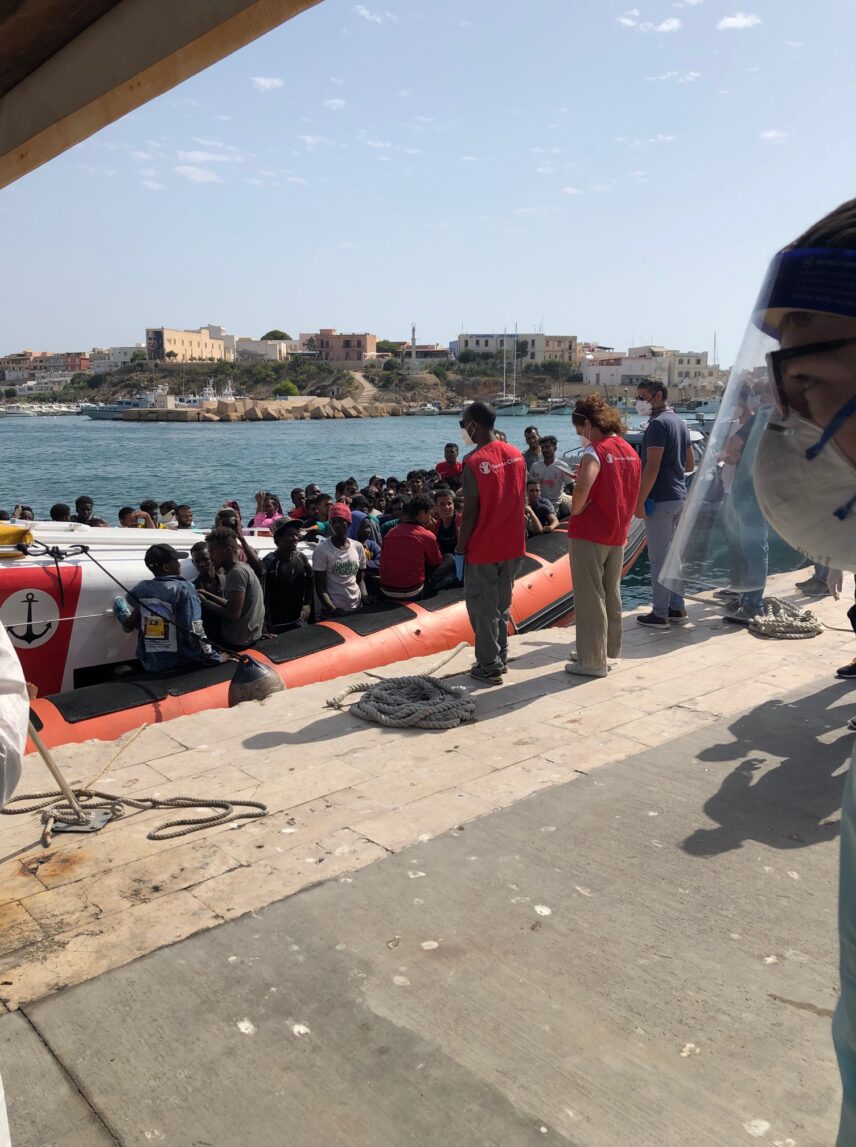
These three ethnographic scenes are among many possible examples I could give from the numerous medical examinations I witnessed during my fieldwork in Lampedusa, starting in 2018. The event is the reception of migrants aboard boats crossing the Mediterranean Sea. Each instantiation, like these three situations, demarcate both the political and bodily space of what I call the “clinical border.” The ways through which the medical gaze categorizes the human body acquire specific forms and meanings in borderlands. Issues of the body and healthcare are intertwined with contemporary border regimes in specific ways. The clinical gaze emerges as a crucial dimension both for the political management of borderlands and the empirical vigilance of the state, governed by international laws on migration and asylum.
Through the framework of the clinical border, I refer to a space delimited by concepts and practices of sovereignty, biosecurity, the right to medical care, and modalities of humanitarian action. The clinical border is the result of tensions between the ideologies of protecting borders versus protecting people at the borders. It is something that emerges in a clear and disturbing way in Lampedusa and the sea surrounding it.
Lampedusa is an island of not even 20 square kilometers (about 12.5 square miles) in size. The island is closer to Africa than to Italy. There are about 6,000 permanent inhabitants, but during the tourist season their numbers can increase as much as tenfold. Most of those tourists crowd mainly on Lampedusa’s most beautiful beach, the “spiaggia dei Conigli” (beach of rabbits), right in front of the exact site where, on the night of 3 October 2013, 368 people drowned in a single shipwreck. This is only one of the countless shipwrecks that occurred around the island, tragic episodes to which we must add those shipwrecks which we have no knowledge of. According to the International Organization for Migration, from 2014 to October 2025, at least 32,000 migrants have died while trying to cross the Mediterranean Sea.
Clinical Borders
Those tens of thousands of “illegal migrants” who drowned in the sea or died on boats have turned the Mediterranean into a vast mass grave. Some call it a cemetery, but in cemeteries the dead have names and a dignified burial—not so in the sea. But besides being a mass grave, the Mediterranean is also a hospital. In other words, it is also a space regulated by the dynamics typical of a healthcare institution. This includes various forms of triage; economic, political, and moral assessments about the distribution of healthcare resources; and, more generally, medical interactions regulated by scientific knowledge, moral economies, and political decisions.
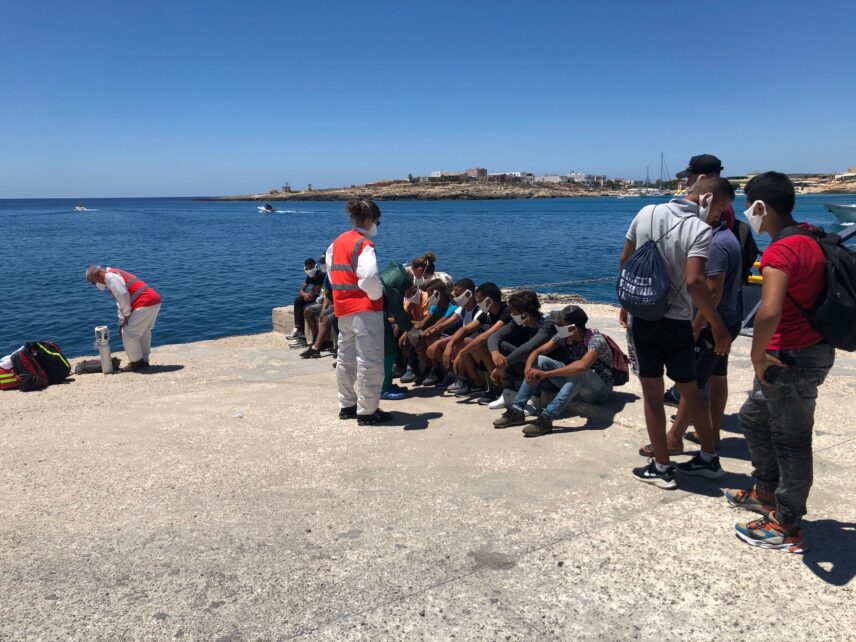
To understand the complex and problematic elements of the contemporary transnational border regime, and to do so through observations of the treatment of bodies in border spaces, requires, I suggest, an approach that engages with two fundamental dimensions of the clinical border. The first one is the apparatus of healthcare in the space of the border and its mechanisms. That is to say, understanding medical infrastructure at the border as a political and technological tool for governing migration. This includes the distinct forms of triage taking place at the border as evidenced by the opening ethnographic scenes. The second dimension includes the bodily experience of the border and its forms of embodiment—the experience of the border through the bodies of those trying to reach it, cross it, and survive it.
Within this analytical schematization, the clinical border emerges at the intersections of biosecurity concerns for sovereign territory and the people involved in illegalized migration. The former results from the dynamics of state formation, especially from the tenuous relationship between legal bodies suitable for the national labor market and bodies to be ejected because they are classified as illegal in the neoliberal discourses of border states. The latter is a result of power relations between different states across the Central Mediterranean, and beyond.
Undocumented Symptoms
The clinical border is therefore a space in which the clinical gaze at the border is no less crucial than the clinical gaze on the border. In the space of the border, when the migrants are examined, whether doctors notice no symptoms necessary to be taken into account or whether they provide treatment, migrants leave the island for mainland Italy without a certificate of health status. On the other hand, in either case, a paradoxical inscription in the national territory takes place: a migrant body passes through clinical scrutiny and enters the field of visibility of the state, being documented and categorized as an illegal body and an illegitimate presence. The central aim of my ethnographic fieldwork was thus to grasp what happens to those who enter this space, particularly in the context of ambiguous and uncertain thresholds of clinical detectability.
Like in the three ethnographic scenes I mentioned at the beginning of this piece, in my observation and interactions with the women, men, and children who arrived in Lampedusa across the sea, I could acknowledge how their narrations of pain and symptoms were directly shaped by their recent experience of crossing the Mediterranean. This is especially through their interpretation of the situation on the island they find themselves in, narrating it in terms of fear, uncertainty, feelings of abandonment and hostility, and experiencing trauma as opposed to relief.
These perspectives illuminate the multiple entanglements between the bodily experience of the border and its medical apparatuses as constituting the deeper essence of the border, a space determined and defined by differential evaluations of the value of human lives. These differential—and clinical—evaluations are conversely the basis for the existence of the clinical border. I consider such perspectives significant in illuminating entanglements not only between bodies, borders and medical infrastructure, but also with humanitarian care.
For instance, civil society, the medical community, the academic community, and various organizations contribute to making the border less violent and its most intolerable effects less invisible. Every time a search-and-rescue non-governmental organization (NGO) bears witness to what is happening in the Mediterranean, which the states involved try to make invisible; every time a search-and-rescue NGO rescues a boat of migrants in distress, filling the gap left by states; every time a doctor, whether governmental or non-governmental, offers a migrant a safe space to be heard and cared for; every time state personnel work, explicitly or implicitly, against the increasingly restrictive directives coming from political hierarchies; every time local citizens and activists take action to make the experience of crossing the Mediterranean less harsh (even if it is just by offering a cup of hot tea or a blanket to people who have disembarked); every time activists and scholars carry out scientifically serious and morally rigorous documentation and analysis work; they create examples of the ways in which the border can be made a surmountable threshold for survival.
These acts subvert silence and invisibility, restoring, at least partially, equity in the evaluation of human life, reaffirming subversive and migrant political subjectivities. The possibility of subverting or limiting the violence of evaluations promises their concrete ability and potentiality to transform the deeper essence of the border.
Sanghamitra Das and Taylor Bell are the section contributing editors for the Society for Medical Anthropology.