

Article begins
This piece is part of a collection of Anthropology News articles on Climate Governance. Click here to read other articles in the collection.
At Brazil’s COP30 in Belém, a city perched at the mouth of Amazon, a handful of students and faculty gathered at the back of a large conference room to plan an upcoming panel we would host. We floated a prompt: “If you could sit down across from anyone at this conference and talk, who might that be?” One of the students stated the obvious: “I’d want to talk with a fossil fuel lobbyist, and ask how they justified their role here.”
Someone had overheard us.
“I would consider myself a fossil fuel lobbyist,” a well-dressed woman broke in from near the door of the room to say. “But the label doesn’t describe the actual people behind it. . . . The label flattens us.”
Her companion, another fossil fuel lobbyist, also disliked “being brushed with the label,” he told us.
The same student asked them, “Where do you think the animosity is coming from?”
“It’s because carbon capture and storage,” the first lobbyist answered, referring to the so-far ineffective technology they were there to promote, “is almost like a get-out-of-jail-free card. You can prolong the fossil fuel industry indefinitely through this technology.”
“Fossil fuel use hasn’t peaked,” she went on. “We are not mature enough yet for a real transition,” she said, shaking her head. “Human behavior is the biggest change we need. If society cared enough, people would change. We need to look at ourselves.”
Look at ourselves.
To encourage just that, the Brazilian presidency of COP30 announced a Global Ethical Stocktake (GES) for the 2025 meeting of the UNFCCC’s governing and subsidiary bodies.Why call for an ethical inventory, in particular? The above exchange dramatizes one reason: the 1,200 fossil fuel lobbyists at COP29 in Baku, Azerbaijan, the previous year stoked fears that the process was at risk of cooptation. This year in Belém, there were reportedly 1,600 fossil fuel lobbyists. “To put it in perspective: fossil fuel representatives received 60% more badges than the 10 most climate-vulnerable nations combined,” COP30 student blogger Havalin Haskell reported.
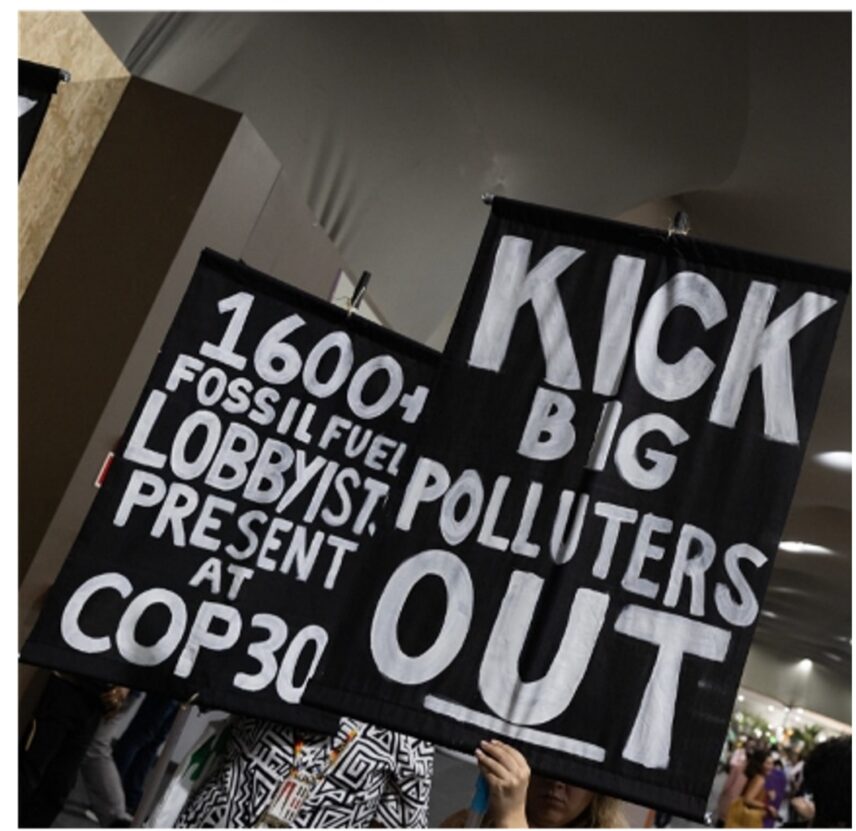
Moreover, the previous three COPs before Brazil had been hosted in authoritarian-leaning petrostates (Egypt, United Arab Emirates and Azerbaijan); tight constraints on demonstrations and the absence of a large public march during all three brought grave concern.
Most basically, though, the Global Stocktake (GST) in 2023 showed progress toward the Paris Agreement goals, but still fell short of what was needed to stay within 1.5 degrees of warming. Subsequent renewed Nationally Determined Contributions that signatory nations made in response to the GST were equally insufficient.
Clinching the need for a Global Ethical Stocktake was the United States’ (second) withdrawal from the Paris Agreement, announced in early 2025. This fresh news contributed to frustration in Belém; for the world’s largest historical greenhouse gas emitter and biggest economy to “cop out” of COP and Paris—was that alone ethically criminal? Still, delegates from continuing signatory nations made game pronouncements like, “We’re moving on, with or without the US,” and even, “It’s a relief to not have the biggest obstructionist and holdout in the rooms, for once.” With obstructionism top of minds, it was timely that the Climate Social Science Network released its comprehensive report on obstructionism in the UNFCCC. From detailing the forms of obstruction by stages of climate negotiations to describing how easily masked or normalized it can be due to its indirect, dynamic and uneven qualities, the efficacy of intentionally slowing or blocking climate action grew clearer.
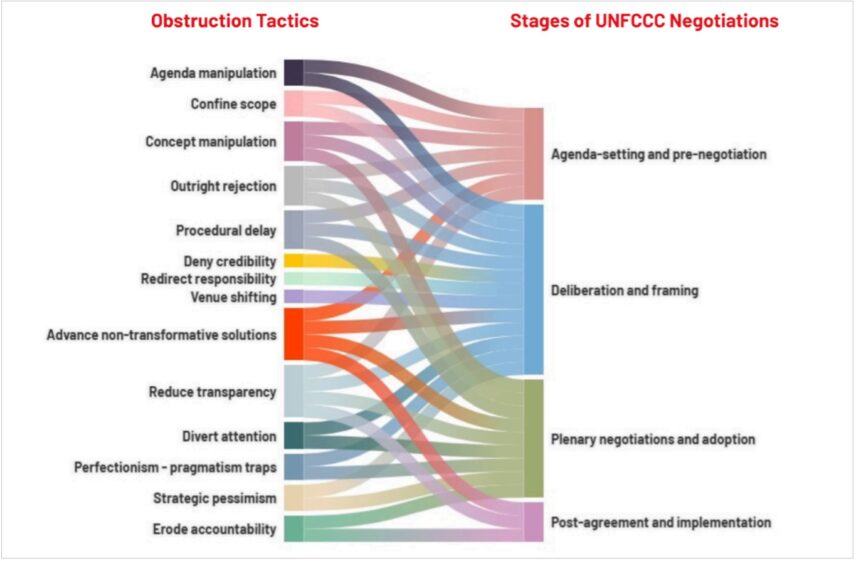
In the face of such questions, Brazil’s inserting “Ethical” into the middle, making the Paris-mandated Global Stocktake (GST) into Global Ethical Stocktake (GES), became a rejoinder to a process arguably wandering off course.
Promise and Realities of the Ethical at UNFCCC
Marina Silva, Brazil’s Minister for the Environment and Climate Change, led the Global Ethical Stocktake, emphasizing that the solutions to climate change “are not technical; they are ethical. We have the technical and scientific ability to solve climate change. Where we have had difficulty is with political will and personal commitment.”
Onlookers asked how calling out ethical transgressions might apply useful pressure, and how hammering on questions of right versus wrong could be leveraged politically. When all compliance is voluntary, is all climate action ethically grounded, by definition? The GES raised all these questions.
A stocktake focused on ethics struck particular chords for my interlocutors with the UNFCCC’s Interfaith Liaison Committee (ILC), who have long identified with bringing moral, ethical, and human rights considerations to UN climate talks. In the firmly secular context of UNFCCC, ILC participants customarily avoid overtly religious (e.g., deistic) or faith-particular references and therefore have come to emphasize rights, justice and peace, and multilateralism over transactional and increasingly bilateral machinations at COP. In this light, ILC leaders anticipated that the GES presented singular opportunities to reassert these values, alongside commitments to multilateralism itself.
Maureen Goodman is a leader in Brahma Kumaris, a woman-led spiritual movement central to interfaith presence in UN work, including the UNFCCC. For her, the GES at COP30 offered “an opportunity to put humanity and the planet, rather than wealth and power, at center stage. To bridge the gap between politics and power and the real-world people who are suffering.”
Goodman decried the paucity of voices at the table in the UNFCCC. “The ILC brings in faith communities, and all our traditions teach how to live with nature and on the land,” she pointed out at a press conference on the GES. “The Biodiversity COP named Indigenous peoples an official subsidiary body, which means they have to be consulted by the governments. The voices not being heard—like Indigenous and interfaith groups—can help, but they need to be at the table.”
GES director Marina Silva appointed six regional leads, all globally prominent voices in their own right. Beginning in July and continuing through September before COP30 in November, each convened formal regional dialogues with high-profile leaders, and also encouraged self-organized dialogues. ILC members were invited to formal dialogues in their home regions, sometimes to specific, interfaith versions. Silva underlined the cross-sectoral makeup of the gatherings: “This effort was to bring together indigenous people, religious, artists, youth, with different languages to carry out an assessment—what are the key issues related to climate change? Why do we make decisions that contradict science? Why do we have good ideas and then not implement them?”
With this auspicious lead-in, many anticipated that the GES could take COP30 by storm.
Our hopes were largely dashed, however. At COP30 itself, most estimations deemed the GES a bust. Complaints began when the self-organized dialogues deadlines were impossibly compact, with few able to submit input by the end-of-September close. Expectations that the primary ethical pillars of UNFCCC work—Common But Differentiated Responsibilities (CBDR) shaping burden-sharing—would take center stage were not fulfilled. Apart from a pretty pavilion which hosted a few, not-especially-prominent events, the GES was largely absent from programming at COP. Neither did inputs from the run-up dialogues appear to shape keynote addresses, or surface prominently within the negotiations themselves.
Ethical Breakthroughs and Breakouts
Despite disappointment about the GES itself, participants in Belém were nonetheless taking stock of the ethical dimensions of our collective predicament. Their scrutiny would not be contained by targeted programming.
Numerous breakthroughs rewarded years of efforts and were expected: the Belém Gender Action Plan, a nine-year framework for integrating gender equality into global climate policy, was approved, as was Belem Action Mechanism for a Just Transition, attending to worker’s rights in energy conversion processes. The Global Goal on Adaptation was clarified, and the global TFFF—Tropical Forests Forever Facility was launched. Each of these achievements represent fruit of longstanding ethical commitments and alliances.
But what I am calling ethical breakouts were something else entirely: they were dramatic, ethically rooted flash points and rebellions.
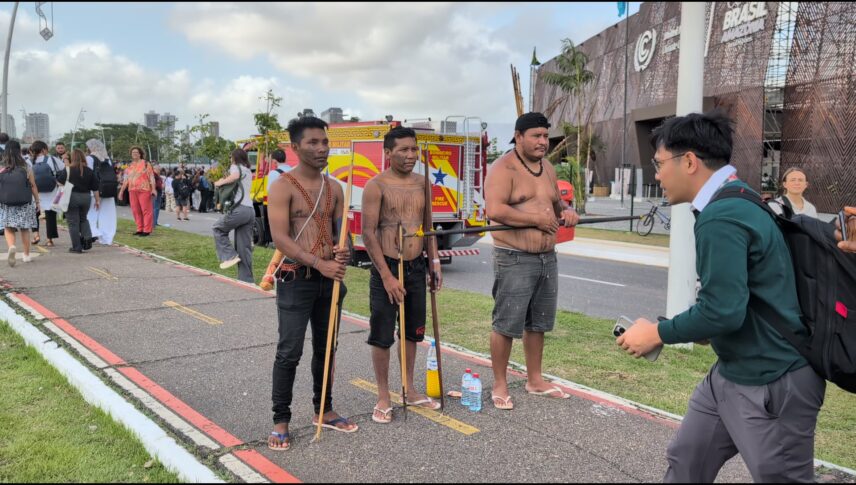
Still early in the COP, Indigenous groups paddled a convoy of dozens of canoes from far within the Amazon, Mata Atlántica and Pantanal regions, demanding demarcation and territorial sovereignty, protections from development including logging and oil exploration, as well as better representation at COPs. In a chaotic protest without precedent at previous climate COPs, they breached and briefly held the gates, leading to quick securitization and a sharply heightened military presence for the remainder of COP30.
But the greatest ethical outbreak was born of the stalled negotiations themselves. As COP30 was drawing to a close, it became clear the Brazilian presidency never had real intentions of forging a clear pathway away from fossil-fuel fuels. The agreement emerging from Belém made no mention of fossil fuels, backsliding from hard-won progress at Dubai at COP28. For Arab Block nations, Russia, China, and India, commitments toward fossil fuel phaseout were red lines they simply wouldn’t negotiate. This minority of nations was blocking the will of the majority, many argued, and circumventing multilateralism in favor of bilateral, “backroom” deals.
A coalition emerged: first of just 8 nations, then 20, then 40—the count murmured throughout the connected tents and tunnels of the venue kept rising. Finally, by the end of COP30, 82 countries together insisted on a roadmap away from fossil fuels.
From this stalemate was born a “coalition of the willing” that would produce the first Conference on Transitioning Away from Fossil Fuels, later held in April of 2026 in Santa Marta, Colombia, and co-hosted with the Netherlands.
Sojourner’s Magazine referred to the Santa Marta splinter as a “holy disruption,” and as an effort to build a flexible, trust-building space across like-minded partners. Both interfaith and Indigenous leaders felt they were afforded better placement at decision-making tables at Santa Marta than within the UNFCCC. The faith coalition and others called for a binding Fossil Fuel Treaty that would halt new extractive projects, phaseout fossil-fuel use bon historical responsibility, and prioritize debt cancellation to fund a just transition. Still, most viewed Santa Marta as a complementary space to the UNFCCC, with greater commitment to horizontal multilateralism and grassroot leadership.
The Santa Marta splinter, alongside the mobilization of Indigenous, interfaith and other grassroot civil society sectors, represents fruits of significant, if less nominal, ethical stocktaking. These show how ethics continue to inform—and indeed outrage—global publics concerned with climate change.