

Article begins
Beyond Acknowledgement
In July 2026, my supervisor asked if I—the US-born great-grandchild of Ashkenazi Jews from Eastern Europe—would be interested in reading our institutional land acknowledgment at a national conference. My initial instinct: Absolutely not! As a non-Native postdoc at the NSF Center for Braiding Indigenous Knowledges and Science (CBIKS) at UMass Amherst, I have become increasingly aware of how individuals and institutions cause and perpetuate harm, even inadvertently, and I share in the growing skepticism toward performative gestures that yield no result.
Over the past decades, critics have challenged the hypocrisy of Land Acknowledgments given without further action, especially actions invited by Native communities. Anthropologists saw this in 2021, when the American Anthropological Association paused the practice in response to Indigenous anthropologists who argued that there was no evidence that acknowledgments produce measurable change. A recent New York Times op-ed by Mr. Reid Walker, a citizen of the Mandan, Hidatsa and Arikara Nation, encapsulated this sentiment: “I’m Native American. Land Acknowledgments Are Infuriating,” asserting that the real test is the action after the words.
After some solo contemplation and conversations with my colleagues, my initial rejection was transformed into a question: What is beyond acknowledgment? Instead of an individual reciting a land acknowledgment, a group of us prepared a ten-minute talk I delivered: “Beyond Land Acknowledgment: Becoming a Good Relative through Community Partnership.” It introduced the core of braiding knowledges: relationships.
Braiding Origins & Foundations
The term “braiding” was popularized by Potawatomi botanist and author Robin Wall Kimmerer in her best-selling book Braiding Sweetgrass: Indigenous Wisdom, Scientific Knowledge, and the Teachings of Plants. Kimmerer’s work spotlights the centrality of relationships: “Restoring land without restoring relationship is an empty exercise. It is relationship that will endure and relationship that will sustain the restored land.”
Braiding is just one name amongst related terms across Indigenous traditions for the practice of uniting diverse ways of knowing. Related concepts in other traditions include Etuaptmumk (Two-Eyed Seeing) in the Mi’kmaw language region of Eastern Canada, Waka-Taurua (Double-Canoe) in the Māori-language region of Aotearoa/New Zealand, and Kaswentha (Two Row Wampum) in the Haudenosaunee-language region of Central Canada and upstate New York. Like Kimmerer, CBIKS centers the Anishinaabe sacred act of braiding as a guide for ethically uniting western academic training with deep, place-based knowledge carried by Indigenous communities. Each is valued for its strengths without needing to be “proven” by the other. The hallmark of braiding is that each strand—each perspective—is respected and maintains its integrity throughout the relationship-based process.
In preparing the talk, we began by reflecting on UMass’s land acknowledgment, which spotlights “nearby lands and waters as important Relations with which we are all interconnected and depend on to sustain life and wellbeing.” This drew our attention to a foundational value at CBIKS, which I have focused on as part of the Braiding Fieldwork Practices & Traditional Ecological Knowledge (TEK) Data Co-Laboratory, a working group led by Dr. Kisha Supernant: Good Relations—a core element of braiding—are what produce measurable change. Dr. Supernant summarized it well in the title of a 2020 keynote titled “Relationality is not a Metaphor”, which focused on foundational elements of relationship-building in the context of Métis archaeology. In line with this, our working group offers practical, tangible, how-to guidance on braiding for diverse audiences.
A bit about CBIKS: Established in 2023 with funding from the National Science Foundation (NSF) Science and Technology Center (STC) program, CBIKS became the first-ever social science STC among natural and physical science awardees. CBIKS is Native-led, with over two hundred members that partner globally with over seventy participating institutions, hundreds of scholars, and numerous global Indigenous communities. The Center focuses on three areas—climate change, protection and care of cultural places, and food sovereignty—both at “CBIKS Central” (UMass Amherst), where Director Sonya Atalay and several staff members are based, and in projects led by eight global Regional Research Hubs. Alongside these sites, Transforming Science Co-Laboratories of interdisciplinary scholars engage with theoretical and thematic concepts such as braiding, relationality, ethics, data sovereignty, storywork, and knowledge mobilization, among others. This structure is unique because of its shared meta-level research agenda: How do we effectively and ethically braid Indigenous knowledges and Western science?
Anyone at CBIKS will nod enthusiastically that braiding is important. Yet in my time there, I have found that explaining braiding can be challenging, even awkward, precisely because its elements are so simple. I often think of an excerpt of Robert Fulghum’s poem “All I Really Need to Know I Learned in Kindergarten”:
Share everything.
Play fair.
Don’t hit people.
Put things back where you found them.
Clean up your own mess.
Don’t take things that aren’t yours.
Say you’re sorry when you hurt somebody.
This list might seem quaint, even laughable, but researchers still unanimously fail to clear this low bar, evidenced historically and anecdotally.
Nuances of Braiding
The infamous Tuskegee Study is one egregious example of what happens when researchers ignore the fundamentals of braiding. The social sciences have also grappled with harm caused by conducting research on rather than “with, for, and by” communities, as George Nicholas and Thomas Andrews wrote in a 1997 volume, At a Crossroads: Archaeology and First Peoples in Canada. Dr. Atalay built on this concept in her 2012 book Community-Based Archaeology: Research with, by, and for Indigenous and Local Communities, which she continues to practice today. One example is her commitment to accessible, engaging ways to share research results through arts-based research such as NAGPRA Comics, a visual narrative of the 1990 Native American Graves Protection and Repatriation Act co-authored with CBIKS Participatory Planner and Cultural Consultant Shannon Martin and the Ziibiwing Center of Anishinabe Culture & Lifeways (2017). This is also braiding: considering accessibility, literacy, and audience engagement beyond traditional academic publications.
Discussions on braiding are especially rich during CBIKS Gatherings, held twice a year for members and community partners to reflect on accomplishments, brainstorm new ideas, and build relationships. In May 2026, we engaged in a “Braiding Dos and Don’ts” activity, inviting attendees to populate an online form with whatever came to mind in each column. Answers like the following examples, which echoed the aforementioned poem, seemed shockingly simple.
- DO: share meals, plan unstructured time, learn basics in the Native language
- DON’T: exploit, assume, enforce timelines
These responses illuminated the experiences, concerns, and hopes within the community, ranging from Indigenous community partners to leads of Hubs and Co-Labs to interdisciplinary scholars. The results constellated around an essential part of braiding: listening to community concerns, priorities, and responses, including the response of NO. Many colleagues said they had encountered researchers who did not value the meaningful results that collaboration and co-creation yield, or who did not bother to build relationships or seek consent. We discussed the challenge of being patient with Indigenous processes and protocols that may not align with institutional timing. We unanimously agreed that braiding practices do more than build community: they lead to better research and results. The outcome of this work transforms the process and product of scientific inquiry. It brings insights that could not be known from one perspective or the other on its own, and it enables us to address global issues together.
Data sovereignty offers potent portals to consider how to braid, starting with what seems like a simple question: What is data? In the Data Sovereignty Co-Lab’s Dos and Don’ts Primer on Indigenous Data Sovereignty, data is defined “broadly and relationally, not narrowly or technically.” Braiding acknowledges that Western intellectual property regimes—copyright, patent, trade secret—often fail to protect data like orally transmitted knowledge, collectively held knowledge, knowledge with spiritual or cultural obligations. Braided research asks: How do my community partners define data sovereignty? To know this, we must ask, communicate, and listen.
Braided processes may be different than many scientists are accustomed to. The Data Sovereignty Co-Lab defines them in their Primer as “collective rather than individual, iterative rather than one-time; conditional, time-bound, revocable”; practicing braiding means regarding community approval as a “governance decision, not merely an ethical courtesy.” To braid means to empower communities with inherent sovereignty and the authority to govern research and data involving their people, lands, and knowledge. In other words: do not submit IRB or even research proposals before communicating with community partners and receiving approvals that may include blessings, rituals, and ceremonies.
Braiding Between Tribe, University, and Federal Government
This section co-authored with Elizabeth Wessells
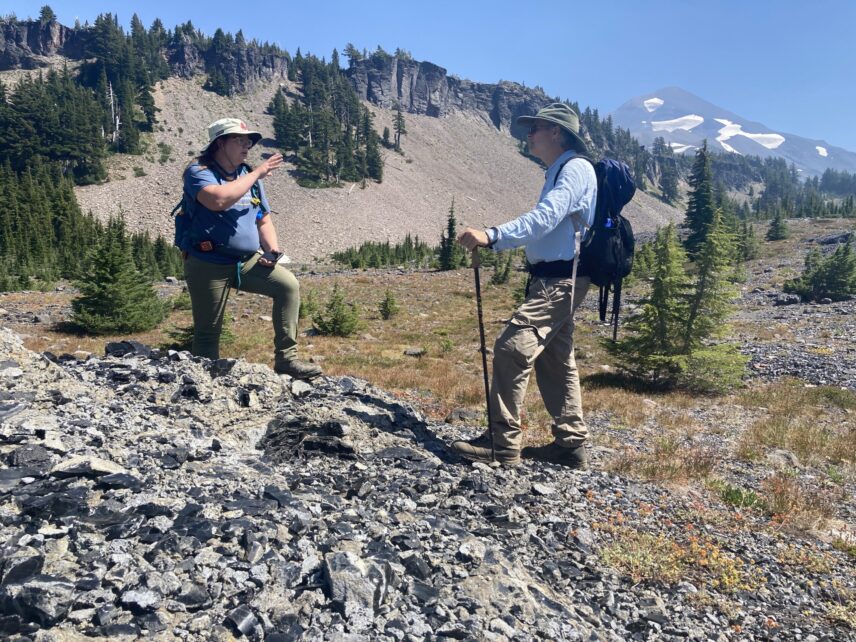
Each summer, a group hikes a winding 12-mile path within the 1.6-million-acre Willamette National Forest in Oregon, trailed by mule teams and mosquitoes. Hikers include U.S. Forest Service (USFS) staff, University of Washington (UW) researchers, and members of the Confederated Tribes of the Grand Ronde Community. Their destination is Obsidian Cliffs, a prehistoric Indigenous site on the unceded, ancestral homelands of Grand Ronde. Their goal? Collaboration on “Obsidian Cliffs, A Cultural Landscape: Confederated Tribes of Grand Ronde’s Relationships to Place Through Time”, a Place-Based Study (PBS) supported by CBIKS.
Braiding knowledges is essential to this collaboration, which aims to protect Obsidian Cliffs by advocating for its addition to the National Register of Historic Places. To navigate this process, each individual and group shares their knowledge and listens to perspectives that may differ from their own. In this context, Grand Ronde Tribal members share Indigenous knowledge about flintknapping and trade relationships; USFS staff and UW researchers share Western archaeological knowledge of the landscape around the Cliffs.
Beyond this exchange, their ongoing conversations on forest management illuminate convergent and divergent perspectives that materially shape the site. One example is decision-making about the ~2,650-mile Pacific Crest Trail, which cuts through the obsidian quarries and other important sites in the landscape. Throughout the decision-making process, the Grand Ronde community shares its concerns and priorities on its territories with USFS staff and UW researchers, who learn to distinguish the relationships of Tribal people on their homeland from recreationists enjoying a beautiful hike. This is especially timely as the USFS grapples with how “wilderness” designations limit what people are legally allowed to “collect.” Such bans contradict cultural practices in which people gather items such as obsidian, bear grass, and huckleberry.
Exchanges on these topics illuminate how structural aspects of land management can continue to harm Native peoples. The Grand Ronde community also gets to understand and engage with the USFS team’s priorities and perspectives. Their discussions inform policies, enrich research, and build trusting relationships.
Elizabeth Wessells, who co-authored this section, is a PhD student in archaeology at UW and a graduate research assistant for the PBS. Her involvement in the project has taught her the importance of braiding: “The relationships built in the field are as much the focus of the work as are research questions on Obsidian Cliffs and Tribal history.” Braiding is not simply about sharing knowledge; it’s a broader experience of braiding understanding, responsibility, and human relations. Successful outcomes of this PBS are not only limited to reports and conference papers, but also include sustained accountability, progress on Tribal sovereignty, and deeper relational connections. As Wessells added: “In this context, non-Native folks learn what it means to be accountable for more than just job requirements.”
Braiding Beyond Acknowledgment
As we prepared the Beyond Land Acknowledgment talk, my CBIKS colleagues and I worked to communicate elements of braiding; how even the simplest efforts of relationship-building transform research processes and products. In delivering the co-authored talk, I began with a brief reflexive gesture, situating my own ancestral lineage to connect on a personal level and humble myself before speaking of a tradition that is not my own. How do we move beyond only acknowledging the land? Continue acknowledging, build relationships, and truly listen.
This material is based upon work supported by the U.S. National Science Foundation Center for Braiding Indigenous Knowledges and Science under Award No. 2243258.
Joshua Babcock is the section contributing editor for the General Anthropology Division.