

Article begins
Editor’s Note: This is the final installment in SAFN’s four-part 2026 series on temporality in food anthropology. We invite you to explore the other contributions by Janita Van Dyk, Janet Chrzan, and D.H. We.
Cheese is an ancient biotechnology for preserving milk. Historically, many styles of cheese were made to travel through trade or nomadic mobility: their curds cooked and pressed tightly to release additional whey, heavily salted to slow the pace of fermentation, aged for many months to increase acidity and further reduce moisture—all steps that contribute to an environment hostile to spoilage microorganisms. Other cheeses were fleetingly seasonal: soft, fresh cheeses made shortly after springtime lambing, kidding, and calving, destined for eating without much aging at all—which is also to say, locally. Over the last hundred years, however, temperature-control technologies, from pasteurization and refrigeration to cold-chain logistics, have combined to meet and expand cosmopolitan tastes by extending the shelf-life of perishable goods, virtually erasing seasonality from globally supplied supermarkets.
Today, not only are “fresh” cheeses available year-round, they are being asked to travel the distances that previously only aged varieties would have undertaken. In any given week, my local cheese shop’s direct-order shipment from Europe might see dainty goat’s milk cheeses from France, sturdy Alpine-style cheeses like Gruyère, and virtually indestructible Parmigiano Reggiano—each representing an entirely different microbial ecology with its own timetable and tempo of maturation—all arriving on the same wooden pallet encased in yards of plastic wrap, having traveled together by truck and ship and truck again since their consolidation at the Rungis food market near Paris. How is this managed, that I’m able to enjoy such an impressive selection in Cambridge, Massachusetts throughout the year?
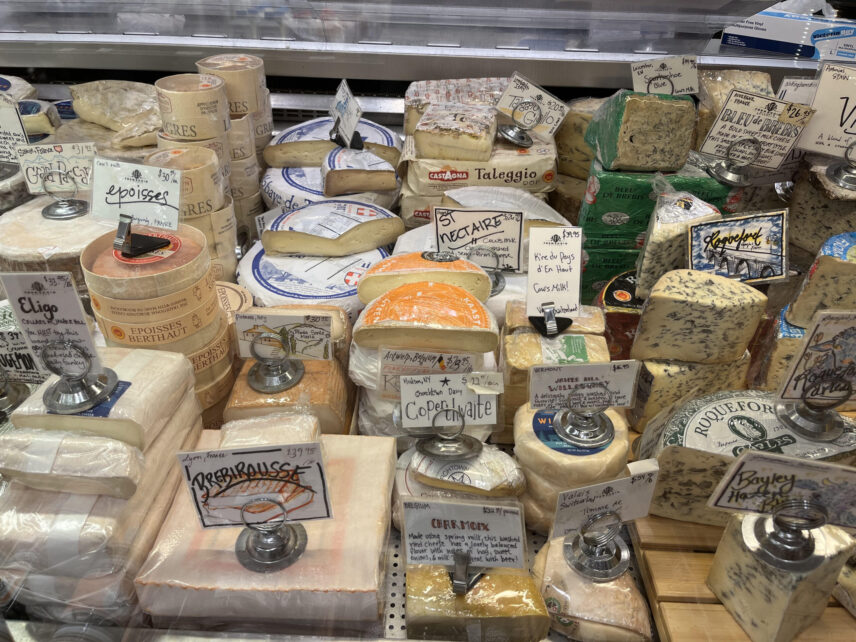
Time is both a risk factor and a tool in the workmanship of specialty cheese importing and retail. Time is not merely passing, marking temporal distance from a cheese’s “birth” in a vat to its eventual ingestion or demise. Rather, time—taking the form of aging, ripening, maturing, rotting—is a dynamic quality in the substance of a living, fermented food that can be calibrated, modulated, manipulated, banked on. Adjustments to cheese temporality can be made indirectly, by controlling the temperature and humidity of the environment, and more directly, through hands-on cheese care.
During transit, cheese sits still, left unattended in mobile shipping containers or stuck in warehouses—and still ripening, moving forward in time. Depending on the type of cheese, ripening can mean increasing acidification, recognizable in a “sharper” flavor. Or it can look like waves of mold growing over a rind. For the most part, sharper flavors in acidic cheeses are appreciated (think of Cheddar) and mold growth is no big deal. “Mold is a part of the crust and crust is a part of the cheese,” a cheesemonger once said to me—although some molds are more welcome than others. On occasion, the monger noted, he will open a shipping box only to discover cheese that’s turned bright pink with unappetizing (though harmless) mold and, worse, rind that is slipping off. A threshold has been crossed and the cheese is no longer saleable, even if it remains edible. (A well-made cheese from unpasteurized milk can “age and age and basically never go bad, just get different,” this cheesemonger’s former mentor once told me.) To be sure, retailers do not make money off every pound of cheese they buy wholesale. “Wastage” (or “shrinkage” of inventory) is anticipated and factored into retail mark-ups from wholesale pricing. The greater the variety of cheeses on display in a shop, the more wastage is likely—and the bigger the price mark-up. Customers pay literally for variety.
Recognizing wheels of cheese to be living, microbial ecosystems protected by their outer rinds (what microbiologists identify as “microbial mats”), specialty stores invest a good deal of time and effort in caring for them. In a cellar corner of my neighborhood cheese shop, a creatively constructed, temperature- and humidity-controlled room serves as an “aging cave” where wheels of mature cheese, resting on open, wooden shelving, recuperate from delayed travel and can continue to live and “breathe” until they’re brought upstairs and cracked open for the cheese case. Recently, I signed up with some colleagues for a “cave tour” led by Julia, Formaggio Kitchen’s owner.
“When you break open a wheel, that’s it, it stops aging; that’s the best it will ever be,” Julia told us. Cutting into a wheel breaks the protective seal of the rind, exposing the interior to air and environmental microorganisms; decay accelerates. “Our goal is always to move through cheeses while they’re good. We don’t want to sell anything that’s subpar.” That would be a disservice not only to their customers, who pay premium for quality, but also to the producers, because it wouldn’t “represent their cheeses well.” Julia pointed to a cloth-bound truckle of Wensleydale, “one of two traditional Wensleydales left in the world being made” in Yorkshire, England. She told us that recently, she had visited the creamery and was tasting the cheese together with the cheesemaker when she was struck by the contrast: the “same” cheese tasted different to her in England, because “it’s a bit drier when we get it here,” in Cambridge, Massachusetts. The cold chain maintains refrigeration but not proper humidity, she explained. Also, since Brexit, shipments of British goods from London have taken “about four weeks on the water”—more than twice the average taken by shipments departing from France. After realizing that Wensleydale was suffering from drying out in transit, she asked her UK supplier to ship the cheese “a month earlier” (that is, to send wheels a month younger in age) to start them out on their extended journey with a higher moisture content. It worked. The cheese “was so much better!” And, at a specialty store where customers are invited to taste a cheese before buying it, the improved quality made it easier to sell the Wensleydale more quickly, before it moved too far on from its “best.”
Julia continued: “A lot of being a good cheesemonger is forecasting, looking at a cheese and really understanding how much lifespan does it have left,” and then also, “what is the natural cadence of selling this cheese? Is that matching up?” If not—if the timetable of cheese maturation falls out of synch with the timetable of sales—then wastage or (let’s face it) sales of subpar cheese may result. And then, “we need to make some adjustments and figure out what we want to do to help move through that cheese” more quickly. In addition to environmental manipulations, like raising the humidity in the cellar, manual adjustments are undertaken as a matter of weekly cellar routine: “flipping the cheeses, turning them, brushing them.” Julia stressed the importance of “touching the cheeses, handling them, and making sure they’re not cracking.” Reminding us of her earlier explanation that the protective function of a cheese rind ceases when a wheel is cut open, she added, “The same is true if a wheel cracks.” Rinds can crack from drying out, again a hazard of refrigerated transit. Years ago, a cracked rind was described to me as “a wound” that can open up a cheese to microbial infection. Skilled cheesemongers (as is the case at Formaggio Kitchen) may keep a wedge of butter at hand to smooth over a cracked rind, “like a band aid.” The beneficial molds that constitute a cheese rind will consume the butter and grow over the crack, healing the wound and re-sealing the crust.
Other adjustments to better calibrate the temporalities of cheese ripening and mongering can be made when placing orders. The job of cheese retail revolves around placing wholesale orders that anticipate customer demand and are able to meet it, three to six weeks out, with products in saleable condition. To elaborate (as I’ve done elsewhere) on what Julia characterized as cheese “forecasting,” a “good” order successfully mediates the seasonalities of both availability (peaking in summer/early fall) and consumer demand (peaking during winter holidays); the transit times of shipping, trucking, and border inspection; and, not least, the varied life cycles or shelf life of individual, ripening cheeses. Beyond experiential and practical knowledge of both cheese and trade, minute adjustments to ordering, such as Julia was able to make with the Wendsleydale, require the collaboration and cooperation of European suppliers. Over the years, I’ve heard repeatedly that success in the specialty import/export business relies on strong personal relationships, which of course require their own temporal investments to maintain.
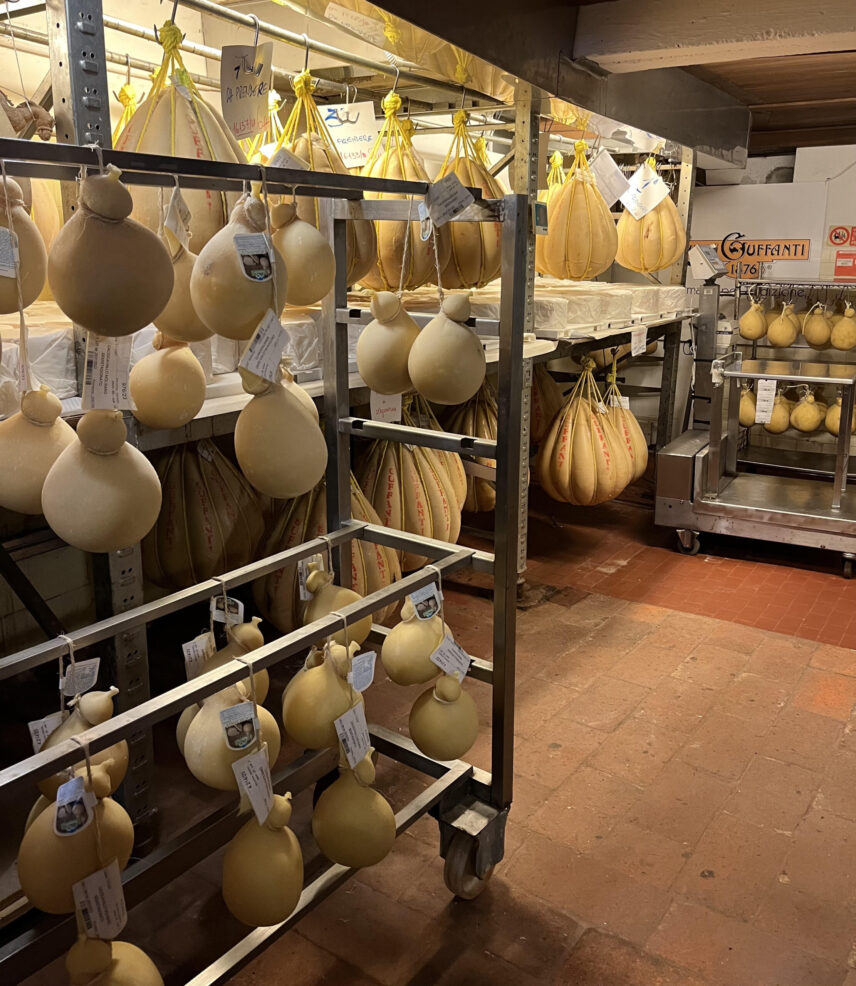
In Northern Italy, I visited a specialty cheese supplier, Luigi Guffanti Allevatore di Formaggi, a fifth-generation family business established in 1876. In another demonstration of how temperature alters time, I learned they sometimes sequester standing orders destined for the USA at a cooler-than-usual temperature to slow the rate of fermentation and buy the cheeses an extra couple of weeks’ transit time. Davide Fiori, who now runs the company with his brother, father and aunt, explained to me their business name: allevatore, he said, means “breeder.” The unconventional usage of the word is intentional, he assured me (their website, in English, describes the business as “cheese growers”): “Allevare means to take an animal and to help the animal grow up. And we do the same with cheese.” Guffanti buys fresh-made cheeses from small producers to “raise up” in their cellars, putting their “imprint” on the cheeses and making them “our own,” before eventually determining “the best moment [for it] to be put on the market.” Gesturing around a room filled with bulbus Provolone and Caciocavallo cheeses tied with rope and hanging from metal stands (see Fig. 2), Davide described the importance of rubbing the cheese rinds with brine solution, and maybe a bit of olive oil, to maintain the rind’s elasticity so the cheese can “breathe.” “Why? Il formaggio non muore mai. ‘Cheese never dies.’ It could be a James Bond title, but it is the truth.” Cheese never dies, it only changes with age—provided it is properly cared for.
Moving through the warren of rooms that make up Guffanti’s aging cellars, Davide directed my attention to a wooden rack holding a series of six or more, weathered-looking wheels of Bitto cheese, facing outward like LPs on display. Their rinds are inscribed with the names and birth dates of his and his brother’s children. These are commemorative cheeses to mark the children’s coming of age. They will be cut into, shared, eaten to celebrate an important rite of passage, “for the 18th birthday, or a degree.” Each cheese temporally representing a distinct, human life, their collective value is inalienable yet perishable, a generational investment in reproducing the future of a family, a business, and a food tradition meant to outlive any one instance.
As a form of preserved milk, cheese requires attention and care to grow to maturity and avoid becoming spoiled. It’s a cliché to observe cheese’s semiotic capacity to represent human mortality (note that birth is a prerequisite for milk and you get the picture). What I’ve instead tried to suggest here is that the linear progression of cheese’s fermentation time, inching towards decay, is neither steady nor automatic. Temperature and humidity are tools that are used—potentially as a favor to a client-friend—to discipline the temporality of cheese maturation, while the hands-on work of brushing, cleaning, and flipping cheeses is as empirical as it is manual. By handling them regularly, a monger gets to know cheese not only by kind but by instance. That knowing is key to cheese “forecasting” and the temporal adjustments and calibrations required to make the business of cheese worthwhile.
Ariana Gunderson is the section contributing editor for the Society for the Anthropology of Food and Nutrition.