

Article begins
Editor’s Note: This piece is the third in SAFN’s 2026 Anthropology News series on Temporality in Food Anthropology. If you haven’t already, check out the previous installments by Janita Van Dyk, and by Janet Chrzan.
Orders-In
Nico and I have been standing awkwardly in the kitchen for what feels like an eternity. This is the first time I’m joining him for a day of work at Pseudoughnym, a mom-and-pop pizzeria slinging New-York-style pizzas out of a warehouse tucked between an auto body shop and a furniture outlet. If we were actually in New York, those details might make good bait for a feature on Eater about the city’s best pies hidden in plain sight. (Maybe not. New Yorkers, don’t come for me.) The reality, though, is that Nico and I are in a ghost kitchen complex in Los Angeles and there is no business-boosting fanfare for Pseudoughnym to be found on the foodie forums or guides online. After all, Pseudoughnym is a ghost kitchen. Unlike a traditional brick-and-mortar restaurant, it operates out of a corporate-owned warehouse alongside 30 other delivery-only restaurant brands that otherwise exist entirely online. It is decidedly not a dining destination. In fact, Pseudoughnym is not a destination anyone can dine in at all.
There are a couple of reasons for the awkwardness: Nico and I don’t know each other well yet, and he’s still not totally sure why I’m here with him today. After all, he normally works alone. His boss has told him I’m interested in studying how digital technologies are shaping his experiences of work as a ghost kitchen line cook, as did I when I met up with him at the start of his shift, but he seems confused why I’d be going to school to end up spending time with him. He’s game, yes, but confused nonetheless.
Perhaps the biggest cause of the awkwardness, though, is our lack of activity. The small talk that filled our first twenty minutes while Nico set up his mise en place was pleasant enough, but we’ve now been in the 200-square-foot kitchen for nearly an hour and a half, and not a single order has come in. In that time, I’ve asked Nico several questions about what brought him to Pseudoughnym and how he feels about working there. He’s answered them all politely, if briefly. The long silences punctuating our bursts of conversation have made the compactness of the kitchen more palpable. Mirroring this, the cramped space rendered time unusually thick and viscous.
All of a sudden, a ticket ejects from the thermal receipt printer. I grab it and tell him, “Order in—one 14-inch pepperoni pizza, Uber Eats.” Nico replies, “Heard,” and grabs a ball of proofed dough, which he starts to stretch into that classic thin disk. As he ladles on sauce, I hear three more tickets print in quick succession. “Fire three more pepperoni, one cheese! Four pepperoni pizzas all day,” I relay. After a slow start, the kitchen starts to heat up, literally and figuratively, all at once.
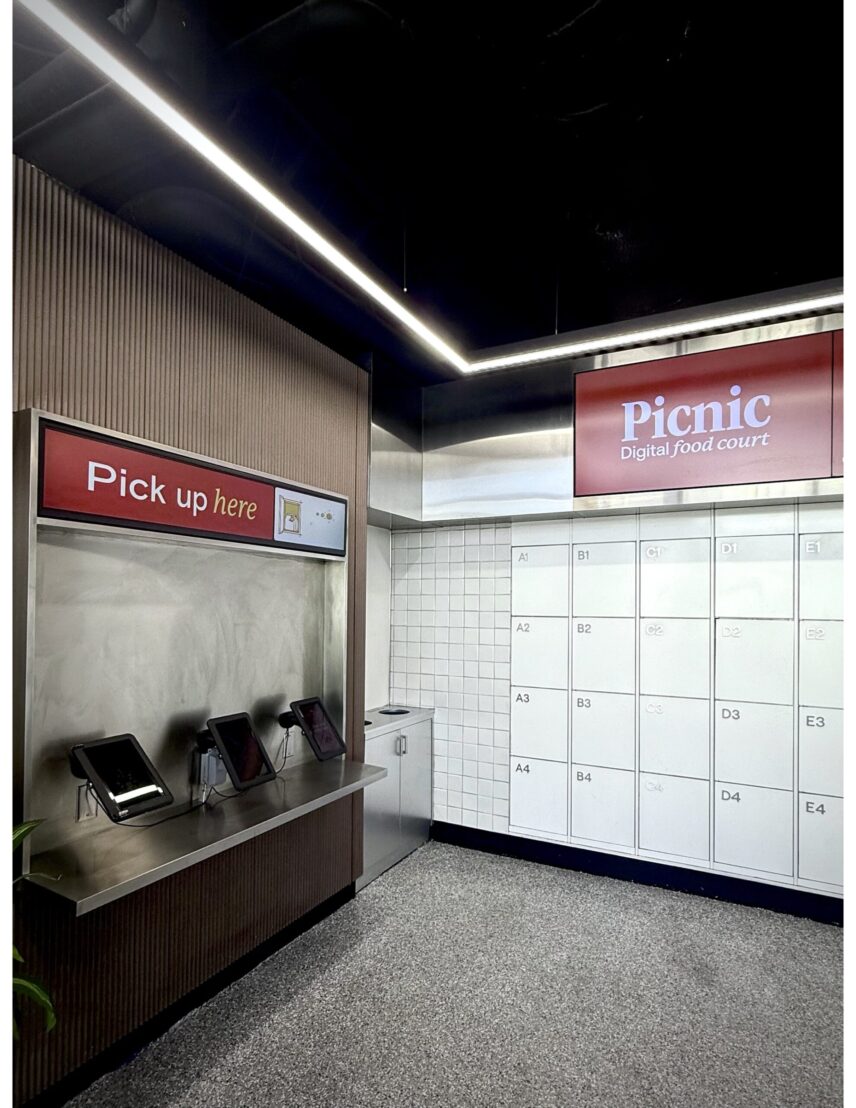
Once Nico boxes up the pizzas, he asks me to run them to the pick-up area of the ghost kitchen complex, where I place the four orders into separate lockers that gig-working delivery drivers will open from the other end. I return, expecting to find Nico working on new orders, but I find him standing idly instead. By the time I leave Pseudoughnym five hours later, only six more orders have come in. As we clean up for the night, I ask Nico if today was a typical workday. “Yep. If anything, we had a couple more orders than usual. Today went by a little more quickly.”
Orders-Out
Throughout the day, on the other end of those lockers, delivery drivers have been picking up the pizzas Nico made. This process is entirely contactless. Drivers pull up to the ghost kitchen, fiddle around with a tablet to determine and open whichever locker has the order they’re responsible for, then grab the contents inside before dashing back to their car.
That first 14-inch pepperoni pizza was picked up by Pedro on its outbound journey. While I wasn’t able to follow along with him for that specific pie, I know from interviewing drivers who deliver through Uber Eats and DoorDash that the flow of time felt very different than it did in the kitchen. For Pedro, the clock began ticking as soon as he accepted the delivery, initiating a race against time. The customer has been given an ETA through the app, of course, but the condition of a customer’s food often starts to deteriorate at the moment of its completion. Despite whatever innovations the food delivery packaging industry has made, food in transit can only stay crisp or fresh for so long when suffocated in its own steam.
The most pressing question for Pedro, then, is how quickly he can get that Pseudoughnym pizza to its final destination. From that question, other questions follow: “Will the customer tip more if I can drop off the order quickly? Will I be able to bump up my rating from 4.89 back to 4.90?” Speedy deliveries translate to happy customers; conversely, orders that have been delayed run the risk of netting low tips and dropping his rating. And while low tips are disappointing and frustrating, a lower rating often translates to being offered less gigs on the app, which affects his bottom line.
From there, the questions get more granular. “It’s only 1:30 PM, but the 101 is already slammed between Western Ave and Downton LA. Was there an accident? Construction, again? Or perhaps more anti-ICE protests and burning Waymos downtown? Should I ignore DoorDash’s directions and take the local roads? But there are so many stoplights, and the surface street traffic might not be any better—is the gamble worth it?” All of these micro-decisions matter for Pedro when the wrong choices can cut into his tips, ratings, and time that could otherwise have been spent on fulfilling subsequent orders.
There is a complex calculus undergirding a workday in this sector of the gig economy, one which deals in shifting flows of traffic, distance across urban space, time per order, a day’s earnings… Under these conditions, the clock seems to tick in double time as minutes slip through fingers like sand. And as Pedro approaches the customer’s address with that 14-inch pepperoni pizza, his phone will ping with a new order, asking Pedro if he’d like to accept the gig and start the race all over again.
On [Stretched/Compressed/Frictionless] Time
Both the line cook and the delivery driver are integral to the corporate ghost kitchen business model; without their respective labor, it simply would not be feasible as an economic formation at scale. And yet their temporal experiences of the workday can be distorted in such markedly different ways. Line cooks, when working in a struggling ghost kitchen, can experience time as stretched and abstracted. Long lulls during a solitary service in a windowless kitchen the size of a one-car garage… Time flows slowly under such conditions. Meanwhile, delivery drivers are caught in a series of fragmented races against the clock. For them, minutes become compressed, flying by as drivers attempt to minimize time per order and maximize deliveries in a day.
Algorithms have become a salient object of academic and popular theorizing as computational technologies continue to increasingly mediate social life. Certainly, the temporal experiences I’ve described thus far illustrate how current algorithmic regimes shape the experiences of both labor and time itself. For the purposes of this piece, however, I want to forego a focus on the algorithmic in favor of reflecting on what these divergent yet interconnected experiences of time might reveal about the relationship between time, labor, and food in a landscape mediated by techno-capital.
First, they remind us that, even in the world of food, time is not an isolable, reified, and standardized objective phenomenon but rather something experienced subjectively. As Janita Van Dyk points out in the first installment of this series, discourses around food often deploy time fetishistically as an ingredient or precursor for the value seemingly inherent to specific items. True balsamic vinegars accumulate value because they must be aged for decades; ramps have short seasons, making them limited and highly coveted. In a classical Marxist sense, value appears to inhere in food commodities by virtue of the various temporalities that shape qualities like taste and availability rather than the labor required to produce them.
But the value of all food is contingent on embodied labor—even food ordered from ghost kitchens, which are, for many customers, functionally virtual. Despite appearing magically at your doorstep 48-53 minutes after tapping some buttons on your phone, the monetary value of the food and the value of the convenience offered by delivery are products of someone working somewhere.
This labor is inseparable from time. Of course, in an immediate sense, we have become socialized to think of compensation for labor in terms of hourly wages or annual salaries. But beyond that, time is itself an implicit product being sold. As is so often the case with the tech and tech-adjacent industries, the various services being sold boil down to marketized convenience. For a customer ordering food, ghost kitchens and the larger delivery-based gig-economy promise an effortless erasure of hours spent on grocery shopping and cooking, or a forty-minute roundtrip drive to pick up food. This experience of frictionless time is made possible because it is extracted from the temporal realities of these two groups of workers. Customers are freed from the burden of time because line cooks and delivery drivers are trapped in its distortions.
The corporate ghost kitchen is representative of the distinct mutations that occur when the tech industry’s obsession with logistics and convenience work their way into historically non-tech industries. Its infrastructures intensify the distorted temporal experiences of cooks, drivers, and consumers by further alienating them from the social relations, interactions, and feedback that can still be found in traditional brick-and-mortar restaurants (even those that fulfill many delivery orders). Without these human rhythms to anchor a workday, time itself becomes unmoored. Nico waits, typically alone, in a windowless kitchen until an order comes in. Pedro picks up food from a locker and races to fulfill a contactless dropoff at some stranger’s doorstep.
This social alienation produces specific experiences of labor-time. Anthropologists of infrastructure rightfully point out that there are temporalities to infrastructure (e.g., networks of pipes are expanded and connected over time). Attending to the various social actors in ghost kitchen ecologies highlight that infrastructures—such as windowless parcels of kitchen space, contactless pickup lockers, city roads, and digital delivery platforms—shape subjective experiences of temporality as well.
Ultimately, the ghost kitchen forces us to confront the uneven distributions of time that sustain the conveniences of contemporary urban life. Focusing on the trajectory of a typical ghost kitchen order rather than the longer temporalities that also define food (e.g., growing seasons) allows us to contend with multiple co-constitutive temporalities à la minute—the time it takes for a food’s condition to degrade, alongside the stretched time for the lone line cook, compressed time for the driver, and frictionless time for the customer. In doing so, we see that time in the food system is never just an ingredient, a neutral measure of efficiency, or a unit by which financial compensation is determined. Rather, the frictionless time enjoyed at the consumer’s doorstep is a luxury commodity—one engineered by infrastructure and paid for by the temporal alienation of the workers who feed us and make sure we are fed.
Ariana Gunderson is the section contributing editor for the Society for the Anthropology of Food and Nutrition.