

Article begins
This post is part of a new AN series produced in collaboration with Anthropology’s Lost Library (ALL), which will showcase the works and academic lives of select contributors to ALL. ALL is an archival project dedicated to preserving unfinished anthropological writings—the books and book chapters never published, the articles and essays never resubmitted, the theses and dissertations never completed—and documenting the stories that help explain why these works never reached their intended audiences. ALL is now accepting works on any topic, in any of anthropology’s four fields. Contributed works can arrive in any state of incompletion, from all-but-published pieces to drafts that stop mid-sentence or trail off into outlines. More information about submission can be found at: https://www.lost-library.net/submit.
The following interview was conducted by Joshua Rubin and Katherine McNally with the family of Dr. Usha Welaratna, and it details Dr. Welaratna’s life and professional career as well as the story behind her completed-but-unpublished book manuscript, Coping with Loss Mindfully and Compassionately. Dr. Welaratna’s manuscript will soon be available to interested readers, in ALL’s searchable database.
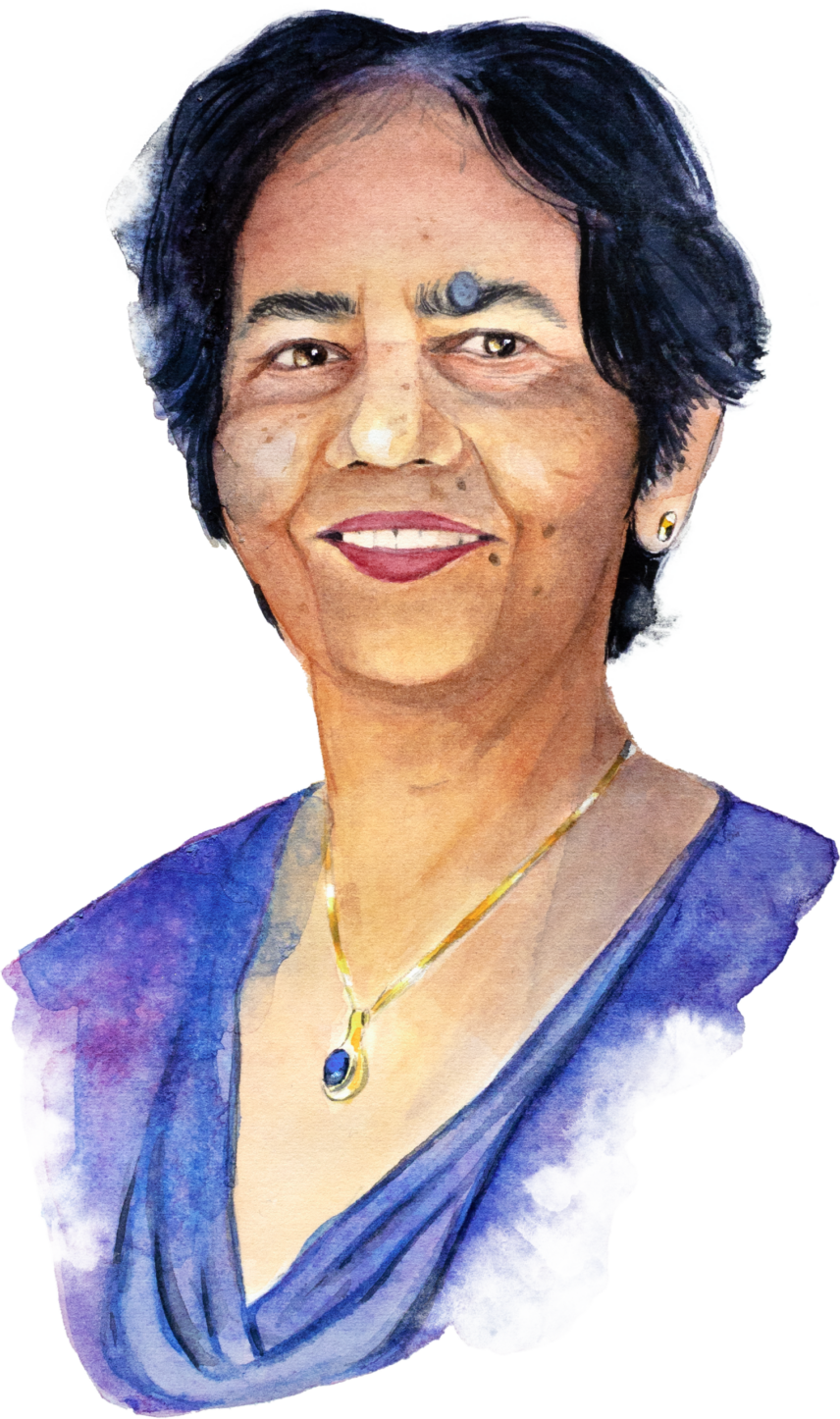
ALL: Tell us the life history of the work you submitted to Anthropology’s Lost Library. We’d love it if you’d paint us a picture of its creation as you remember or understand it. For example, to start your thinking: When did the work on this project happen? Where did the work take place, geographically or spatially? What questions and interests were exciting to you or its author? Please respond however feels true and meaningful to you.
On December 26, 2004, our family was all in the Bay Area but in scattered locations, enjoying post-Christmas dinners and delayed festivities with various friends. Late in the day, we each discovered separately that a vast tsunami had roiled the Indian Ocean, and the videos were starting to reveal the horrifying extent of the damage. Our mother Usha, at that time a professor at San Jose State University, leapt into action by helping the Sri Lankan Buddhist temple we attended organize emergency supplies to be sent to the worst-hit areas in Sri Lanka.
Usha always described herself as a Western-trained Sri Lankan Buddhist anthropologist, and in the aftermath of the disaster, her training wouldn’t let her sit on the sidelines. Within the month, Usha was on a plane to Sri Lanka. She landed and made her way to the western coast where the tsunami had destroyed whole swathes of the coastline, taking with it homes, roads, and even train tracks.
Usha was a remarkably resourceful researcher. In addition to working through her strong existing network from having grown up in Sri Lanka, she applied her anthropological training to quickly build trusted relationships with a variety of community members, government officials, and temple clergy who helped her enter villages and have conversations with people who had just lost whole families and were grieving deeply.
Usha recognized that this disaster had unique qualities that needed to be documented. Such a large tsunami hadn’t really taken place in the modern era, but climate change was making it an increasingly likely occurrence. Her earlier research study focusing on survivors of the Cambodian Holocaust, which resulted in an award-winning thesis later published by Stanford University Press, had equipped her with all the tools needed to work with survivors of another tragedy of unprecedented proportions. Usha’s personal connection to Sri Lanka meant that she was uniquely positioned to conduct a comparative study on ways of coping with loss from a Therevada Buddhist perspective – and her prior in-depth research into Asian religions including Mahayana Buddhism, Sikhism, Hinduism, and Jainism gave her the tools to serve many more of the island’s populations.
Her research didn’t end there. At the behest of various advisors throughout the five years she spent on the study, she expanded the scope of her analysis to include the impacts of the tsunami in Japan as a comparison on both the ecological and sociological impacts.
This work did not come without great cost, financial, physical, and emotional. Usha took time off from teaching to conduct this research unfunded. She and her then-husband, Sri, supported the communities she entered with donations of much needed supplies like burial fabrics, towels, clothes, and toiletries. Usha recorded hundreds of hours of video, including documentation of one terrifying trip along the coast with her landlady, Thusanthi, and Thusanthi’s son where, as she is holding the camera, the perspective dramatically drops and turns askew as she falls into quicksand. She was very nearly sucked fully in and could have drowned that day except for her landlady’s son’s quick actions, as could be heard by the shouts and shaky laughter in the aftermath of the incident.
There were hundreds if not thousands of emails and letters documenting her meticulous research and her efforts at collecting official documentation tracking how policies were decided upon, implemented, and changed in the months and years following the tsunami. These policies spanned everything from funeral rites and burial methods allowed to ordinances and codes related to rebuilding – including whether people would be allowed to rebuild their homes right up against the coastline as they had originally been permitted.
ALL: Could you tell us the story of how this work became lost, unfinished, or never published? As a prompt for your reflection: anthropology as a discipline has generally not emphasized many of the life conditions necessary for scholars to participate in its production–time, resources, funding, job stability, institutional and interpersonal support, personal or family health/ability, luck…. We hope to shed light on how easily these conditions can become unsettled and to highlight the effects of their instability on anthropologists as people and anthropology as a field.
Originally accepted by the same editor she worked with at Stanford University Press to publish Beyond the Killing Fields: Voices of Nine Cambodian Survivors in America, the completed manuscript was later rejected by another editor after the first editor retired. It was a severe blow to Usha, and she spent some time thinking about how to proceed. She submitted a query to UC Press, and, at first, found positive interest for a public anthropology series they were putting together.
Extensive revisions were requested by UC Press to change the audience for the book from a purely academic audience to a general interest audience – a shift Usha had the experience to make, as she had authored articles for children’s magazines earlier in life as well as a regular column for The San Jose Mercury News called Anthropologist-At-Large, which introduced many readers to the field. But by 2009, Usha’s health was in decline. She had back and shoulder problems that were causing numbness and pain, ultimately resulting in her not being able to send the completed manuscript to UC Press for several years. In 2012, after she was able to finally submit the finished work, it was rejected on the basis that it was “not quite a scholarly book and not a general-interest title either.” The editor felt that the book would not reach a large enough audience to make it viable for their press.
This proved to be the final blow. Usha continued to work on the manuscript, deciding to shape it further into a book for the general public, officially naming the work Coping With Losses. She would go on to complete additional revisions but did not query other publishers. She seemed to lose her confidence in the work after that.
At the end of 2019, Usha was diagnosed with stage 4 breast cancer, just three months before the pandemic triggered the global lockdown. Usha then spent a year living in isolation in her home, with weekly visits from her older daughter Sumudu and ex-husband and occasional visits from her son, Ruwan, the eldest in the family, who flew in from London and quarantined before visiting her. Towards the end of the pandemic, Usha’s youngest daughter, Deepthi, suffered a severe psychological breakdown partially caused by not visiting her mother during the pandemic. As soon as the travel ban was lifted, she moved up to the SF Bay Area to help take care of Usha. A year later, surrounded by her family, Usha passed away.
One of the incredible gifts Usha gave her family, among countless others, was a detailed binder with her will, her advanced health directive, and detailed instructions for her funeral arrangements. As reflected in her caring and generous dedication to helping those who had experienced the worst that life could offer, experiencing genocide and natural disasters, Usha felt a deep commitment to ease the suffering of those around her. Usha had no fear of death, and that quality was one she drew on time and again to help others.
One small but cruel irony, and a core reason Usha’s youngest daughter specifically felt compelled to maintain her legacy and not allow this work to be lost, was that in 2021 to cope with her psychological breakdown, she was prescribed an antipsychotic drug called Seroquel, which she believes caused severe side effects lasting several years. During this time, she decided to reread the Coping With Losses manuscript as she was preserving her mother’s work, and discovered that, among many other vital findings, Usha had uncovered evidence of Seroquel’s damaging impacts on the grieving family members who were prescribed the drug back in 2005.
The competitive environment of publishing means that important insights like these that the public could benefit from can remain locked away in manuscripts and unfinished works. This is why Usha’s family believes Anthropology’s Lost Library has such an essential role to play in preserving knowledge, regardless of its perceived marketability or circumstantial loss. If a baseline of quality exists and academic rigor and ethics are preserved, it is a disservice to society for academic texts to be disregarded or discarded.
ALL: What were your or the author’s hopes for the work, in the discipline or in the world?
From entering university for the first time in her 40s, Usha excelled in her field. She was given special permission to skip her B.A. degree and go straight into the graduate program in cultural anthropology. From obtaining her master’s degree onwards, Usha was a working cultural anthropologist. Earning her Ph.D. was one of her proudest achievements. She conducted her dissertation fieldwork with gang members in inner-city Long Beach, both in and out of schools, and her earlier background as an ESL teacher in the California public school system was extremely valuable in that role. She consulted for the San Jose District Attorney’s office to help them communicate with a murder suspect who only spoke Khmer. She probably never imagined all the various twists and turns her life would take, but her dedication to her profession was a constant throughout her later life.