

Article begins
Insights from ethnographic work with children in Haiti demonstrate the power of fluidity as a lens on learning.
Much of what we take to be learning is often imprisoned in a kind of conceptual stasis: dualistic categories of achievement vs. failure, students vs. teachers, in school vs. out of school, individual vs. collective, rote learning vs. critical thinking. These views of learning, associated with the idea of learning as transmission, are often at odds with the ways anthropological research has suggested that children learn through participation in cultural activities. This work illustrates how social participation, connection to nature and the non-human world, observation, attention, embodiment, agency, and autonomy are central to learning. Learning, in this view, is embedded in an ever-shifting landscape of cultural activity in which the usual conceptual oppositions appear inadequate to account for the fullness and complexity of children’s engagements with the world.
Over a period of about 15 years, I did fieldwork in Haiti with children living under conditions of social disadvantage. Most had very limited schooling, and, like many children in Haiti, they did not live with birth parents but in other households where they engaged in domestic labor. Some also did street work. The dominant discourse presented a powerful image of “stolen” childhood—characterized by themes of vulnerability, trauma, violence, lack of stable and loving families, and exclusion from society. While not denying the challenges children faced, my research suggested that they were clearly learning much of value from their engagement in a variety of activities. They were skilled contributors to households, engaging in wage-earning activities as well as having responsibilities for marketing and meal preparation. In addition to caring for siblings and other children, they were often primary caretakers for disabled or sick adult relatives or grandparents—roles in which their caregiving was highly valued. They pursued what I came to call “self-education”: a form of working on and developing skills, talents, and abilities in the absence of institutional opportunities and, often enough, in resistance to dominant views that excluded and marginalized them. They pursued, in sum, the project of becoming persons through learning to develop domains of expertise that were not crystallized but enabled aspiration and striving toward a higher sense of belonging and participation in the world.
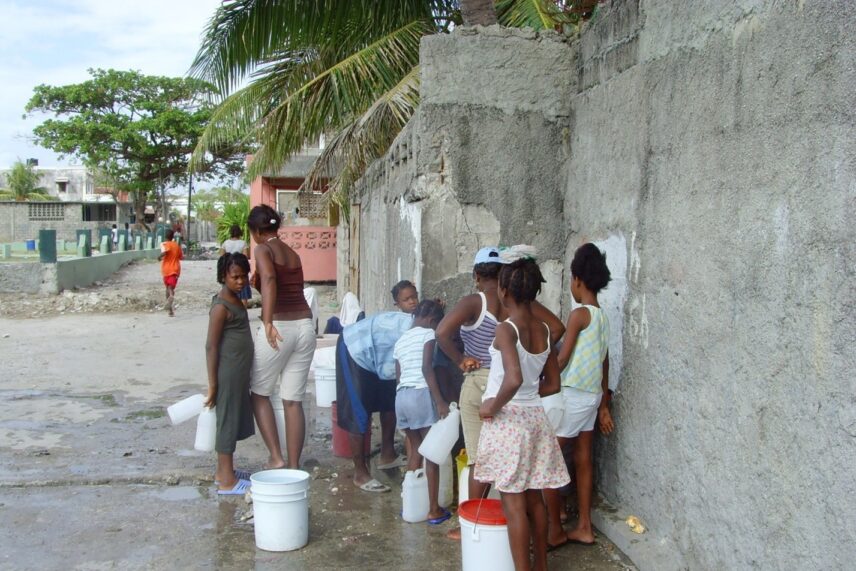
While not inaccurate, over time this picture became unsatisfactory to me. It was as if in trying to offer a cultural reading of children’s lives that recognized their agency and strengths, I was still “fixing” them in place. What began to appear more interesting to me was their movement. Children moved constantly in and through their environments. They moved in public spaces as observers and participants in a diverse array of community events and activities; they moved from one household to another and into the streets on a daily basis. They moved for varying periods of time to stay in different households. They actively sought out opportunities to move to households that offered a better chance of access to schooling or other family connections that could be beneficial in the future. Many children moved independently, ostensibly living in one town but moving to work or visit relatives in another, in some cases traveling substantial distances on foot or by public transport.
In one of my projects, conducted in an afternoon community school serving disadvantaged children, both Haitian and US observers in different classrooms were surprised by the extent to which children were in constant movement. One Haitian observer asked, “In my class I saw a lot of movement—why are they moving around so much?” Another Haitian observer asked, “Why doesn’t all the movement bother the teacher?” US observers too noticed the movement: “What movement is normal and what movement needs discipline?” In my fieldnotes I even drew diagrams with arrows to capture how students were moving. Another Haitian observer also noted that kids “were always turned around looking over their shoulders, looking around…”
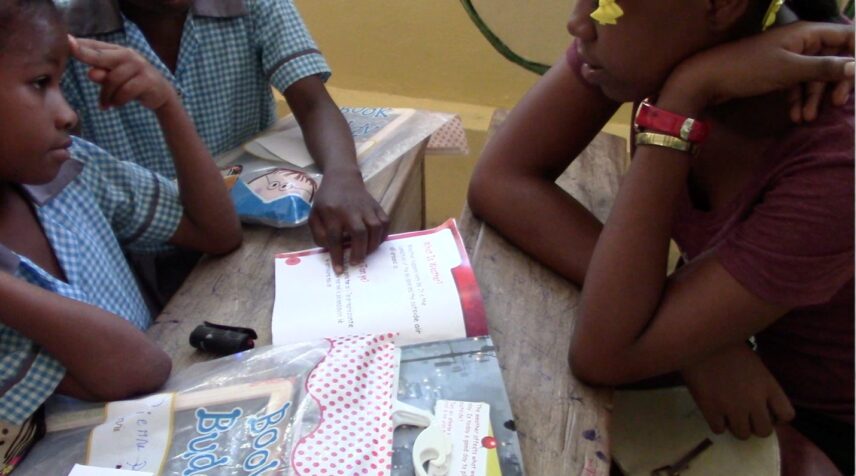
Video footage of small peer groups taken during another study exploring aspects of children’s social interactions around literacy revealed how movement, wide-angled attention, and multisensory engagement with the environment were central to children’s learning. Touch and even taste were prominent modalities of engagement, as children used their bodies to interact with each other and with materials such as notebooks and texts. Children shifted their gaze continuously—appearing to take in information from many sources in the environment, demonstrating a marked fluidity of attention. I was struck by how similar this way of attending was to the open or wide-angled attention that Gaskins and Paradise and Rogoff and colleagues have suggested is common among children in some indigenous communities in the South. Video data also revealed how participation was distributed across the space, as students moved around to observe and join in on others’ activities.
Movement, I began to see, enabled learning, for through movement the pathways of engagement between the person and the world became more fluid and thus fuller—more open to a diversity of meanings and possibilities. The usual analytical frames associated with learning as transmission were clearly static and inadequate to account for this fluidity. Could we really specify what was being transmitted or learned in a given instance? Could we really isolate the teacher from the learner, the learner from the setting, or the learner from the learning? Even if we could, what would be the point? Rather, in the absence of adults “teaching” and in the presence of such movement, sensory wealth, wide-angled attention, and keen observation in a landscape of great social complexity, it seemed that learning could best be approached through a lens that honored its fluidity as an ever-changing modality of engagement of the person and the environment. Becoming a person and learning were aspects of the same phenomenon, and both were about being drawn into a larger domain of meaning and being—one that was itself always in flux.
One day, I went with a group of children hanging out in the neighborhood where I was living to climb a tall hill that rose up behind the community. From below, all one could see was a grassy and rocky slope. The path was steep, and as we walked, the children held my arms to steady me and coached me where to place my feet. At the top, to my surprise, there were many people, a church in full song, children playing on an abandoned backhoe, small homes, fields of tall grassy vetiver. During our walk, children commented about the things they heard and saw on the path, answering my questions and offering their own observations, as together we created new meanings. As Vergunst and Ingold observe, walking was learning: it was an education of attention, an enmeshment of the person and the world. We passed a goat tied to a tree, its rope twisted, and I suggested we try to untangle it, but the children said simply, “It’s not ours,” educating me in their perception of social norms.
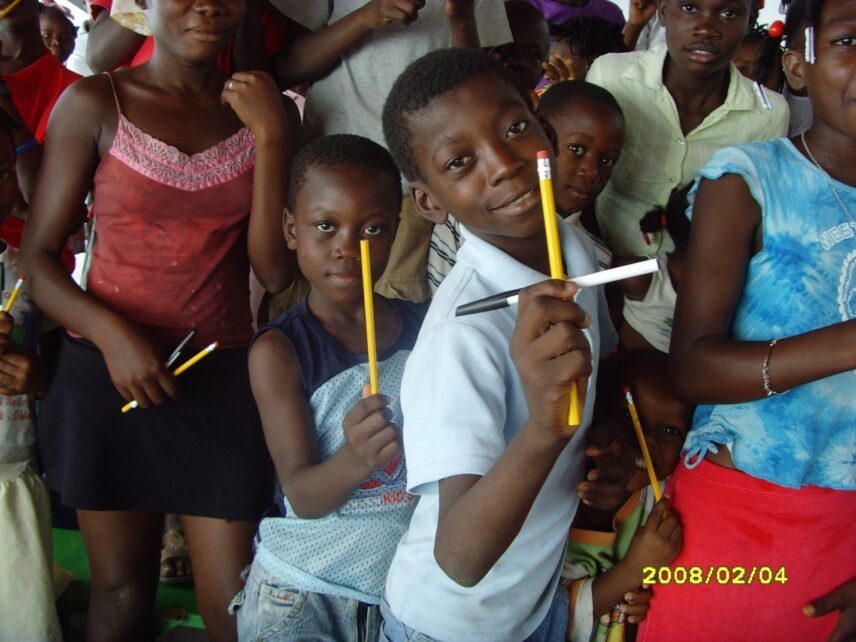
A few years ago, in preparation for a talk, I was reviewing old photographs I had taken at the very beginning of my fieldwork. Some of the children had taken the pencils and pens I had given out as gifts and made crosses, holding them up for me to see. It was only at that moment, years later, that I recognized how meaningful the gesture was. In Vodou, the indigenous religion that exists alongside and in syncretic relation to Christianity, the cross is a gate or pathway between the spiritual and the material worlds, just as in Christianity it represents the path from this world to eternal life of the spirit. Children drew fluidly on both systems of meaning, connecting ordinary activity with a larger domain of spiritualty while also drawing me into their worlds. I had missed this deeper meaning until I, too, had become able to see and learn.
Fluidity offers a more useful and ultimately more powerful way to look at learning by treating it as a shifting encounter between the self and the world characterized by wide attention, movement, embodiment, and spirituality—the latter almost always being fundamentally about connecting the person with a larger domain of being. As a lens on learning, fluidity opens a range of social and cultural phenomena to multivalent and polysemous interpretations, enriching our appreciation for the many ways people create meaning under even the most constrained and challenging circumstances, while working against the stasis that characterizes many understandings of learning prevalent in schools and dominant social discourse. For those who have been marginalized by society, recognizing fluidity in their engagements with learning is also an ethical stance that resists what Erickson and Espinosa have called the conceptual domination in the lenses we apply to teaching and learning. To see fluidity in the learning and lives of those around us offers a renewed focus on what (should) matter to the heart and soul of anthropology.
Tricia Niesz is the section contributing editor for the Council on Anthropology and Education.