

Article begins
Given the sensitive nature of this piece, the author has chosen to use a pseudonym.
When does sweat become suspicious? When does a crisp white shirt transform a migrant into a “European gentleman”? I never had imagined these questions until the afternoon my phone rang in my small apartment in Basel, Switzerland. It was April 10, 2017, and my older brother Sipan’s voice was trembling through the WhatsApp line from Milan. The July 2016 coup d’état in Turkey reversed the peace process between the Turkish state and the Kurdish Movement and reshaped millions of Kurds’ lives overnight. For the Kurds, already living under the weight of decades of forced assimilation, discrimination, and forced migration, the crackdown that followed was swift and merciless. Many Kurds fled to Europe, to the US, carrying with them stories of persecution that stretched back generations. Sipan was one of them. He had committed no crime except being Kurdish and demanding that basic human rights be extended to Kurds in Turkey. In the eyes of the Turkish state, his very existence, his Kurdishness, was a threat. Yet that same identity that is marked by a history of pain, displacement, executions, and erasure became his only possible lifeline. Sipan hoped that in Europe, this truth might be recognized and grant him the protection he sought as a refugee. However, he was now stranded in the borderlands of Europe, not on a map, but in that intangible liminal space between legality and illegality, between mobility and immobility.
I was shocked as I had not been informed about his plan. As I learned later, everyone in our family knew about Sipan’s plan, but they decided not to tell me to protect me from the “illegality” of the border crossing. He was supposed to be on his way to Germany, following a route arranged by a kaçakçı (“smuggler” in Turkish) who would take him from Italy to France and onward. However, the route was exposed, patrols had intensified, and the kaçakçı abandoned him in Milan. The only advice from his kaçakçı was to hide and avoid the police. He did not want me to know his situation until he reached his final destination, Germany. Yet, his abandonment by kaçakçı changed everything, and I was his only hope.
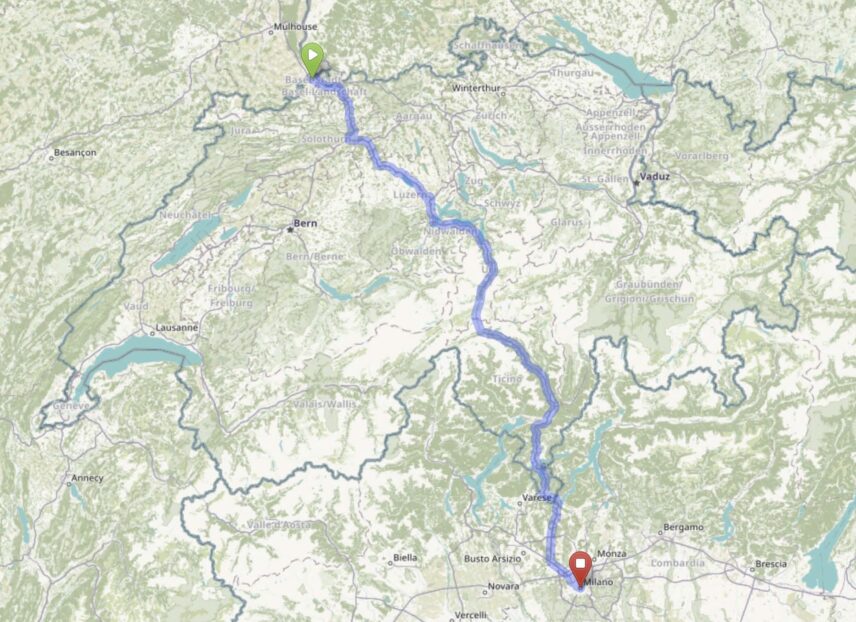
Contrary to Sipan, as a master’s student at a Swiss university, I had the relative privileges of free mobility in the Schengen Area provided by a Swiss visa. Sipan’s voice was weighted with the opposite reality: immobility enforced by law, patrolled by soldiers, amplified by the unspoken judgments of strangers. He had become one of the “foreign others” that the European border regime is designed to contain. He took refuge at a Turkish Kebab House. After a four-hour luxury train trip, I arrived at the restaurant. On my way from Basel to Milan, I was never stopped, nor did I have my identity checked. Borders are selective; they target specific individuals and groups who are deprived of certain mobility capital.
A Kebab House as Refuge
The Kebab House smelled of roasting meat and fried bread. My brother was sitting at a small table with two overstuffed backpacks. His eyes darted toward the door every time it opened. We were close to Milan’s central train station, where soldiers patrolled with rifles slung over their shoulders. Sirens punctuated the air every few minutes. It was at the height of the “migration crisis” that alarmed European countries. Once I became part of his “illegal travel,” my position also shifted, and “I” became “we,” making it impossible to continue speaking as an “I” alone. For this reason, I use we in italics throughout to index this shift.
After talking to learn some details of his travel, we started thinking about the night: where should we stay? We couldn’t stay in a hotel—no visa for him, too much risk. We didn’t know where we could go. It was at that moment that one of the restaurant’s workers approached us and talked in Turkish. He was aware that we were one of those “illegals,” but he also noticed that we were talking in Kurdish and Turkish, and perhaps thought that he had to do something for his “Turkish brothers.” Indeed, he did. He offered his two-bedroom apartment for the night.
While waiting outside for our host to arrive, I could see the weight pressing on my brother’s body. The sirens and patrols were making Sipan extremely anxious, and no matter what I said to him, he could not calm down. He was avoiding eye contact. There was a slight shake in his hands. This was not the man I knew, the man who once broke up street fights and carried himself with unshakable confidence. My childhood hero became someone else. Who was he? Being in that liminal space without any “proper” identification document, the fear was embodied and could easily be observed from Sipan’s gaze and movements. In Milan, his “illegality” was written on his posture, his silence, his skin, his backpacks, and his sweat. Shame has a way of seeping into the body. It’s not just the absence of documents that marks someone, but the way the gaze of others turns that absence into an essence: you are an “illegal.” You are a “danger.” You are the “crisis.” That night, my brother carried that shame like a second skin. He was obviously ashamed of being seen by me in that liminal space and kept asking: “Did I do the right thing to leave? Why am I here now?”
Lake Como and the Spectacle of Border Crossing
In our host’s small apartment, there was a sense of belonging among the three of us in Milan. I think our host was our accidental relation providing shelter, information, and affective support, which made the journey possible. After breakfast the next morning, our host gave us directions to the northbound trains and bought us tickets. Before parting ways at the station, he pressed the tickets into our hands like a blessing. We took the train north to Como, the last Italian city before Switzerland. The air was smelling of pine, and tourists were wandering around the colorful houses. My brother smiled for the first time in days, telling me that Hollywood stars like “George Clooney own a villa here.” I was baffled. How could he be thinking of movie stars when the police could appear at any moment? But perhaps this was his way of holding onto something light in a heavy moment.
As we walked, I noticed how his clothes—a faded green T-shirt, worn jeans—made him stand out. The two massive backpacks screamed “migrant.” I remembered an ethnographic account told to anthropologists Shahram Khosravi by one of his “illegal” informants. Border crossing is not just about papers; it is about performance. Appearance is a form of camouflage. Confidence can be as important as documents. If you act as though you belong, you can sometimes slip through unnoticed. The right shirt, the right shoes, the right posture: these can be tools of survival. I decided we would restyle Sipan. Borders are selective, but not in the ways we think. They operate through a gaze shaped by race, class, clothing, and even posture. They don’t just check documents; they indeed read bodies. We stepped into a Zara store and checked the crisp white shirts. He balked at the price, 50 euros, but agreed when I promised to get one for myself. In the changing room, he emerged transformed: tall, handsome, and suddenly able to pass the border as a European gentleman.
The plan was simple: I gave him my Swiss ID, seated him in a different train car, and had him open my laptop as if working. I would take his backpacks, which were the obvious markers of his status alongside his somatic behaviors. We boarded the train to Bellinzona. For the first 30 minutes, everything went smoothly. I was speaking to him on the phone from my seat, checking in. Then, he noticed a female officer eyeing me from the other car, perhaps noting my glances, noting “my” luggage. As we approached Bellinzona, Sipan called, “The officer and police had just checked ‘my’ ID, waved me through, and are coming to your section.” The border had now read me as the suspicious one. I did not know what to do. Fortunately, the train stopped at Bellinzona just before the police arrived at my car. When the train stopped, I grabbed the backpacks and bolted off, ducking into an open building that turned out to be an empty storage space. I went into the bedroom and locked myself in. Minutes later, Sipan called again, laughing this time: “The officer was so sure that you were ‘the illegal one.’”
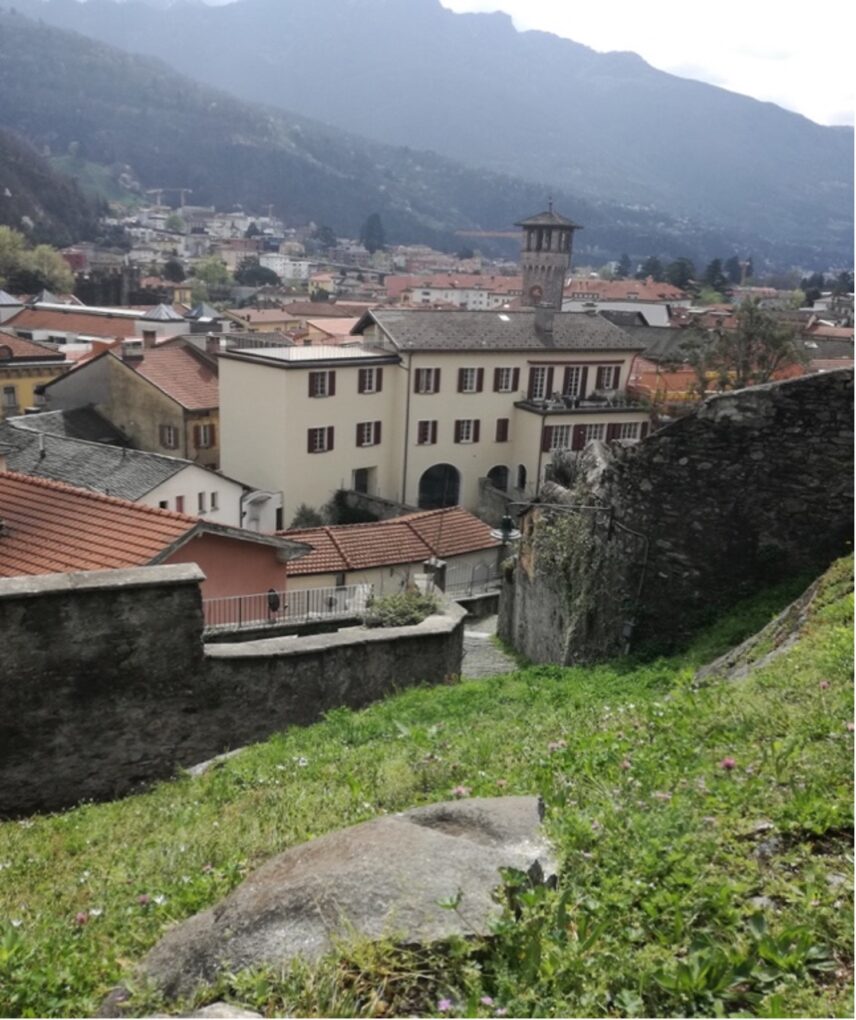
In the end, borders are selective and have specific targets. The border gaze on the train did not read me as an individual but rather as a type. At the borders, bodies are fluid. Hearing Sipan, I left the storage space where I had refuge and searched for another safe space. The beautiful castle was not too far. I passed through narrow streets to reach the castle to hide. Each time I heard the police siren, I was getting nervous. This time, it was me shaking and sweating. At the borders, passing is not guaranteed. Accompanying my brother Sipan, I entered a world where borders are not just lines on a map but liminal spaces where people become fluid subjects, constantly shape-shifting under the gaze of the Others. The journey was not just about passing from Italy to Switzerland. It was about the fluidity of identities under the pressure of borders. In Milan, Sipan’s body was treated as the other. In Como, with a white shirt and a laptop, he became something familiar in the eyes of the border. On the train, I moved from “legal” to “suspect” without taking a single step across the line.
Reversal
Borders are often imagined as static, but in reality, they are fluid zones. They move onto trains, into train stations, into our very bodies. They can turn a Kebab House into a sanctuary, a storage room into a hiding place, a white shirt into a passport. In these spaces, belonging is not a binary but a performance, a negotiation, a constant reshaping. Fluidity, in this sense, is both a survival strategy and a quiet act of resistance. It’s the ability to adapt, to shift forms, to remain unfixable in systems designed to pin you down. It is exhausting. It is dangerous. And yet, for many, it is the only way to move forward.
By the time Sipan reached my apartment in Basel, our roles had already reversed. He had made it across and passed as a European gentleman; I had been the one hiding. Waiting on a hill in Bellinzona and watching the natural colors of the city, I got a call from Sipan. He was in my flat in Kleinbasel. Now it was his turn, and he was making fun of me as my border-crossing performance was not successful, and my body failed me. After hearing that he was safe, I decided to start my own journey, but this time, I planned to use multiple public transports, including local buses, local trains, and speed trains. It took me more than 6 hours to arrive in Basel. It was around 8 pm, and Sipan was still sleeping. After waiting 10 minutes, he opened the door and welcomed me to my home while laughing.