

Article begins
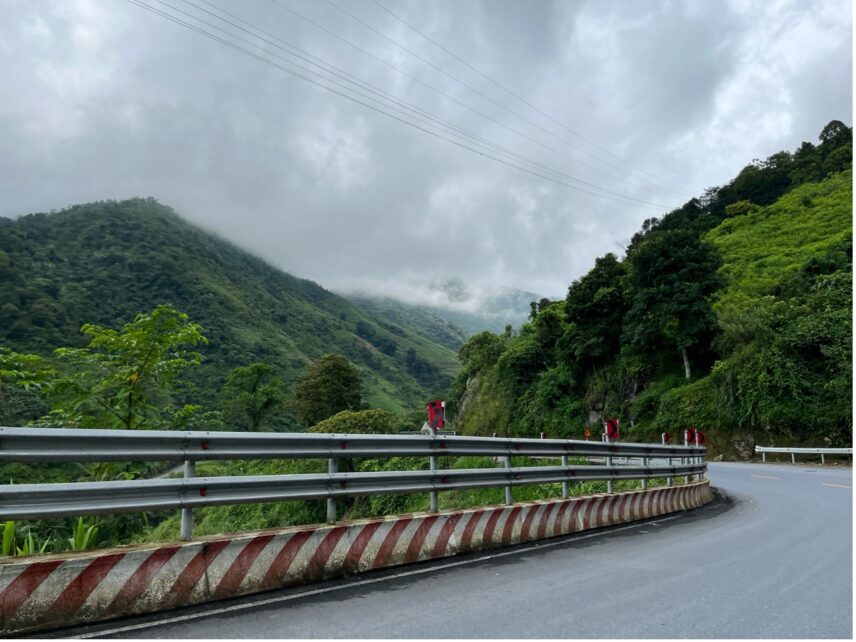
“I cut out that part. It shouldn’t be exposed,” said Nga (pseudonym), a Vietnamese Hmong vlogger in her mid-twenties who is active on international and Chinese video-sharing platforms such as YouTube and Douyin. We were sitting together in a riverside café in Lào Cai, through whose window China lay just across the water, its riverbank now lined with barbed wire. Nga pulled out her phone and, after scrolling for a moment, opened a xunqin (Mandarin: “searching for relatives”) vlog on Douyin that she had filmed earlier. We sat together, watching it side by side. In the vlog, the undulating mountains rushed past in motion. Suddenly, Nga tapped the screen, “I forgot to connect the Wi-Fi. Wait a sec, okay?”
Before I met Nga and followed her xunqin journey offline, I had been part of her virtual audience for two years, watching how different Vietnamese women in China digitally reunited with their natal families after years of separation through her mediation. Living in Lào Cai, a city in northwest Vietnam that borders China, Nga and her friends began their careers as vloggers and live streamers in 2019, both as a form of social connection and as a way of generating income. Their sustained digital labor on video-sharing platforms gradually made them more visible and accessible to Vietnamese migrants in China, many of whom are undocumented and seeking to reconnect with their natal families. Nga told me one day while we were traveling to film a vlog.
“Since 2020, after the pandemic began, my friends and I started receiving private messages from them (Vietnamese female migrants). Many of them came across our videos by chance, scrolling on Kuaishou, Xigua, Douyin—these Chinese platforms—and asked if we could help them look for their families.… Some went to China on their own, some were tricked. Many of them don’t have documents and have no contact with their families, and with stricter border controls, they can’t come back. So they send us whatever information they remember, names, addresses…and travel expense to ask us to drive to their natal family to help find them.”
With the vloggers’ permission, I began following their xunqin journeys in person in 2024, and my own positionality shifted from being just an audience member to becoming both an audience member and a companion. As I experienced these journeys both offline and through video platforms, the invisible layers of xunqin began to surface: untranslated conversations, unrecorded moments, unpublished clips, and, gradually, the underlying logic behind these absences. The transformation from the physical journey to the edited vlog is not just a matter of documentation, but is a layered combination of offline and online labor. The offline xunqin journeys themselves typically stretch across one to four days, yet they are ultimately condensed into vlogs that last only 10 to 40 minutes. Moreover, the transformation from offline journey to footage to final vlog is shaped as much by what is left out as by what is shown.
As Butler notes, the frame does not simply await interpretation; rather, it actively participates in the interpretive process, even shaping meaning in forceful ways. These vlogs function similarly, actively shaping the way stories of separation and reunion are received.
A few weeks earlier, I asked Nga how she puts a vlog together. Nga laughed and gave me a knowing look, “It’s impossible to record everything; my phone doesn’t have enough storage. It’s usually days, and audiences don’t have the patience to watch it all.” Yet these moments of invisibility were not only created by technical limitations or audiences’ expectations. They were also shaped by ethical choices, temporal pressures, and aesthetics decisions, which carried as much weight as what made it into the final cut.
Outside the café window, the Nậm Thi River was flowing steadily, tracing the border between Vietnam and China. Inside, Nga held the phone up in her hand and played this vlog again, our attention briefly drawn into the world she had once filmed. In this vlog, Phu, a Hmong woman who went to China a decade ago, was speaking with her parents, whom she had not seen for over a decade. Slowly, Phu began to recognize other family members. Under her parents’ prompting, she recounted how she had ended up in China: “I was tricked.”
Then, her recounting was cut off. The vlog jumped to the next scene, where Phu told her parents about her current life and her children.
“I remember this. I watched on YouTube before. But it had two different titles.” I looked up from screen and turned to Nga.
While the visual content of the vlog remained unchanged, its title took on different contours across platforms. This vlog, uploaded to YouTube, carries a bilingual title. In the Chinese title, Phu had “gone to China for ten years,” while in the Vietnamese version, she had “bị bán sang Trung Quốc” (was sold to China for ten years). This disjuncture, created through translation, is visible to those who understand both languages. On Douyin and other Chinese video-sharing platforms, however, only the Chinese title remains, and once again, Phu “went to China for a decade.”
Cross-border mobilities in Vietnam-China borderlands have been often pursued as livelihood strategies by those living in rural precarity and regional disparities, including economic hardship and interpersonal conflict. Although border control has periodically tightened since the Sino-Vietnamese war in 1979, the mountainous terrain, such as in Lào Cai – Yunnan, features land borders that extend along rivers. The easily crossable rivers and interlinked networks continued to facilitate everyday undocumented crossing—until very recently, when a border fence was constructed on the Chinese side during pandemic. Mobilities of female migrants like Phu are shaped by multiple, intersecting dynamics. China’s rural gender imbalance, fueling a demand for marriage migration, renders their mobilities marked by both opportunity and risk, and sometimes entangled with gendered deception. I asked whether the shifting of the title across platforms had anything to do with protecting privacy. Nga frowned slightly, thinking as she spoke,
“I wouldn’t call it privacy. Before China installed barbed wire along the border, this kind of thing happened a lot around here. You see the river? Back then, you could just take a boat and cross over.… If we really wrote it that way in the title, Douyin might take it down.… The part where she was tricked in Vietnam, we might keep that in. But once she arrived in China, and it was handled by people over there, we usually cut that part… Sometimes, that part is also too painful.”
Such past gendered mobilities are not only personal, but they are also relational and contextual. Whether and how these stories become digitally visible depends not just on what is said, but on what is strategically withheld, muted, or translated ambiguously. The ambiguity itself becomes a mode of digital storytelling. Nga added, “Those who regularly watch my vlogs understand. If someone just happens to scroll past this video, they might not and that’s okay too.” For returning viewers, this ambiguity begins to function as a shared code and a form of knowing, which is a kind of invisible visibility made possible by intimacy, continuity, and digital attunement.
In the vlog, in Phu’s parents’ home, harvested rice, packed into woven sacks, was neatly stacked against the wall. Her sister-in-law pulled a notebook from between the bags of rice, turned to Nga, and said, “Do you have her phone number? I want to write it down in this notebook so it won’t get lost.” Nga nodded. A moment later, she added, “She just sent it to me. Start with 0086, that’s China’s country code—”
Nga’s voice was cut off mid-sentence in the video. In the next shot, Phu’s sister-in-law laid the notebook open on the table, leaning over to copy the number. Nga stood beside her, helping double-check it. On-screen subtitles explained: “We are writing down the phone number.”
They straightened up, and Nga quickly ran her finger over the number in the notebook. “When you call her, just dial it like this—don’t forget to start with 0086. Once her international roaming is activated over there, she’ll be able to call you back,” she said.
Similar to this scene, during reunions, migrant women and their natal families usually exchange phone numbers to maintain contact. These moments, however, are often fragmented in vlogs: the spoken numbers are either muted or cut entirely. In that silence—and in the visible discontinuity between scenes—surrounded by the sounds of earlier moments and the quiet movement of lips still visible on screen, the absence becomes striking. The lack of sound or continuity does not make the moment invisible. Instead, it draws attention to itself.
“I cut out that part. It shouldn’t be exposed. Privacy.” Nga shared this about her edition choice. For her, as well as other vloggers, privacy is layered. The most obvious line they draw is around migrant women’s faces and phone numbers, since most of them are undocumented in China. Faces and phone numbers symbolize traceability, which may lead to potential intrusion and disturbance once the distance between the public and private get suddenly decreased. In most xunqin vlogs, the faces of Vietnamese women are typically shown only to their natal communities and the vloggers themselves, kept deliberately out of view from the broader audience. Visual representations of the natal families are often more direct and unfiltered. In contrast, her face becomes private and visible to vloggers and her families, but invisible to viewers.
Xunqin through vloggers can function as alternative modes of transnational connection, especially when official channels are unable to respond such request. Tham, another female vlogger producing xunqin vlogs shared,
“There are some cases where the police actually know, but they just turn a blind eye and don’t send the women back when they asked. I don’t know why… And some are because of language or not remembering their address in Vietnam. There was one woman who said she went to the police several times, but they told her they couldn’t help unless she could provide an address in Vietnam. She didn’t speak Vietnamese, so she couldn’t write it down—and in the end, she had no choice but to come to us for help.”
Moreover, reunion through official channels is often perceived as too risky or uncertain. These risks may include deportation, separation form marital families, or being placed on immigration blacklists that prevent reentry into China for several years. However, reunion through xunqin and its very digital visibility can also expose women to risk, especially when their stories become widely circulated. Some interlocutors mentioned that local authorities are aware of the presence of most undocumented Vietnamese women. It is treated as a public secret, tolerated to a certain extent. However, when a video becomes too viral and this clandestinity draws the attention of higher-level authorities, this once-tolerated presence may shift into a state of monitored visibility and potential enforcement.
And then, among forms of biometric data, it is the selected and translated voices of Vietnamese migrant women that become the exception and the enabler of narratability. For many scenes where the dialogue is conducted in Vietnamese, Hmong, or other minority languages spoken in northern Vietnam, the women’s original voices and the conversations with families would not reach the audience without the vloggers’ mediation. Through translation, paraphrasing, and subtitling, vlogging shapes how these voices are heard and what becomes intelligible and affective. In this sense, original voices, selected visuals, and vlogging co-produce a new narrative register, one that carries fragments of speech and emotions across linguistic and bureaucratic borders.
This selective visibility is simultaneously a strategy for navigating bordering practices and a means through which vloggers sustain their digital livelihoods. For many undocumented Vietnamese migrants, privacy is a primary concern, and some explicitly withhold consent for their stories to be uploaded. Consequently, vloggers must balance ethical obligations with the economic realities of platform monetization, where visibility is both currency and risk. With the digital labor of vloggers, Vietnamese female migrants negotiate how to be seen and heard while still making connection possible, resisting being traced without exposing themselves to the full gaze of the state or the digital public.
Yet, what is invisible is not static; it shifts and transforms alongside the evolving contours of the migrants’ transnational journey. As some Vietnamese women’s transnational journeys unfold—especially when they return to Vietnam to obtain documentation—their faces started to appear in vloggers’ follow-up reunion videos. These clips are often accompanied by links to the original xunqin videos, weaving their once-hidden faces, unclear voices, and untold stories into a new layer of narrative. In a recent follow-up xunqin vlog, a migrant woman who had previously reconnected with her natal family through Nga’s digital mediation returned to Vietnam—not just virtually, but physically. She came back to apply for documentation which would later allow her to register her marriage in China. After completing the paperwork, she met Nga in person. They shared a meal, and part of their encounter was filmed and included in the vlog. Unlike before, her face was now visible. At the beginning of this vlog, Nga explained:
“When I filmed xunqin journeys in the past, I used to focus more on the family in Vietnam. Back then, many of them [migrant women] didn’t have documentation, so it wasn’t appropriate to film them. Some net-friends suggested I screen-record the video call to show both sides of the reunion… but it didn’t feel right. Now, she has documents; she can appear in the video.”
Visibility, just like invisibility, is not static—they shift, blur, and bleed into one another. As visibility is strategically crafted across the Vietnam-China borderlands, transnational connections are reconfigured, lived, and consumed. Within this mediated borderworld, unlikely social actors come together. They traverse physical separation and navigate the constraints of migrant and border regimes, while also reproducing these divisions and complexities in new ways.