

Article begins
Vernacular Halting
The Lagos traffic jam, “go-slow,” a mercurial phenomenon that can snarl the metropolis for hours, knows when you are most in a hurry! Despite government efforts to ease congestion, such as banning danfos (passenger vans) and okadas (motorbikes), these measures face resistance. Such bans eliminate essential tools Lagosians use to navigate gridlock, thereby diminishing their agency to manage immobility, time, and their spatial understanding of the city. Unsurprisingly, this slow violence is etched into cultural memory, from Fela Kuti’s 1972 lament “Go Slow” to the protective inscriptions painted on vehicles, like “nothing pass god” and “na Jesu save.”
The pervasive slowness is promiscuous, infiltrating Nigerian life through systemic corruption, institutional erosion, and failing infrastructure. Within this “post-grid imaginary,” the stagnation of universal public systems forces a shift toward private, disintegrated alternatives. This transition prioritizes individual wealth over shared citizenship, producing temporal and physical lacunas that are always being renegotiated, thus threatening equity for the vulnerable. Historically, the concept of malingering, deliberate slowing of the body, or a lack of effort, perceived as laziness, was used for gatekeeping, judging an individual’s moral worth by their alignment with fluid labor and productivity. When applied to Lagos, slowing becomes a tool for exclusion from citizenship and a moral condemnation of the city and its denizens.
Yet, if we look closer at the malingering, the “halting” rather than fluidity of movement, this stagnation reveals itself as something more than just unproductivity. For Lagosians, this friction is not merely an obstacle; it is an ontological condition, a unique vernacular for relating to and navigating the relentless complexities and systemic stresses of this modern African metropolis.
Ongoing stagnation in Lagos is arguably a direct legacy of colonial imposition of a Western, linear model of time and efficiency, one that framed development as a universal progression from “underdeveloped” to “developed.” Infrastructure meant to embody the “colonial sublime”—railroads, buildings, roads, designed for speed and extractive productivity—subsequently encountered the vernacular indifferent to sustaining such flow. Dilapidated vehicles, uneven structures, and machinery prone to breakdown subvert the ordered rhythms envisioned by colonial planners. These breakdowns, improvisations, and refusals powerfully destabilize the colonial lattice, revealing until-then invisible connections, and thus offering potentially crucial opportunities for a praxis of decolonization.
Waiting and Dashing

On arrival at Murtala Muhammed International Airport, the immigration officer studied my face, glanced at my passport, and listened closely to my accent. The mismatch was clear: an American voice attached to a Yoruba name with a Nigerian passport. Confusion!? A smile signaled her quick assessment before she said, “Welcome home.” Subtext understood! Her greeting doubled as an invitation to offer a “dash” to avoid delays. I handed over the equivalent of five U.S. dollars in naira (figure 1), and she waved me past the waiting travelers, now crowded in the hot hallway.
The choreography of waiting and “dashing”, a culturally embedded, ambiguously functional form of compensation, begins long before arriving in Lagos. It starts on the Nigerian Embassy’s online portal, where navigating interlinked forms can consume over an hour. Though designed to prevent fraud, the system produces a microeconomy of self-styled “visa agents” charging exorbitant fees. The embassy appointment, as relayed in Teju Cole’s Every Day Is for the Thief, further demonstrates how the dash prescribes time. Despite signs that admonish “do not offer bribes,” I found myself in a room with around a hundred other exasperated travelers, all attempting to mediate the misery of waiting with the expediency of “dashing.”
Waiting, as Javier Auyero details in Patients of the State, reveals profound power dynamics that transcend geography. In Nigeria, the burden of waiting is unequally distributed, aligning with the existing hierarchy of power. The “dash” functions as a social lubricant, enabling speed and offering an opportunity for social performance in a culture where relationships are paramount. Navigating this requires finesse: giving too little risks being insulting; giving too many risks being seen as foolish or vulnerable. The transaction is often softened with creative euphemisms like “something for the children” or “sea no run dry,” acknowledging the impropriety. Both givers and receivers recognize the vulgarity of the act yet feel compelled by a pervasive systemic force. The result is a clear divide: those who cannot pay wait, while those with means, like my hybrid self with perceived privilege, are prioritized. The dash brings fluidity and movement, acting as the opposite of waiting. “Welcome home,” indeed.
Cyborg Danfo
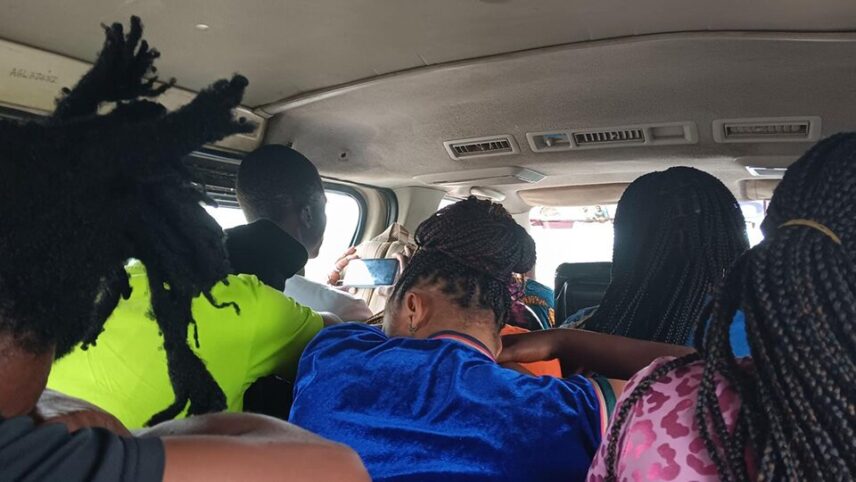
The airport’s sliding doors opened onto a plethora of ground transportation. Faced with taxis, kekes, buses, and okadas, each vital to the city’s transit ecosystem, I chose a danfo. The iconic minibus taxi remains Lagos’s primary transport mode, couriering nearly seventy percent of motorized trips.
I paid my fare; the conductor briskly shoved me into the packed vehicle. Despite open windows, no air moved inside. Passengers were packed in like sardines, squeezed together so tightly that flesh melded with flesh and then fused with metal, transforming the vehicle into some sort of monstrous speeding cyborg of Cronenbergian extraction (figure 2).
We barreled down unpaved roads, challenging other drivers as if racing daylight itself. At one bend, we nearly struck a mother and two children crossing, yet we did not stop. We covered twenty miles in under thirty minutes before slamming to a halt. Lagos go-slow don catch us!
Deceleration disarticulates the cyborg danfo as passengers and drivers disembark for air, and some, after hours of stagnation, abandon their vehicles and walk home. Yet where the “go-slow” halts mobility, it generates economic opportunity. Traffic exposes the daily labor of street vendors whose livelihoods depend on fluctuating speeds and urban rhythms. Smiling hawkers surround stalled vehicles; eyes lock, exchanges begin, and passengers’ temporal inconvenience becomes economic salvation. These conditions shape vendors’ strategies, bodily movements, and the social relations that emerge along Lagos’s roadways, dynamic workplaces animated by delay and temporal obstruction.
Decay and Disruption
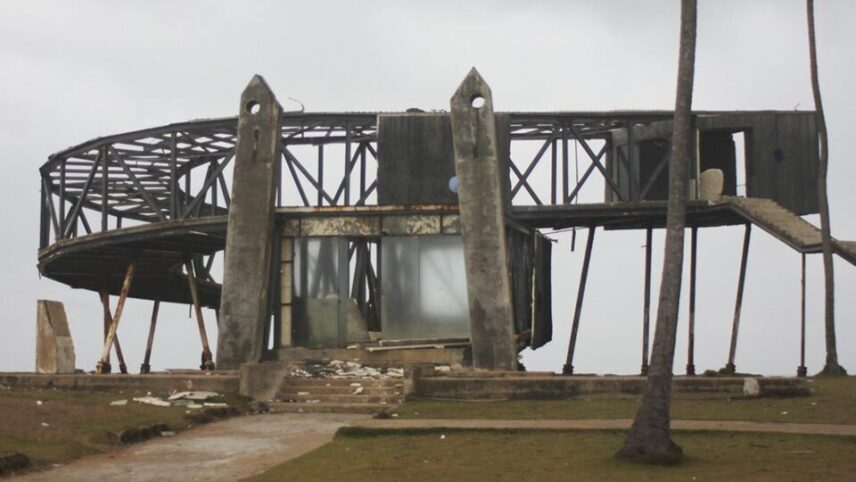
Aje yelled, “Prof! Come now, or we’ll get fined!” My research assistant’s urgent call from the beach shattered my contemplation atop the crumbling Point of No Return Monument in Badagry, Nigeria. Authorities, perhaps police, had spotted me climbing the structure, forcing a swift descent. I scrambled down the slope, navigating holes, rebar, and fallen steel, my path strewn with beach detritus, a tangible illustration of the site’s decay.
I had traveled to Nigeria to study memorializations of the transatlantic slave trade and encountered repeated forms of stagnation and disrupted flow. Once promoted as a “world-class tourist destination,” the Badagry Point of No Return monument now marks a rupture in time and memory. Despite continual reinvention, its crumbling plaster and Styrofoam structure exposes political, fiscal, and governmental failure to achieve a utopian dream of memorialization as seen in neighboring Republic of Benin and Ghana. Stripped of sacred purpose, the ruin prompts a critical question: how can such a collapse serve the government agenda, tourists, or, more importantly, ancestral spirits?
Ruins belie the power of the state. As monuments speak to particular configurations of power, ruins function as the physical interment of past political failings, existing in the present as traces of a state’s attempt to establish an instituting imaginary, particularly where monumental infrastructure is perceived to require economic and political stability. When the state fails to commodify, consign to the archive and control remains, debris of the past retains spectral disruptive potential that haunts the political present.
At the Point of No Return (figure 3), reading against the archival grain reveals decay as a disruptive force. By linking the trauma of slavery to contemporary government corruption, the ruins “stir up disorder” and dismantle the state’s sanitized official narratives. So rather than restoring its flawed structure (the Sisyphean urge of the state), I question whether it is better to engage with the spectral forces of debris, as the ghostly, ancestral call to the present, debris as a vault of future memory. Such an approach, I argue, preserves lessons in political accountability, spurs economic revitalization efforts, and offers pilgrims a stark, honest narrative of commemoration tragically ruptured.
Deceleration in Action
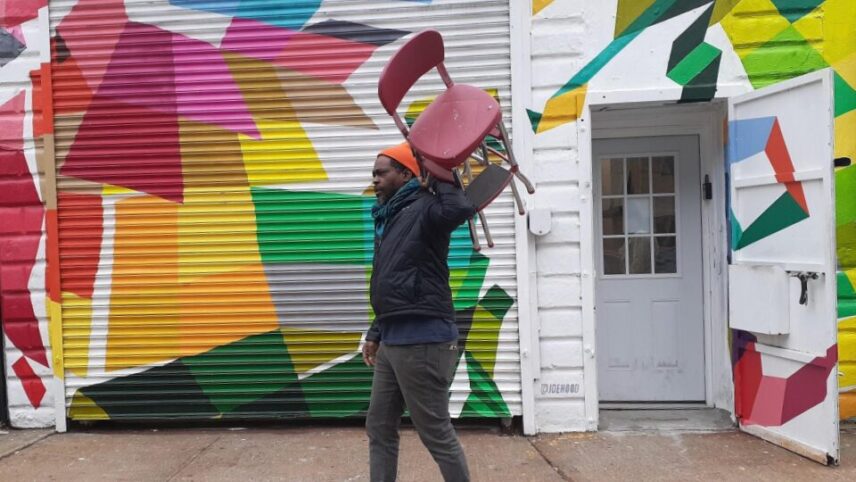
On return, reflecting on my trip, I recognize that power compels the body through hegemonic temporality, the subtle institutional rhythms of daily life. To resist, one can practice Nia Love’s notion of “deceleration.” This somatic “spiritual flow” leverages proprioception and memory to attune the performer to a transformative, slower tempo, linking memory to spatial and temporal contexts via the hippocampus.
Motivated by tensions between fluidity and stagnation during the COVID-19 pandemic, I conducted experiments to reclaim time for myself through the body (figure 4). By layering Google Calendar data, inserting family moments, and printing the results, I staged public interruptions, pausing and sitting on a red stool, to enact embodied self-care amid imposed hegemonic temporality (figure 5).

Flow, ease, and fluidity connote efficiency at the cost of pausing for contemplation. Attending to halting rather than movement invites a reconsideration of stagnation as something other than mere unproductivity. This practice of “go-slow” acts as a potent resistive force, a temporal refusal. While the malingerer or loiterer is often judged negatively by agents of progressive temporality (capitalist, colonialists), their refusal, rooted in a habitus of self-preservation, constitutes a challenge to enduring colonial legacies. For bodies oppressed… to effect resistance… go-slow! go-slow!
Pablo Herrera Veitia and Darlène Dubuisson are the section contributing editors for the Association of Black Anthropologists.