

Article begins
On January 1st, 2026, democratic socialist Zohran Kwame Mamdani, a thirty-four-year-old African-born South-Asian American, was sworn in as New York City mayor with his Syrian-American wife, Rama Duwaiji, by his side. For the oath-taking, Rama held two Qurans: Mamdani’s grandfather’s Quran beneath a smaller late-eighteenth-century Quran borrowed from the New York Public Library. The choice of Qurans was symbolic, highlighting his family’s multigenerational diasporic reach as well as the historical record of Muslim New Yorkers. This celebration of transnationalism and public Islam took place amid a staggering conservative anti-immigrant turn in the US, and only a year after the national defeat of another democratic candidate of South Asian heritage, Kamala Harris.
This decisive moment illuminates Mamdani’s enterprising ability to subvert America’s Anglo-White normativity and expand the image of the American citizen through strategic semiotic and multilinguistic choices during his mayoral campaign. Yet, as the new mayor’s father, Columbia professor Mahmoud Mamdani, reveals, Zohran entered the race with no expectation of winning. Instead, he leveraged his campaign to foreground social and economic initiatives for the city’s working class and immigrant diasporas. Politically, he pledged to protect New York City’s immigrant sanctuary status and amplify the voices of those speaking out against the genocide in Gaza. With lower stakes in the game, Mamdani had greater freedom to curate an aspirational reimagination of New York as a city of and for immigrants—a strategy that made his campaign deeply resonant, especially among his largest support base of young and BIPOC voters.
With a rising public presence in the New York State Assembly, Mamdani’s young-millennial charisma and ability to cultivate an earnest presence both in person and online played a fundamental role in the defeat of his more establishment-rooted mayoral opponents, Andrew Cuomo and Curtis Sliwa. Another surprising factor in his success was his refusal to censor the parts of his multi-hyphenate identity not palatable to a mainstream Americana glazed in a whitewashed aesthetic. A polyglot, first-and-a-half-generation Brown, Muslim American, Mamdani staunchly identifies as a New Yorker. His campaign, which centered around his experiences navigating the city, mimicked the playful Brown aesthetics of his brief career as the hip-hop artist, Mr. Cardamom. Unlike Kamala Harris, who used identity politics in her 2024 presidential campaign to appeal to BIPOC voters through tales of her mother’s struggles to overcome the immigrant label and raise upstanding American citizens, Mamdani centered his own immigrant positionality, showcasing his love for NYC’s ethnic food scene, his Muslim identity, and his embrace of languages other than English.
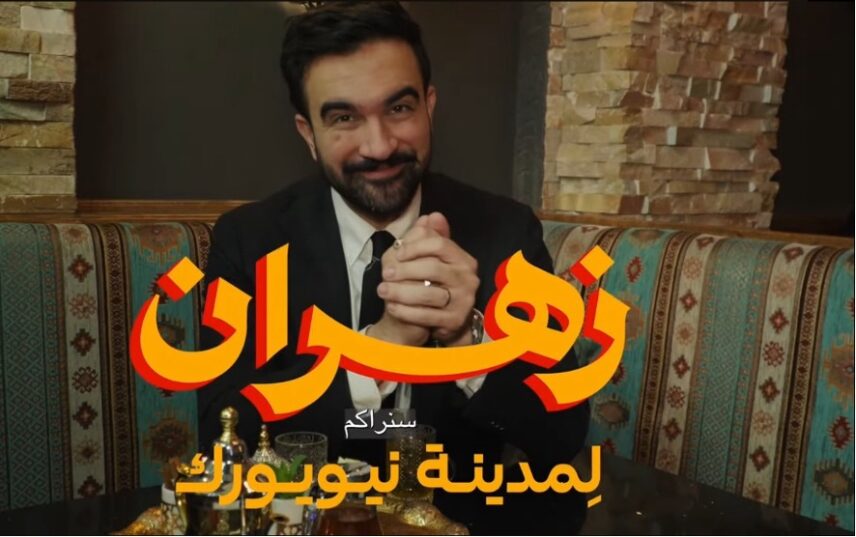
Below, I conduct a discourse and semiotic analysis of two widely circulated videos from Mamdani’s campaign. I pay attention to the ways he leveraged social media and the multilinguistic and immigrant-centered semiotic choices he made that subverted the status quo of a public sphere steeped in secular Anglo-White normativity.
The first video, filmed on October 16, 2025, is Mamdani’s viral response to Islamophobic comments leveled at him by his bipartisan opponents. An earnest monologue directed at the camera, Mamdani recounts a conversation with a well-intentioned uncle who advised him while he was running for assembly not to reveal he was Muslim. Uncle here is a socially meaningful term used in South Asian and Muslim communities to refer to a community elder. Mamdani’s decision not to use another term, like elder gentleman, locates said uncle within New York’s Muslim diaspora and tactically includes the audience within his communal base as Muslim and non-Muslim allies.
Mamdani interprets the uncle’s message to mean that it is in the shadows that Muslims “could embrace the fullness of our own identities. And… it is in those shadows where we must leave our faith.” In the shadows, which echoes Bonnie Urciuoli’s intimate and informal inner sphere, is where Muslims exist outside the scrutiny of secular White-normative surveillance. Here again, Mamdani’s use of our and we places him within New York’s Muslim community and centers it as a formative constituent in his audience, rather than presuming a White audience as the default addressee.
As he relays the Islamophobic smears calling him a global jihadist and supporter of a new 9/11, Mamdani contemplates the failures of a respectability politics that prioritizes nonconfrontation and assimilation to a dominant White public.
“I thought that if I behaved well enough or bit my tongue enough in the face of racist, baseless attacks, while returning back to my central message [representing every New Yorker, no matter their skin color or religion], it would allow me to be more than just my faith.”
Realizing the futility of this approach, he declares: “I was wrong. No amount of redirection is ever enough… In doing this, I have told the wide-eyed young boy in Jackson Heights, or the first time voter in Parkchester, that they too should remain in the shadows. No more.” In marking this resolve, Mamdani deliberately names particular constituents and thereby brings to life different immigrant communities across the city.
Like the alienation felt by Urciuoli’s Puerto Rican interlocutors in public domains, where non-native English speakers experience a persistent awareness that they do not fully belong, Mamdani notes: “More than one million Muslim New Yorkers exist in this city only to be made to feel as if guests in our home. No more,” he repeats. The use of our home positions Mamdani and members of the Muslim community as both Muslims and New Yorkers. The repeated refrain of no more underscores this as a categorical turning point. He rejects the advice of the well-meaning uncle and pledges to comport himself unapologetically in public, pursuing his popularly-documented activities, like eating biryani with his hands and attending prayers at the mosque—acts that subvert public Western middle-class and secular aesthetics.
In emerging from the shadows, Mamdani centers the immigrant as a multigenerational “both/and” who embodies a diasporic and New York way of life. He demonstrates this through multilinguistic campaign videos addressing different NYC diasporas in Arabic, Bangla, Hindi, Luganda, and Spanish, languages he has varying degrees of proficiency in. In so doing, he flouts the unmarked English monolingualism and whiteness of what Jane Hill dubbed White public space, the arena of public interactions which include consumer establishments, government, media, schools, and workplaces.
The second video, filmed entirely in Arabic a few days before the mayoral election, addresses New York City’s religiously diverse Arab diaspora of Muslims, Christians, and other religious affiliations. It starts with Mamdani walking down the street in his trademark dark suit. “Marḥabā [hello!], ismī [my name is] Zohran Mamdani,” he says in impressively proficient Levantine Arabic. He then announces he is running for mayor while seated at an ornately upholstered booth at a Levantine restaurant. “I know what you’re thinking,” he continues in Arabic while pouring tea with fresh mint into a small gold-rimmed glass. “I look like I could be your brother-in-law from the Levant.”
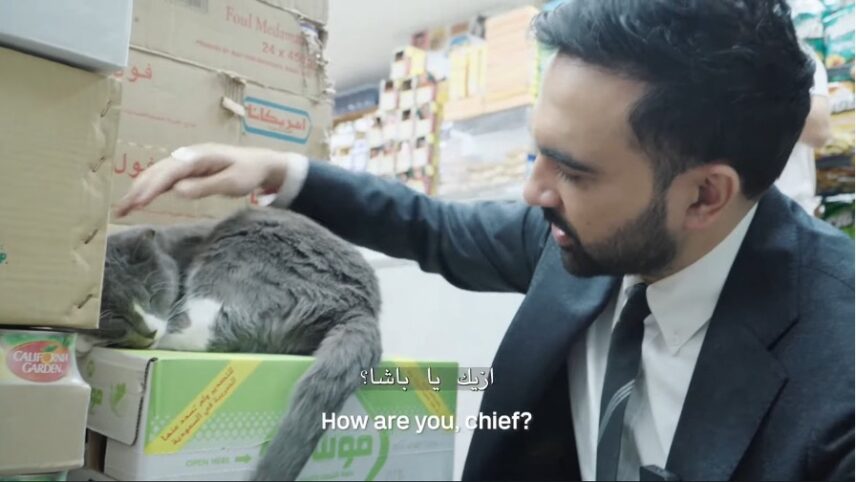
In a subsequent shot, Mamdani strolls through a bodega as he acknowledges that New York has become expensive for everyone. The camera then captures a kneeling Mamdani petting a cat, Egypt, who is napping atop a pile of boxes of canned ful, or fava beans, an Arabic breakfast staple. “Izaiak ya basha [how are you, chief]?” he codeswitches seamlessly to Egyptian Arabic. Through this charming moment, Mamdani spotlights the quintessential New Yorkness of a bodega cat. Indeed, that the cat could be both Egyptian and a New Yorker is at the very heart of Mamdani’s campaign.
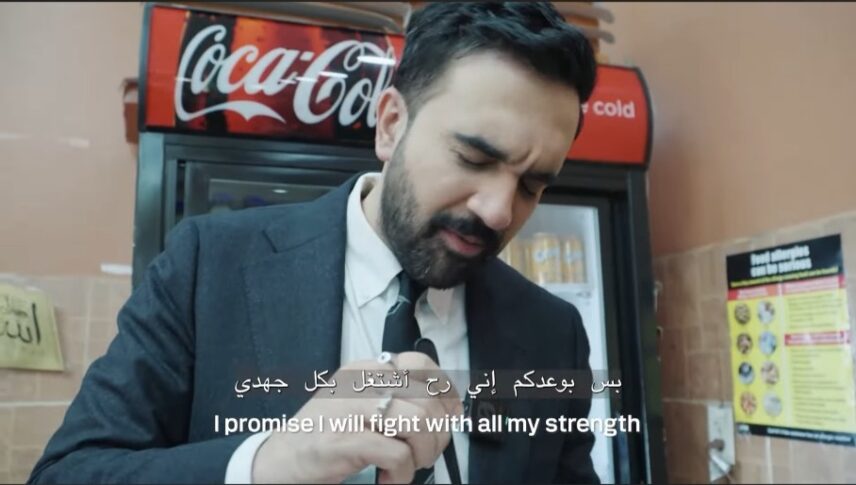
As Mamdani lays out his program of rent freezes, free buses, and universal childcare, he leans against a Levantine bakery counter eating a piece of Nabulsi knafeh—a popular dessert of syrupy shredded filo dough filled with salty Nabulsi cheese, originating from its namesake city of Nablus, Palestine. Between bites, he wittily remarks, “While I may not convince your uncle that the Nabulsi knafeh in Steinway is better than New Jersey’s, I promise you that I will fight with all my strength to make it easier for you to open your small businesses and pay your rent and build your future in the City of New York.”
Mamdani’s linguistic and semiotic maneuvers center New York City as a gateway to the American dream. By addressing the Arab diaspora in Arabic (and others in their respective languages), he turns the norms of White public space on their head. Anglo-White normativity embraces multilingualism only when it features prestige forms of Western European languages as signs of cosmopolitanism, and it embraces immigrants in so far as they provide opportunities for middle-class capitalist consumption. Here, Mamdani subverts ideologies of public comportment that cast the use of certain foreign languages as disorderly. Instead, community members become, as Erving Goffman describes, the ratified hearers or intended listeners, while the non-Arabic speaking public become overhearers who bear witness to the rich conjuring of this community’s lifeworld.
Pointing to the camera, Mamdani clinches his message: “I am from you and for you.” As in the first video, he harnesses the cultural power of kin relations through the use of kinship terms and this final proclamation that he is both part of and accountable to the community. The camera then cuts to Mamdani with a group of young Arab New Yorkers. In unison, they shout, “Snarākum [we will see you].” The video ends by leveraging the power of the written, closing on an official campaign still in orange Arabic script which declares: “Zohran for the City of New York.”
These two videos showcase Mamdani’s radical ability to flip a normative cultural script. By leveraging language and social media, he brings immigrant diasporas out of the shadows and normalizes their existence in New York City, not just as spaces for White consumption, but as communities with equal claims to the American dream. But it is not just his choice to use Arabic here. By codeswitching into different Arabic dialects and drawing on kin relations, humor, and a shared love of food, he demonstrates his ability to truly see his intended audience, many of whom, like Mamdani himself, embrace both/and subjectivities across intersectional borders.
Courtney Handman and Siri Lamoureaux are the section contributing editors for the Society for Linguistic Anthropology.
For recent articles in the Journal of Linguistic Anthropology on related themes, please see:
The Abu Dhabi adhan: An orienting soundmark through scaled configurations of space and time
Deina Rabie
Contested heritage landscapes for Arabic language learning in a postcolonial France
Chantal Tetreault, Alexandrine Barontini, Kiana Sakimehr
The life of a political speech(writer): Metadiscursive text trajectories in high-end language work
Gwynne Mapes
“You’re Soviet trash!—You’re a liberass!”: The political life of social slurs
Maria Sidorkina