

Article begins
Thayer Hastings was awarded the 2024 Student Paper Award from the Middle East Section. In this piece, he summarizes his award-winning paper. Find out more about this annual award for undergraduate and graduate students and the submission process on the MES website.
I met a young woman I am calling Sara during my fieldwork in Palestine in 2022 while researching how the politics and policies of ethnic majoritarianism in Jerusalem manifest in the lives of the Palestinians in the city. Sara is from a family of Palestinian Christians indigenous to the city. In practice, however, she lived her life on its fringes and borderlands with difficult access to the interior and severe limitations on her mobility more generally. The crux of these limitations arose from the deprivation of her legal personal status under Israeli governance. The Palestinian population of Jerusalem that was incorporated into Israeli rule following the conquests of 1967 were awarded a provisional status of permanent residency requiring perpetual renewal of access to movement in and out of the city and the country.
Although Sara was born in and had never left the area of the West Bank (of which East Jerusalem is included) and was in her late 20s when we met, she still had not obtained basic documentation, registration of an identification number, and ultimately recognition of personhood. The state claims that the family had missed a deadline for registering her birth in a Bethlehem hospital and this had cascaded into a lifelong impediment for Sara. Without an identity card, many basic aspects of life founded on bureaucratic documentation became difficult if not unattainable: travel, licensing, driving, higher education, and so on. Although she had challenged her non-status through the Israeli court systems for a decade, she still had not made any substantive progress in obtaining these foundational records. As a result, she lived a geographically contained life resembling a situation of civil death, one that was automatically applied to her and others like her since she was born rather than one that was issued punitively.
Sara and her nuclear family—her father, mother, older and younger brothers—all lived on the eastern edge of the city in the Bir Ona neighborhood next to Beit Jala and Bethlehem. Together, they lived in a new apartment building in the small neighborhood with limited parking but on the fourth floor where they had a sizable view over the apartheid wall. The apartheid or annexation wall, also euphemistically referred to as a “separation barrier,” abuts and defines the neighborhood. This fragmented space is on the southern end of Jerusalem, technically and crucially within the municipal boundaries, but in practice through the displacement and exclusion of the wall, a part of the greater Bethlehem urban fabric. Access to the interior of Jerusalem requires crossing a circuitous route and a checkpoint.
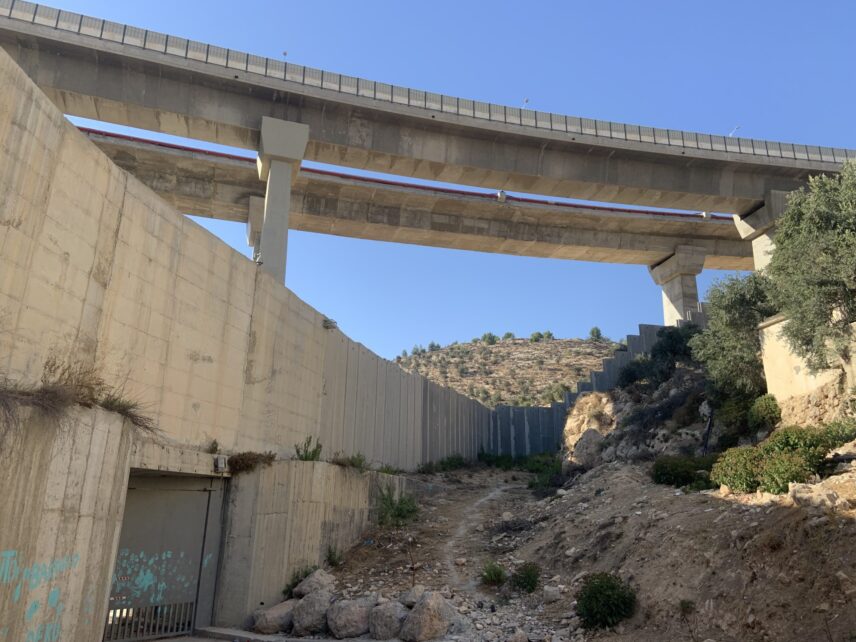
Living within this territory containing a couple dozen apartment buildings has become extremely valuable and sought-after in the last thirty years. In 1994, Israel opened the floodgates to a policy of revoking residencies of Palestinians in Jerusalem. Some 15,000 revocations were issued peaking in the late 1990s and 2000s, although they continue to this day. With revocation came displacement and dispossession, not just for the individual but also their families, especially if children were registered under the name of someone whose residency had been revoked. For Sara’s family members, living within the Jerusalem municipal territory is essential for maintaining and renewing their Jerusalem residency status. For Sara herself, on the other hand, living in Jerusalem was the prerequisite for obtaining her residency in the first place, an ongoing legal battle and one which she insists on waging with the Israeli state. Yet, living on the borderlands, what is functionally outside of Jerusalem because of the wall, provided her with access to everyday, although limited, mobility. Although she never traveled abroad, she studied in different universities in the West Bank, held a job in her field of study, socialized with friends, and visited local sites and establishments. On the level of routine, borderlands like the Bir Ona neighborhood enable a crucial sense of normalcy.
A sense of normalcy is one thing, but what makes life viable at the intersection of residency status and geography is much more fundamental, quotidian, and intimate. Take, for example, one of the multiple instances in which her family thought their years-long struggle to obtain status for their daughter was concluding. A lawyer they hired promised results and the excited family organized a holiday to celebrate her soon-to-be-obtained mobility. The family would travel to a beach resort in the Egyptian Sinai on the Red Sea. The date for the resolution of Sara’s status came and went, but the lawyer’s promises were unfulfilled. The family reached a point of reckoning. Reflecting on that moment, Sara told me:
I had already bought clothes, got my luggage ready. And the situation made itself clear that either they would lose everything they had booked or I wouldn’t go. So I said, that’s it, I’ll stay behind.
While she could not join the family on the trip, as consolation, she was treated like royalty by her extended kin. She stayed at her grandmother’s apartment in Jerusalem proper for the whole week rather than their home on the borderlands of the city on the West Bank-side of the wall. Her very presence there was transgressive, since she did not have an identity card and therefore did not have a legitimate means of visiting or residing in Jerusalem proper. In normal circumstances, she would visit her grandmother regularly with the help of friends and family sneaking her across the checkpoint, but this was an opportunity to remain in the city like a resident rather than as a visitor. Under these terms, she received a constant stream of visits from friends and relatives. She recalled being invited over to people’s homes or out for every meal, a luxurious exception, as well as free rein over her shopping: “People bought me whatever I wanted, took me to restaurants. My family wasn’t with me, but it was the best week of my life.” In her narrative, denial of her status was transformed into an exceptional period by her community who centered her desires. This she described as “dalāl, in a word.” The Arabic term of endearment dalāl or daleʿ typically describes pampering and the act of doting on a person. It carries a negative connotation akin to “spoiling” in English but also conveys the kind of affection showered upon someone who is cherished.
Through attention and pampering, the dalāl that Sara experienced and that her extended kin and community showered her with took the form of care. Dalāl, an established category of exceptional although everyday treatment towards people, was expanded by relatives and friends into a state of living for the duration of the week and in direct parallel to the family beach vacation in Egypt. Sara’s repeated use of the word dalāl in our conversations emphasized that this form of care was a transporting experience despite her lack of mobility. It was a social embrace and elevation cohering around and in response to formal exclusions, like being prevented from crossing Israeli-controlled borders internal to the city or access to other basic aspects of urban life. More than simply providing a sense of normalcy, in this context dalāl became a way to compensate for the deprivations of the state.
Of course, dalāl is not equivalent compensation for state deprivations, restrictions, and dispossessions. Rather, Sara’s family and community mustered an intense and contradictory form of daleʿ out of a complicated sense of responsibility, love, guilt, and restitution for her restricted opportunities. In the context of state-level non-recognition and denial, dalāl addressed Sara’s emotional well-being and did so by pivoting out of the frameworks that bureaucracy and governance claim control over. The shift to care and compensation shows how dalāl can become a technique for living with the contradictory push-and-pull dynamic that permanent residency status—or its absence, as in Sara’s case—induces. In that sense, dalāl is best understood alongside other counter-hegemonic repertoires within local traditions of resistance, return, and steadfastness (sumūd). As the case of Palestinian Jerusalem shows so starkly, structural exclusions decenter people while communities take shape by recentering them.
Dalāl indicated the contrasting collectivity that necessarily emerges alongside dispossession. In Sara’s case, the family was the primary medium for filling in for the deprivations of the state. In the face of everyday bureaucratic violences, dalāl stitched back a version of the collective by re-signifying obstacles that fragment and individualize—that is, denied mobility—as opportunities for converging around a community member. Hence, prevention from traveling on a relatively extravagant family vacation could be transformed into “the best week of [her] life.” What is subtly refashioned in that process are the patterns of life that exceed the violent containers leveled upon them. Dalāl provided a way for Sara and her kin not just to relieve the tension of immobility, but to create an emotional refuge for her and themselves as a community. Given the deprivations accumulating to denied or revoked residency status, centering practices like dalāl are better understood as forms of renewal that create the possibility for continuing to live under the multifaceted pressures of Israeli military occupation over Jerusalem.
The Israeli denial of Palestinian residency status stems from a long history of colonial population engineering in the Middle East, especially in Jerusalem where the goal of a Jewish majority remains an explicit objective of how the municipality should be ruled. In contrast to the civil death that the condition of non-status in Jerusalem suggests, when cases of severe state-induced dispossession, abandonment, and deprivation are weaponized, care is one mechanism that sustains the social relations and bureaucratic reproduction required for insisting on presence in the city and, more fundamentally, makes life viable.
Timothy Y. Loh is the section contributing editor for the Middle East Section.