

Article begins
Imagine a post-industrial rural wasteland, where abandoned infrastructure and decaying buildings dominate the landscape. There’s a post office or a store that used to serve people just a few years ago, but now the buildings gape like skulls onto streets littered with broken glass. An abandoned school or a kindergarten is used as storage space. There are overgrown fields wherever one turns. Such landscapes are common today in rural Belarus, where a once-promised Soviet dream of a productive countryside has crumbled, leaving behind barren fields and dilapidated structures. The remaining residents, primarily elderly women in their sixties and older, live in isolation. Their children have moved away, and their spouses (if they ever had any) have passed away. “All the men our age are in the cemetery” was a common, somber observation the women made.
The government claims to be “revitalizing” agriculture, but even those feeble, largely propagandistic, gestures do not concern smaller rural settlements. They are deemed unsuitable for development; they are the “unpromising” (neperspektivnye) villages. For the residents of these villages, the state’s developmental focus elsewhere translated into a tangible experience of abandonment. The unspoken, yet widely understood, logic underpinning this policy is one of managed decline: the residents are implicitly encouraged to relocate to larger rural settlements. Or die.
I worked with those old, rural, post-Soviet women who are left—those icons of an exhausted modernity and of a sad, wasted subjectivity. The diverse experiences of such women are invisible. They feel ignored by politicians and public officials. Whenever anybody notices them, they are usually dismissed as being politically conservative, socially homogeneous, and spent.
However, these elderly rural women are far from spent. They are active and vigorous, especially in their relationship with plants. These women maintain life in places that otherwise are imagined to have nothing.
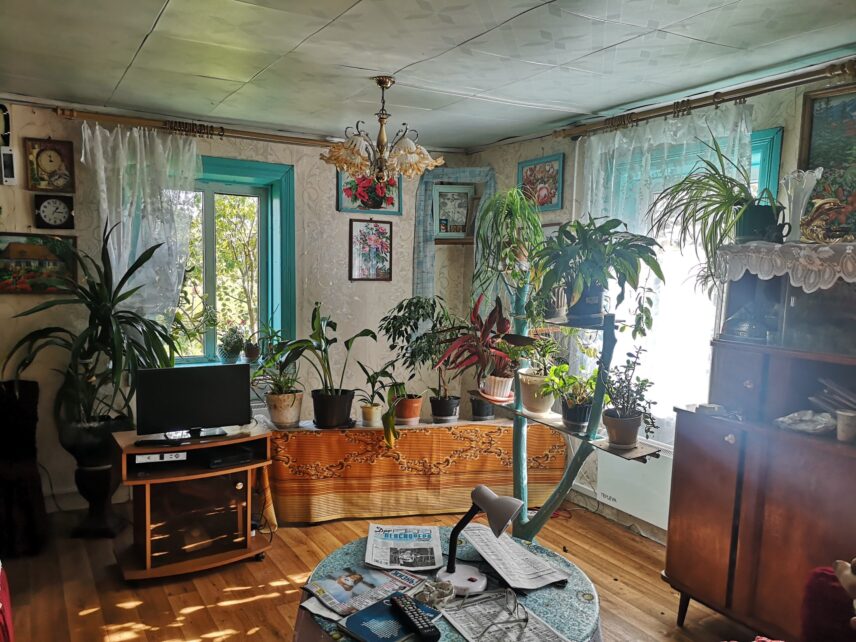
“What, city girl, did you think I wouldn’t have this?” 74-year-old Zina used to ask me in a goading manner, pointing at the rhododendron bush she managed to grow. The women I knew not only grew hearty vegetables; they made well-tended gardens with exotic, luscious flowers. They decorated their weatherbeaten, decrepit homes with fussy, demanding houseplants.
Multiple vegetables—potatoes, cabbage, onions, radishes, carrots, beets, beans, zucchini and whatnot—were crammed in their yards. And in the shady, cool rooms inside their houses, all the windowsills were lined with plants—cacti, ficuses, begonias, and violets. Geraniums, deep red gloxinias, nasturtiums, tall ferns, giant rubber plants, fuzzy fern-asparagus, and sharp mother-in-law tongues often occupied almost every flat surface available in a house.
The areas around women’s houses were like oases in a desert: green in the summer, fertile, cared for. Anytime I came to visit, these women were occupied with working in their backyards and improving their homes—tidying homes, painting fences, and, crucially, assembling their gardens. They would water the plants, weed the beds, dead-head wilted flowers, straighten the trellis that supports their climbers, harvest fruits, and so on. The women defined this practice of taking care of their gardens in terms of inscribing order, making gardens look “tidy” (čysty), “ordered” (u paradku), and “well attended to” (dahliedžany).
Women’s gardens were a tangible representation of the transformative power of their care. In stark distinction to a messy environment and overgrown field, the plants assembled and arranged in women’s gardens conveyed a sense of order, beauty, and diversity, which acted as a counterpart to the melancholy and abandonment haunting the villages where they lived. The order brought about by women caring for plants, to an extent, made up for the government’s neglect.
But as much as the women’s gardening activities could be seen as restorative or compensatory to abandonment and neglect, they were just as transformative and creative. The profound engagements of these women with plants—from the vibrant green of their summer gardens to the fussy houseplants lining every windowsill—directly confronted state-imposed invisibility. Women’s gardens were not just a private solace. They were dynamic, flourishing spaces that drew the eye, asserted color, and emitted the undeniable signs of active life, making visible the continuous efforts of care and the enduring presence of these women in a world that seeks to overlook them. The very act of transforming a messy environment and overgrown field into an “ordered” and “well attended to” garden was an act of making manifest, bringing forth into the visible realm the transformative power of their neglected hands. Here, in the “unpromising villages” with no young people, no services, and no future, the women care for plants, which they talk about as practices of love.
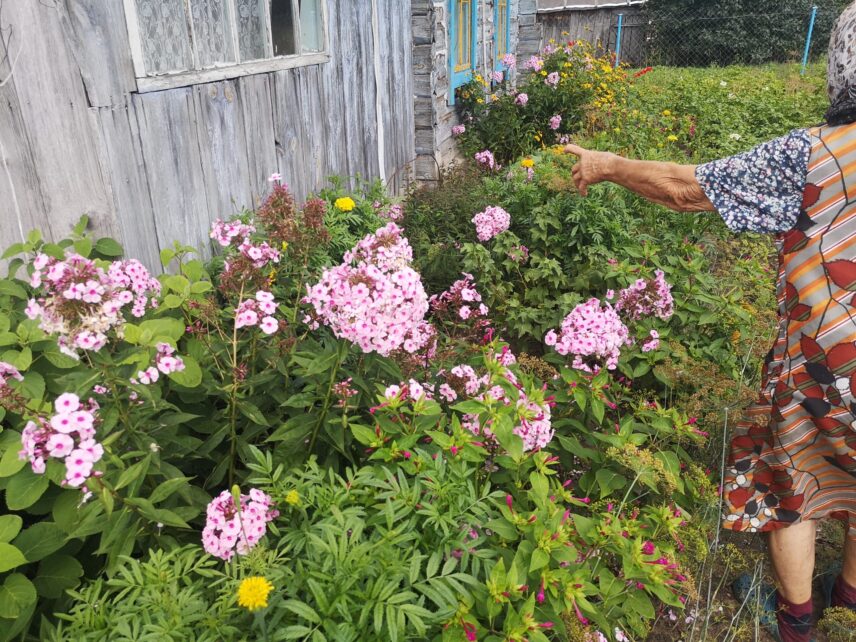
“If I didn’t love plants, why would I grow them?!” Zina liked to reassure me. Plants inspired deeply sentimental reflections about attachment, sincerity, and reciprocation. “I love plants! I love them to the moon and back! If I planted them on the stone, they would grow anyway,” 84-year-old Nina used to say with excitement. “You see these roses?” she would ask, her voice softening as she gently touched a velvety petal, “I kiss them every morning. They are like family.” Such pronouncements of deep affection for plants were common amongst the elderly women I came to know, hinting at relationships far exceeding mere horticultural interest.
Despite women’s agreement that love of plants took care and work, many of them downplayed the extensive work they did to make their plants thrive. Rather than a result of regular strenuous physical activities, they saw their success in cultivation as the outcome of love. “I love plants; that’s why they grow well,” 82-year-old Lidzija used to say. 71-year-old Tonia expressed this idea like this: “Well, you have to take care of them [plants]. Well, if you love them, that’s not a big deal. But there is a return. When you get tired, they just make you happy. Probably, they give vivacity and, well, strength to you. All this…,” she gushed. The women liked to tell me that they cultivated plants because they loved them, not because they had to.
The women made a distinction between love “from the heart” versus planting “just for beauty.” This distinction articulates what affect theorists identify as the difference between intensive and extensive modes of relation—between embodied, transformative encounters and representational, distanced appreciation. When Nina argued that plants would “grow on a rock” if loved truly but wither if planted merely for display, she showed the ethical difference between relations that increase life’s power versus those that diminish it.
The plants were profoundly autobiographical. More than mere reminders, they were a living archive, materializing distant kinship ties and the socio-historical context of the late-Soviet period. Standing before her white phloxes, 86-year-old Lida would invariably begin: “Do you know where these phloxes came from? From Riga! My uncle Luka, may the Kingdom of Heaven be upon him, got them from the Botanical Garden and sent them to me in a parcel.” In outliving their givers, these plants transformed into invaluable material markers of past attachments. They were tangible extensions of the deceased within the vibrant present of the living garden. These living memorials were dynamic, required ongoing care, and participated in life cycles (growth, blooming, dormancy, propagation, death). They were not just reminders of the past but active presences in the present, co-creating future memories.
In addition to maintaining “tidiness” and “order” in their gardens, women introduced new exotic species and experimented with them—a practice they often framed as “play” (huliacca). Among those species that required play, women mentioned cyclamen, yucca, zygocactus (decemberist), dieffenbachia, rose, gladiolus, and others. Playing with such plants could mean setting up a suitable microclimate for them, digging up and storing the bulbs, defending them from being moved or touched, and other tasks that implied extra efforts, in addition to learning and adjusting.
Caring for previously unknown exotic plants is difficult, and women had a hard time ascertaining whether they “got them right” and what “getting right” might involve. Is it too little light that prevents plants from growing and flowers from blooming? Inadequate temperature conditions? Lack of moisture? Incorrect pruning? Guessing was common among women who tried to tend to those newcomers.
Many women complained about how difficult it was to care for in-house plants during the winter. The plants could not stand the cold, and the windowsills of rural houses were too drafty for them to thrive. Women explained that it generally was city-dwellers who could afford to play with indoor plants, because they were able to afford special lamps and heaters for cultivation. “There are none of those [devices] in the village,” 64-year-old Tamara once observed. And still, the women played.
Introducing demanding, whimsical plants, again and again, the women visibly enlarged the limits within which they could play. Women’s play involved experimentation (trying new plants or techniques), creativity (designing spaces, arranging plants), engagement with contingency (unpredictable weather, pests, plant growth), intrinsic satisfaction derived from the process itself (nurturing life, observing growth), and aesthetic pleasure. Through their experimental and imaginative engagements with plants—particularly exotic or challenging species—these women created spaces of possibility within conditions of constraint, demonstrating how care can be simultaneously sustaining and transformative, practical and creative.
Older women’s love of plants might be thought of as an alter power that confronted dissolution and neglect of the rural life. Their love provided “the kind of pervasive virtual infrastructure” in which many of the living beings “could flourish . . . and seek genuinely to be in relation in real-time, making an alive life.” Even more so, love for plants, encompassed in the material vegetal beings, could even transcend women’s lives, passing their love to the future. Lida once said, “Well, I love, I love. I know I will die soon, and my lilies and peonies will stay. And I feel pity, and I love. I tell my daughter-in-law, ‘Whatever you want, Lily, but don’t give them to anyone!’”
This desire for continuity, for the living beings Lida had nurtured to persist, gestures towards a form of active hope—not for a grand reversal of rural decline, perhaps, but for the endurance of beauty and care in a specific place. Women’s profound love for plants could not, in itself, resolve the structural issues facing the community or fill up the emptiness they live with. What it did was slow down the unravelling. Women’s acts of persistent cultivation were everyday practices that insist on the possibility of life and meaning-making even when broader narratives were pessimistic.
“Prepare to die but sow the rye” (pamirać sabrałasia, a žyta sieju) is a folk saying I often heard from women. They seemed to think that the proverb summed up their attitude to the challenges of life. In this single phrase, the women encapsulated a philosophy born of history that had taught them that the future was not a promise of linear progress, but an unpredictable cycle of good times and bad. It is a philosophy of profound realism about the proximity of endings—of a season, of a political order, of a life. Yet it is simultaneously a philosophy of radical, active hope. By actively cultivating life amidst decay, by investing labor and love into their plants, the women were not just passively wishing for a better future, but were embodying and enacting hope, creating small pockets of vitality and continuity.
The women said their villages would die. Yet the rye must be sown. The seedlings must be tended. The beds must be watered. The roses must be kissed. In these small, tenacious acts of care, these women render visible the vitality and beauty that endure a neglected world and defy the imposed invisibility of their lives and places. Each blooming flower, each given cutting, each shared vegetable makes visible a future that refused to be promised, yet is daily made real through the women’s hands.