

Article begins
“What does visibility conceal?” Marilyn Strathern posed this question in a piece for British Educational Research Journal over twenty-five years ago. Strathern’s earlier research in Papua New Guinea on gift exchange informed her exploration of “the tyranny of transparency” engendered by the integration of neoliberal audit culture into the conduct of research and teaching in British higher education. Another anthropologist suggested that I take a look at Strathern’s piece to help me think about a problem for observations in educational policy research that I encountered this fall: what happens if you are invited by one person to join a business meeting of a set of policymakers, but this invitation is overruled by someone else?
During field research in Belgium and France in 2025, I was disinvited from not one, but two meetings of European bodies concerned with transnational cooperation on educational policy. In each case, my prospective hosts had reason based on precedent to believe that I could join as an observer. In each case, as the start of the meeting was approaching (in one case, I was already inside the room) my hosts were overruled, one of them expressing private confusion to me about “transparency.” “Committee meetings only after closed doors” was the justification. This turn of events reminded me of an earlier “ambiguous transparency” I found in Slovakia’s transition from Communist rule that brought to light tensions between visibility, transparency, and secrecy.
Strathern’s piece focuses on the problem of too much information, while the fieldwork experiences I am relaying here are, of course, ones of preventing access to certain kinds of information. To be clear, the transnational bodies of educational policymaking with which I was trying to engage do not just block channels to learning about their work; they routinely make various sources of information available for public consumption. But to what extent should these curated disclosures justifiably be read as a relatively “performative” transparency? What counts as transparency? To what extent is the virtue of “transparency” only realized when its audiences might say that they are satisfied in it?
Bridging Worlds of Policymakers and Anthropologists
In the rest of this piece, I use two of Strathern’s secondary observations to posit a strategy for how anthropologists of educational policy might respond to the kind of gatekeeping that I experienced. The stakes are not small: the militant right-wing populism in the US and across Europe at this moment legitimizes itself discursively to a significant degree in profound distrust of large intergovernmental bodies, most prominently the United Nations or the European Union (EU), but sometimes including others such as the World Health Organization or the Organization for Economic Co-operation and Development (OECD). Education is a policy area on both sides of the Atlantic in which the desire for control that feels relatively local—like it is done by “our” people, for “our” youth—is particularly strong. We anthropologists ourselves tend to value politics that support pluralism of lifeworlds, something that transnational governance often seems to threaten. However, the prevailing energy of right-wing populism is a growing threat to that governance as well, something anthropologist Douglas Holmes described taking shape across Western Europe already a quarter century ago. Perhaps this is a moment when anthropologists and transnational institutions might benefit from greater curiosity in one another.
The Mediation of Transparency
Digging a little further into Strathern’s piece, her exploration of “visibility” and “transparency” in higher education policy in the United Kingdom lingered on the form of social imaginary that we might call “an organization.” She observed a heightened recursive tendency for how an organization describes itself to become part of how that organization is understood from outside, more than with other forms of social imaginaries. To study a supranational organization such as the EU, a complex intergovernmental body that has contributed to a European educational policy space, is indeed to study an organization that is active in the public narration of its activities. “Transparency” is a key claim in the EU’s narration of itself. Its orientation toward transparency is a particularly text-based self-narration.
Indeed, four years into research on how institutions of the EU try to influence how the EU member states educate for diversity and inclusion, I find impressive the ecosystem of publicly available documents, videos, and various text or media artifacts touching on education, particularly once it becomes apparent that a great range of issues—employment, security, and migration among them—have been used to justify a European scale of involvement. The EU is an elite-driven project. Cris Shore has described how, as the political leadership of member countries has expanded collaboration beyond economic policies, the populations of those countries have grown increasingly confused and also angry as to what the EU actually does. Political leadership across institutions of the EU has invested heavily in publicity materials, as well as opportunities where citizens of EU countries can feel that they are watching European-level democracy in action, such as through public tours of the European Parliament, and an infrastructure to receive visitors there.
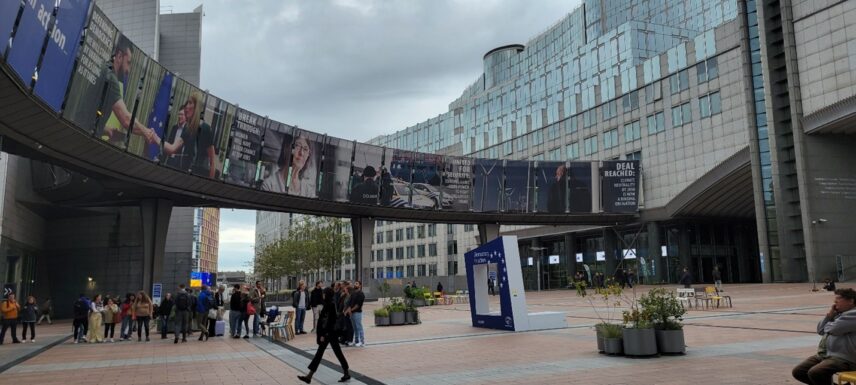
In addition, ample opportunities abound to sign up for periodic digital updates on these institutions. Having signed up for several newsletters, I am struck by their efforts to narrate the policy process for the reader as indefatigable (if slow) progress. Monthly newsletters seem to often summarize one recent meeting and then point to an upcoming one as reason to stay tuned for further developments.

Over the course of 2025 I observed in either live or recorded videos how an initiative called the Union of Skills was talked up in sunny terms, but without much detail, by Roxana Mînzatu (the Commission’s Executive Vice-President for People, Skills and Preparedness) first at the March EU Social Forum and then the October Electronic Platform for Adult Learning in Europe (EPALE) Community Conference.
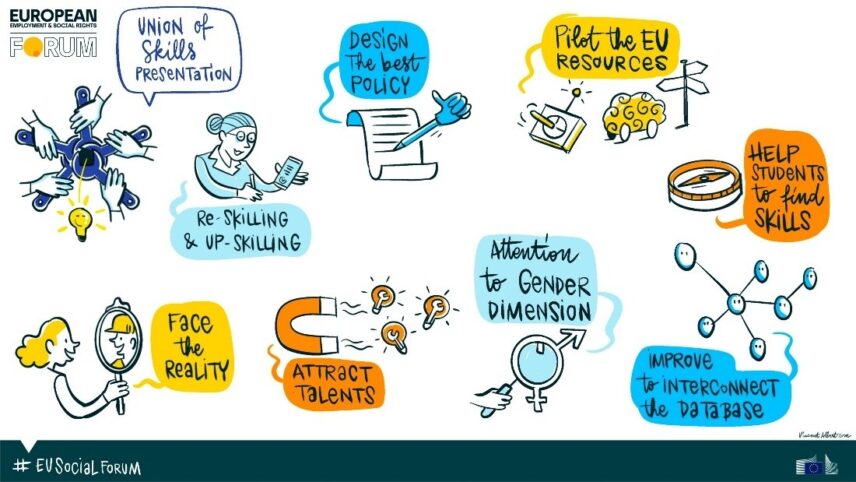
These events suggested intimate dialogue through a format that at times resembled a talk show, but one involving an audience of professionals in related fields, not the general public. The effect on this researcher is one that seems intended to captivate a selective audience waiting in anticipation for what policy-making figures around the EU are preparing for us next. Between publicly released text artifacts (documents and audio-visual materials), carefully managed tours (of a parliament that many political analysts of the EU have commented for years is often marginalized in EU policy processes), and composed online events, one can sense that institutions of the EU operate with a particular ideology of mediation as to what counts as “transparency” that does not include more direct experience. Perhaps the larger the organization, the greater the degrees of extracted separation of publicly available sources of knowledge and core organizational activity.
Education across the space of EU countries, because this policy area seems more likely than some others to draw interest in more direct personal knowledge of who is making the policy, might be paradoxically more complicated to get to know relatively “in person.” Scholars such as Martin Lawn and Sotiria Grek have traced the weaving of national educational policies in Europe into the standards, assessments, and various technologies of governance cultivated by other transnational bodies such as the OECD, UNESCO, or the Bologna Process for higher education. This decentralization of how transnational structures contribute to the governance of education in a majority of European countries respects the legal competence that delegates oversight of education to the EU member states. However, it also weaves a much more complicated web of transnational influence over how educational policy gets made. The ways in which this European educational policy space stretches across and through different institutions make it perhaps impossible to get to know through direct, in-person contact with its representatives and workplaces. This makes gestures toward transparency by published texts or orchestrated experiences more pragmatic, if all the less likely to satisfy public interest in how the education of the next generation is being shaped.
The Unavoidable Utility of Secrecy?
The final observation of Strathern’s piece that I raise here is observing “the guarded intimacy between time and growth,” or the way in which the development of plans often seems to benefit from some potential interlocutors not knowing what might be afoot. In a smaller project on eavesdropping scandals in East Central Europe in the 2010s, I could in fact see clearly the significance of secrets in political strategy, even if sometimes as more of a weapon than a tool. In any effort to develop an educational policy, perhaps experiences from our own institutions lead us to allow that some degree of concealment of a policy process can enhance conditions of this act’s felicity. Indeed, my hosts’ subsequent understanding seemed to accept that the denials of entry protected the space both to work out ideas that could then be defended in other settings available to the public and to avoid the distraction of news media sensationalizing glimpses into flashes of diplomatic anger. Max Gluckman famously noted the pull that many anthropologists feel toward scandal. Strathern provokes the anthropologist reader with a question about not making everything from our field research visible. In consultation with my hosts, I have abstained from a more descriptive opening vignette to this piece out of respect for their ongoing working relationships.
I return to the earlier observation of Strathern’s about the challenges of studying entities that are engaged in extensive narration of themselves (such as large organizations). How does an anthropologist of education work with, around, or through a policy-making entity’s (or space’s?) narration of itself as its nod to transparency? Might anthropologists’ respect for “an intimacy between time and growth” serve as an asset for navigating research on educational policy involving large, even transnational, organizational structures? I am probably not the first person to note concerns that anthropologists and transnational institutions, previously uncertain bedfellows, might share with the rise of militant right-wing populism. I suspect that institutions such as the EU would reduce blowback to their work by expanding the range of ways by which wider publics learn about their work, including through more direct observation and discussion. Anthropologists seeking to conduct research with these institutions might find Strathern’s cautions about indiscreet transparency helpful in this dialogue.
Kathryn Wright is the section contributing editor for the Council on Anthropology and Education.