

Article begins
“Ozali?” The Congolese radio operator shouts into her two-way radio’s microphone. She calls out in Lingala—are you there?—before lifting her finger off the transmitter to listen for a response, but the speaker emits only static. We both crane our necks as noise obscures signal on the frequency, interrupting her short conversation with a distant villager. Suddenly, a muffled “nazali”—I’m here—cuts through the static, barely audible. Clinging to each other on this wireless connection, the two attempt a conversation marked by interruption more than anything else.
Such fleeting moments were a frequent occurrence during my research on two-way radios—known locally as radiophonies or simply phonies—in the Uélé region in northeastern Democratic Republic of the Congo. Often in today’s interconnected world, it is easy to think of communications infrastructure as enabling a seamless flow of information. Narratives of cell phones, the internet, and globalization imply a wave of connectivity that covers more and more of the world. But the reality is one of nodes rather than flows, as the late James Ferguson once wrote, and anthropologists have long traced these point-to-point connections and taken the innovative, improvised, and heterogeneous ways people use technologies as a starting point for understanding how we connect. Doing so means paying as much attention to the static, the glitch, or the lag as to the actual messages being sent and received.
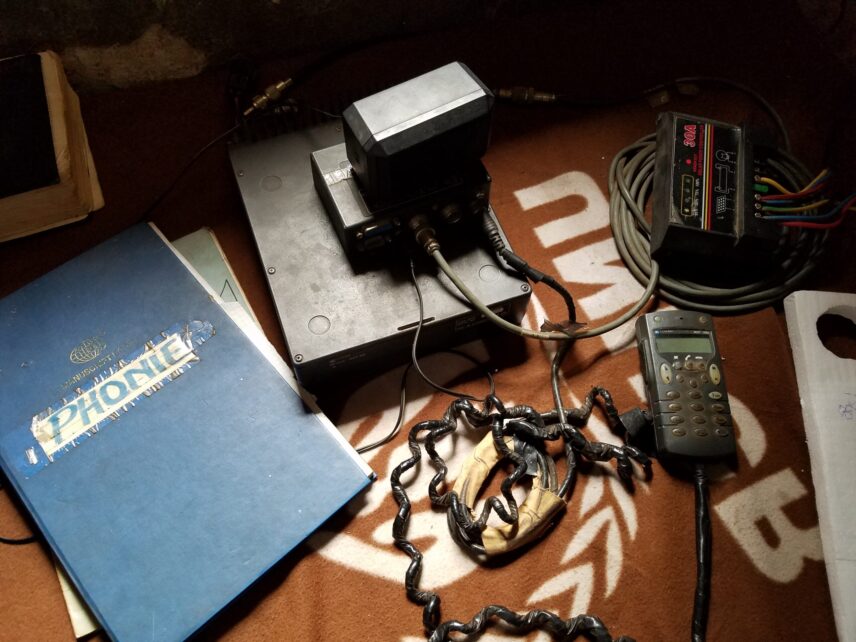
The radiophonie has a long history in Congo and remains relevant even as cell service slowly expands across the massive country. Today, urban residents use the radio to share updates and send money to rural kin, truckers update their bosses while on the road, migrants to Kinshasa find each other while connecting with a common home region, and churches stay in touch with remote missions. After Ugandan rebels carried out a series of massacres in the northeastern corner of the country, this old technology became a promising lifeline: a Catholic web of rural phonies served as a model for a humanitarian conflict early warning network that uses two-way radio to link dozens of villages in the name of protection and connectivity.
A typical day on the early warning network might sound like this: a humanitarian phonie operator like Aminata would begin her day by switching on the radio in her NGO office and breaking the static on the channel by announcing the morning round, during which she hails individual communities in quick succession. In rural communities across the region, volunteer field operators drag their solar panels out and tune their radios onto a common frequency—called the boulevard—listening to the humanitarian’s roll call. Each would respond to Aminata in turn, answering with any updates about their village.
Many days, the news would be that there was no news, a happy normal that allowed villagers to share mundane exchanges such as discussing the weather or joking with other phonie operators. On such quiet days, with nothing to report, the daily round ended quickly and turned into a moment for distant operators to send and share messages with one another on behalf of their neighbors, hopping off the boulevard and onto open frequencies where a woman could ask after a relative in town seeking medical treatment or a man could reassure his family that he had reached his destination safely.
Sometimes, though, the daily round was a way of collecting news of insecurity. Perhaps a hunter happened upon armed bandits while walking in the bush, or a farmer was abducted by rebels on the way to her field, or travelers encountered a roadblock set up by armed men and turned back. In moments like these, the phonie kicked into gear an array of possible interventions that might help a community protect itself or seek safety while also mobilizing humanitarian or security responses from afar. In this sense, the phonie served as both an urgent, humanitarian intervention and a more mundane communications infrastructure, addressing exceptional crises as well as a more long-standing disconnectedness.
Intrigued by this radio warning system, I spent much of 2019 following humanitarians as they installed phonies and implemented their project and listening to aid workers and villagers alike talk on the airwaves. Driving along rugged roads that were sometimes swallowed by floods and brush, the importance of infrastructure was readily apparent. Amid insecurity, connectivity could offer the potential of protection, though this promise wasn’t always borne out in practice. Due to the fragility of two-way radio as a medium and competing ideas about who constituted a threat and how to respond, both connection and protection could prove elusive. The network warned civilians of danger using the infrastructure available, undoubtedly saving lives and making the most of precarious circumstances. The connection that phonie infrastructure offered, however, was incredibly delicate and contingent, something humanitarians and everyday people contended with.
Any discussion of what it’s like to talk on the phonie should begin with the noise. A two-way radio receives radio waves from the ionosphere through its antenna, waves which are filtered based on frequency and made audible through transduction. This process is meant to isolate a particular signal and filter out the rest, but it can and does transmit other waves as static. Many phonie operators decried the bruit, or noise, of the phonie. Humanitarian radio operator Tubylando sometimes referred to static as crachat, or spit, after its phonetic qualities, the word crunching in his mouth. But static was referenced by my interlocutors most often with the French word interference. Interference could be attributed to many causes including the weather or electrical equipment—but no matter the source, it made communicating difficult. “There’s a lot of interference,” Aminata would often lament, sometimes giving up on sending or receiving messages, hoping that the operator on the other end would try again later because the interference was too makasi, or strong.
Communications scholars have long argued that noise is a key feature of technological communication. Understanding how operators used the phonie meant taking noise seriously. It meant I had to learn to listen. Attending to interference, I followed radio users’ communicative practices, attuning myself to their sonic habitus, or the way they adapted to sound, and the ways that sound shaped their experience. What I found was that using the phonie meant speaking and listening through noise.
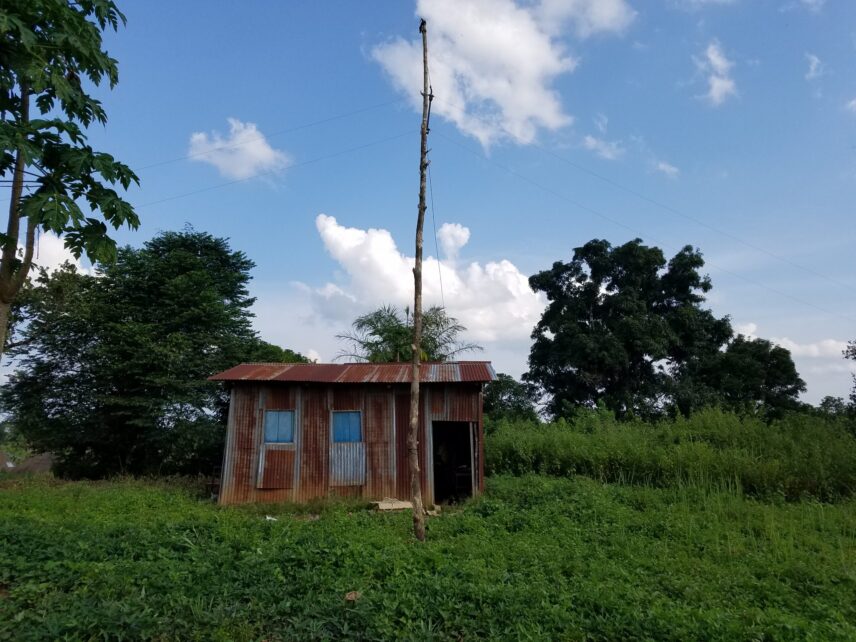
Listening to Congolese villagers and humanitarians communicate on the phonie, I quickly learned that using this technology requires particular repertoires of speech to cut through the static and that radio operators used specific techniques of listening to and through the noise.
“On the radio, you have to speak slow, speak loud, speak clear,” Jericho, the Congolese manager of one radio early warning system, once told me. I noticed such repertoires of speaking as I listened to him and other phonie operators speak forcefully into microphones from across the desk or down the hall at their office. Shouting into the microphone was a way of overcoming the static. Several operators told me that one had to speak “with force” in order to be heard.
I also often heard voices repeatedly inquiring or declaring presence—like the “Ozali?” “Nazali!” dialogue above—a phatic attempt to maintain connection and be with one another. A frustrated “nalobi boye—” (“I’m saying—”) was a common refrain to indicate that one had something to say, a sort of demand that others stop talking and listen. While more localized languages were sometimes used, Lingala was the region’s lingua franca and such phrases were common shorthand among operators on the boulevard. These were also attempts at managing a noisy channel filled with static, crosstalk, and provisional signals.
In addition to such speech, the phonie also demanded particular techniques of listening. I often witnessed Jericho hunched over his table like a student asleep at his desk, taking notes with one hand while the other cradled the speaker by his ear as he picked out vital words floating amid static. Here operator and phonie merged into an apparatus of attunement, an assemblage of man and machine that developed new sensibilities of perception. Operators also toggled between frequencies and modes on the radio’s hardware, listening for crosstalk and a clear signal as they left the sonic boulevard and tried to find a place where they could hear one another.
Like many modern communications technologies, the phonie traverses space as it facilitates real-time conversation across distances. It is often said that the radio and its predecessor the telegraph freed communication from geography, cleaving it from transportation. But this is not to say that radio talk removes users from space altogether. Rather, listening to the radio was a way of emplacing voices, and static interference had a geographic quality to it.
The way a message moved on the phonie depended, to some extent, on where it came from and where it was going. Static interference was experienced by each operator differently depending on their location. Sometimes interference rendered a community unreachable to one operator but accessible to another due to differences in topography or weather. The former could then ask the latter to act as a “bridge” by relaying the message to the intended recipient and bypassing the interference, through a practice that Jericho called “triangulation.” Thus, the form and reach of the network was constantly shifting, a dynamic web whose configuration was in flux.
During moments like this, the phonie reinscribes place as much as it collapses it—it brings people together across distances but also connects them through their geography. The different ranges of each phonie’s antenna shaped what reception was possible. Phonie connections are not straight lines between nodes but complex, networked, disrupted, improvised systems of communication. Attending to these practices, we hear how people parse signal from noise and how they locate themselves in a geography of sound.
What’s more, operators also listened to the static itself, gleaning information from sonic distortions and interpreting the interference. On a clear day in town, for example, unusually bad static might indicate to a radio operator that there was poor weather on the other end. At times, a weak signal might index failing equipment, a reminder of the contingencies of radio technology in the rural countryside where heat or dust shortened hardware’s durability. And when a humanitarian operator relented to the static and gave up on a conversation, that disconnection represented the fragility of the network as a whole and the ambivalence of unstable connectivity.
The premise of the early warning system was that it connected and protected remote communities. By listening to people actually talk on the phonie at the center of the network—how they spoke and listened amid static interference—I found that the mode of connectivity mattered tremendously. Technological media can structure forms of communication and how users adapt to the affordances of technology in order to communicate effectively. The nature of radio technology is one of contingency and instability. Despite this, people improvised ways to connect, to find each other, to collect and disseminate vital information across insecure and difficult terrain. As humanitarians, technicians, volunteers, and everyday people talked on the phonie, they wove new and old connections between seemingly remote communities.