

Article begins
In November 2023, right at the beginning of the new academic year, Xelîl told us he could not attend our first online thesis writing seminar. A Turkish drone had destroyed the only water station serving his town. Water was being delivered by tanker, and that day it was his neighborhood’s turn. He needed to collect it. Xelîl was an MA student at the University of Rojava in autonomous northeast Syria, researching drones and their social effects. That day, a drone strike on a water station had effectively cancelled his class.
I began working with the University of Rojava in 2019, and helped establish its Institute of Social Sciences and Humanities in 2020, serving as co-director. Drawing on that experience and those of colleagues and students, in this essay, I consider what these universities can teach us about building institutions that respond to society’s needs and contribute to its autonomy and self-defense, even amid war.
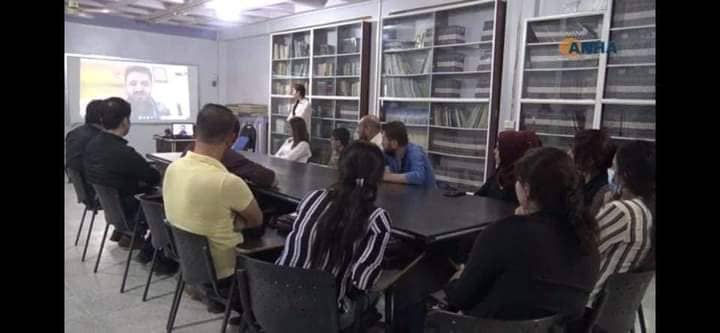
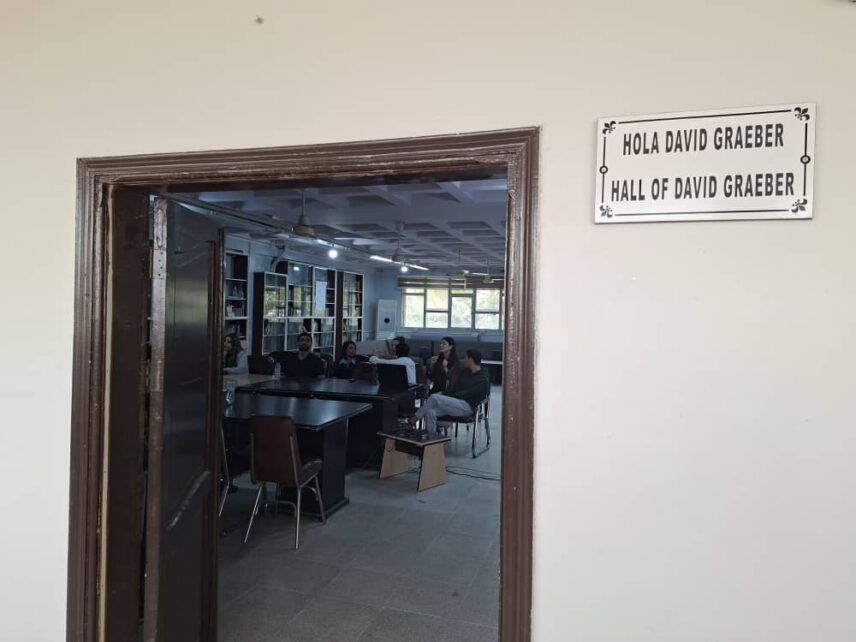
The photograph of our opening meeting (Figure 1) shows colleagues and students gathered around a table in a room lined with bookshelves in October 2020, in Qamişlo, Rojava. I joined by video from Toronto at 4:00 a.m. We were starting a graduate program that would allow students to study their society without leaving it. We had no ready-made model. We developed courses in social theory and research methods suited to students’ and society’s needs, while trying to sustain rigorous education through recurrent disruptions. We named the main hall after the late David Graeber (Figure 2) who had recently passed away. He had called on the international left to defend Rojava during the ISIS assault on Kobani in 2014. His work also belonged in the discussions we hoped to have there about how people organize themselves and how they might change the institutions governing their lives.
Building Universities amid Civil War and Revolution
The Rojava Revolution emerged in 2012 amid Syria’s civil war, when Kurdish-led movements began building autonomous institutions grounded in democratic confederalism, women’s liberation, and grassroots democracy. Education was central to this project, both as a means of challenging decades of state-imposed assimilation and as a space to study excluded histories and to develop new forms of knowledge for collective self-governance. Academies grew alongside communes, councils, and women’s organizations. They laid the groundwork for Afrin University (2015), the University of Rojava (2016), Kobani University (2017), and Al-Sharq University in Raqqa (2021). Education was free, and dormitories enabled students from more distant areas to attend.
Learning in the midst of war, these institutions challenged an education system that had long served the Ba’athist state’s Arab nationalism. Kurdish language and histories were excluded from its account of Syria. A politics of assimilation and Arabization along with economic de-development was imposed on the majority Kurdish-populated parts of northeast Syria. University provision was concentrated in western cities; many students from the northeast had to leave home for higher education. Kurdish students entered a system in which their own language had no place in academic work. Rojava’s universities sought to reverse that exclusion and train teachers and professionals needed by their communities.
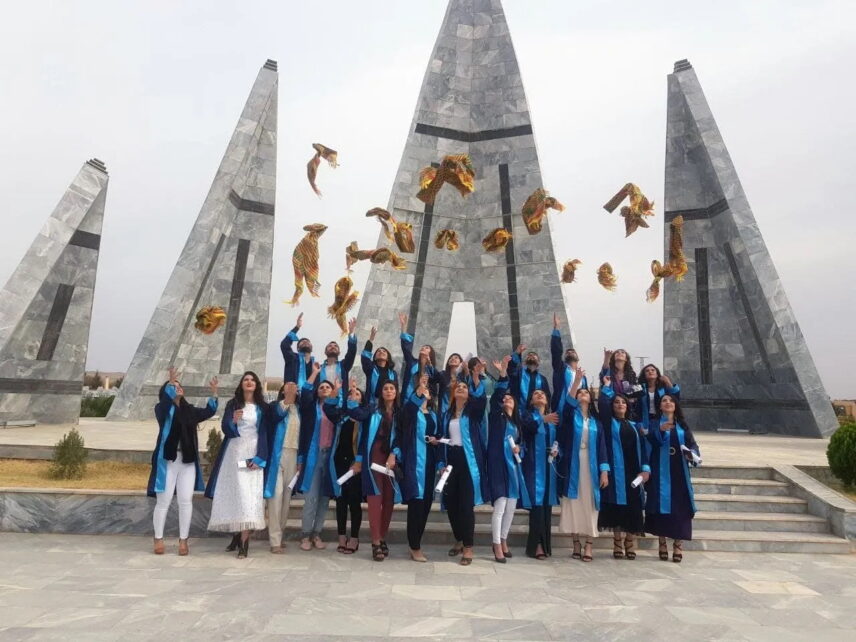
In 2021, Kobani University held its first graduation ceremony at the cemetery honoring those who had resisted ISIS in 2014 (Figure 3). Graduates threw patterned scarves in Kurdish national colours (yellow, red, green) into the air. Their choice of venue connected graduation to the self-defense and reconstruction of their city. As Nazan Üstündağ’s (2016) work on self-defense in Rojava suggests, academies and communal institutions contribute to society’s ability to defend itself against domination, including the possibility that revolutionary institutions reproduce state authority. Universities face this problem too. Training teachers for Kurdish-language schools and creating space to examine the social effects of violence contribute to collective self-defense.
Teaching in Kurdish required developing curricula, translating scholarship, and supporting academic writing. Jineolojî, a knowledge system developed by the Kurdish women’s movement, challenged patriarchal assumptions about knowledge. Women’s councils and co-presidency reshaped who could make university decisions. These were not simply curricular choices but efforts to transform the university as an institution. They raised questions about whose knowledge counts, who has the authority to produce it, and how education might enable people to govern their collective lives.
Across the Middle East and North Africa, universities bearing American, British, French, and German names train young people for professional careers. Their orientation toward neoliberal imperatives, international rankings, mobile professional careers and privileging of Western theoretical and methodological frameworks reproduce an epistemic division of labor: metropolitan institutions retain the authority to theorize while local societies furnish the empirical material.
Rojava’s universities challenge these epistemic hierarchies. They train teachers, engineers, and health workers, but unlike conventional higher education institutions, they grew from grassroots organizations already running schools and public services, making professional education part of a collective effort to sustain and govern society. Local communities are in dire need of their graduates as war has driven qualified people away. This close relationship with society also places a responsibility on universities to produce knowledge grounded in the experiences and questions of the communities they serve. Yet, they have undertaken this work largely without formal recognition or access to international funding.
The Everyday Work of Learning and Teaching in the Shadow of War
At our institute, students brought experiences and questions of the communities into their research. Xelîl used Achille Mbembe’s concept of necropolitics to examine how drone warfare changes everyday life and the meaning of death. His thesis traced how the threat of violence changed ordinary conduct. One interlocutor, a local teacher, recalled children asking him to hold classes only on cloudy or rainy days, or in the evening. They wanted to be at school, but feared the drones. Others described work interrupted by attacks and hesitation about helping people injured in a strike because another might follow.
These disruptions also affected higher education. In their November 2023 open letter, colleagues from the University of Rojava described the destruction of infrastructure following Turkey’s October bombardments and announced temporary university closures. Continuing an education depended on circumstances well beyond a student’s control. Water shortages, electricity failures, and internet interruptions competed with the time needed for study beside it all. Xelîl’s missed seminar was one instance of a much wider problem.
His acknowledgments describe some of the conditions under which he wrote. His family set aside a corner of the house for his study. His older sons took on domestic work, and he apologized to his youngest for the games he had missed. His studies continued alongside teaching, admin work, his work in communes and local councils, and attendance at funerals, especially for those fallen because of Turkey’s aerial strikes. This is part of what social reproduction means in war, in revolution, and in practice. The work that made his research possible extended well beyond the university. Xelîl defended his thesis on May 23, 2024, in Kurdish, with highest mark, before committee members, his family and university colleagues gathered in person and online.
For students like Xelîl, the university offered a way to continue an education while remaining involved in their communities. This matters in a country where leaving has become a routine consideration, especially for young people. A university cannot remove the dangers that drive people away. It can, however, provide opportunities to study and prepare for work locally. Staying needs such practical support. Losing a university would reduce those opportunities and make it harder to replace the teachers and professionals who have already left.
The Struggle for Recognition, International Solidarity and the Future of Universities
For most of their existence, Rojava’s universities lacked Syrian accreditation and access to major international education funding and support. Students bore the cost when their qualifications were not recognized officially. In the face of these obstacles, we sought international partnerships through the academic work itself. Joint seminars with the University of Bremen began in 2021 and developed into recurring summer schools, later joined by the colleagues in the School of Advanced Studies (EHESS) in Paris. We organized public discussions and translated scholarship into Kurdish, including Frantz Fanon’s The Wretched of the Earth.
Much of this teaching was voluntary, with colleagues abroad fitting courses around other obligations. These collaborations sustained learning and built lasting relationships, but could not substitute for recognition or reliable funding. To advocate for Kurdish-language education, official recognition and autonomy of these universities, together, we formed the Global Scholars’ Network for Rojava Universities. Our solidarity pledge asks colleagues to undertake concrete academic work. It also asks them to support the universities’ participation in decisions about their future.
As of October 2026, more than 5,000 students have registered for the new academic year at the University of Rojava, while negotiations with the government in Damascus continue. These negotiations seek to determine how the institutions established under the Autonomous Administration of North and East Syria (Rojava) will be incorporated into the new Syrian state, and to what extent they will retain their autonomy.
Recognition and autonomy are related but distinct. Both graduates and students need degrees that allow them to work or pursue further study. Universities also need control over teaching and research. Offering Kurdish only as an optional course—as imposed by the Ministry of Higher Education in Damascus—would not preserve a Kurdish-language educational system. What is at stake is not simply the recognition of these universities, but the preservation of the pedagogy and educational ethos they have developed.
An October 21 announcement by the Integration Committee in Rojava reported that several faculties had received approval for official recognition, while decisions on others had been postponed. Nonetheless, key issues remain unresolved, including Kurdish as a language of instruction, the place of Jineolojî in university curricula, and the universities’ autonomy to govern their own academic affairs based on principles of academic freedom. These decisions and uncertainties have immediate consequences for students, who need to know whether their programs will continue and whether their degrees will be recognized. Rojava’s universities did not wait for formal recognition to build their institutions and develop their autonomous educational system. Yet, under the so-called democratic integration process, the preservation of their autonomy, alongside formal recognition and financial support by the Syrian government, is the minimum that Rojava and its people can expect.
Meanwhile, international initiatives to reconstruct higher education in Syria are advancing. The German-Jordanian University leads Syrian Innovation in Academia Project (SyrIA)—a German Academic Exchange Service (DAAD)-supported project coordinated with Syria’s higher education ministry. Its €800,000 grant covers a conference in Amman in November 2026. As of October, neither Rojava nor Kobani universities had been invited to participate institutionally in that conference or a higher education dialogue held at Humboldt University in Berlin. German colleagues also report rejected grant proposals for advancing cooperation with Rojava’s universities and pressure from the Turkish embassy against such partnerships.
My own paper was accepted for the Amman conference, but individual participation is not the same as allowing the universities to help set the agenda. Their staff have spent a decade building higher education under the conditions that reconstruction programs now seek to address. Excluding them gives the Syrian state considerable power to determine which institutions are recognized as participants, before discussion of the future system has properly begun.
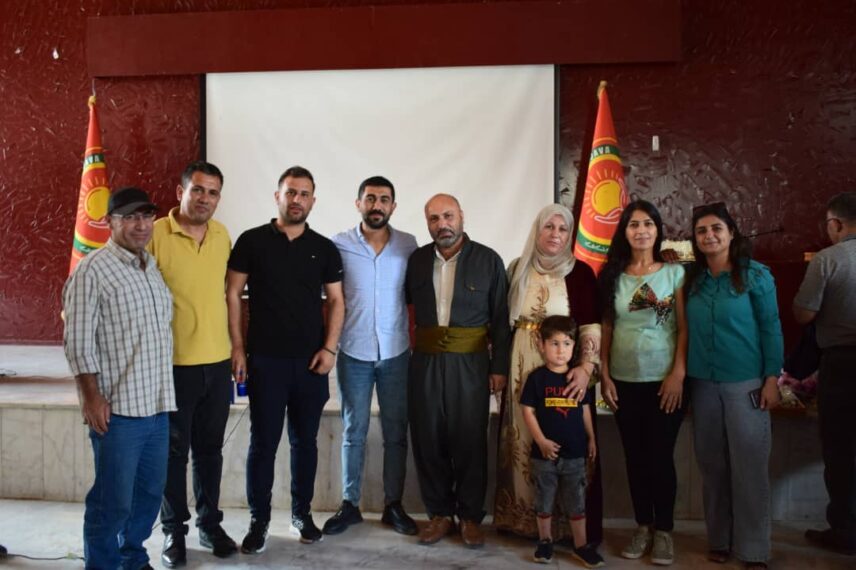
The photograph of Xelîl’s defense (Figure 4), with his youngest son standing at the front of the group, records a completed thesis and collective labor that made it possible. For me, it is also a record of hope sustained through difficult years. Today’s students deserve the chance to complete their studies with academic freedom and independence. Protecting that possibility means recognizing not only their degrees but the universities and forms of collective life that made them possible.
This essay was written with contributions from Xelil Hisên.
Jessica Olivares and Cagri Yoltar are section contributing editors for the Association for Political and Legal Anthropology.